Lavender’s Blue
Tide“Lavender’s Blue” is a recurring song that moves from the ordinary sounds of household work to one of the clearest revelations about Meira’s curse. Its lilting promises of love and queenship first sound in the kitchen, sung by Little Emblyn; later, Galahad hears Meira sing the same tune alone on a hillside and understands that she can use her voice only when she believes she is unobserved. The song’s return turns a familiar melody into evidence of both Meira’s hidden capacity and the conditions that suppress it.
First Appearance in the Household
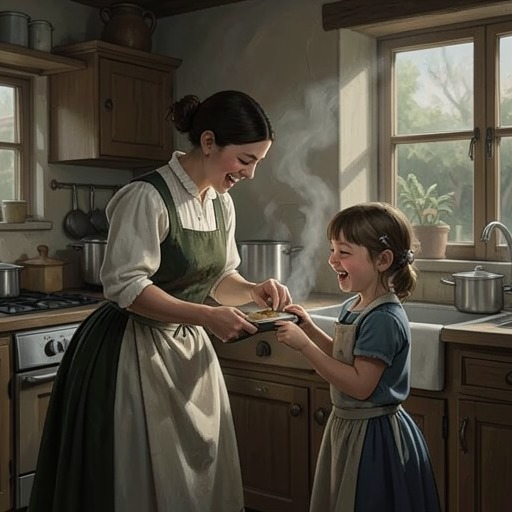
The song first enters during a domestic scene. After returning home, Galahad hears girlish singing from the kitchen, accompanied by brisk scrubbing. He recognizes Little Emblyn’s voice. The lyrics imagine a beloved who will be king and a singer who will be queen, then attribute that promise to the heart. The verses make the workaday setting feel briefly like a small, improvised courtship song: affection is expressed through a familiar refrain while household labor continues around it.
Galahad’s view of the room complicates that lightness. In the parlor, Meira is on her hands and knees in a brown dress and soot-covered apron, her hair covered by a kerchief as she removes fireplace ashes. The song belongs audibly to Little Emblyn, not to Meira; the distinction matters because Meira herself is present, laboring in silence. The scene establishes the melody as part of the women’s shared domestic world while showing how little that audible warmth reveals about Meira’s own ability to speak.
The lyrics’ image of a future king and queen also gives the song a resonance beyond the kitchen. Later, Prince James is proclaimed king, and his marriage makes him King James and Beatrix Queen Beatrix. That later royal outcome echoes the song’s simple pairing of love and queenship, but the song does not announce or explain the political events. Its force comes instead from the contrast between a childlike promise of being loved and Meira’s much more constrained position: her voice, unlike the song’s imagined declaration, is subject to a curse.
The Tune Returns on the Hillside
After the storm has cleared, Galahad stands in the fresh morning air and hears singing from just over a hill. He recognizes the tune, but knows that the singer is not Little Emblyn. The recognition gives the melody a new narrative function: it leads him from a remembered domestic sound to the discovery that Meira can sing.
He sees her wandering in a green dress with pink trim, carrying flowers and wearing more in her braid. She sings as she moves across the hillside, then twirls and waltzes over the meadow. The wind stirs her hair and skirts, and birds add their own notes to the scene. These details make the performance feel open and unforced, unlike the laboring, soot-stained image of Meira at home. The melody has not changed, but the singer and setting have transformed its significance: what Galahad first heard as Little Emblyn’s cheerful household song now comes from Meira herself, in a moment of apparent freedom.
The words she sings include the same promise that love should be returned: if one loves, the other will love in turn. Here that lyric is not merely a child’s refrain performed in company. Meira sings while apparently alone, so her voice can emerge without the constraint that governs her in the presence of a hearer. The landscape’s accompaniment heightens the contrast between the song’s apparent ease and the secrecy required for Meira to sing it.
What the Song Reveals
Galahad’s response changes the scene from an encounter with beauty into a discovery about the curse. The sound first draws his attention; seeing Meira’s mouth move and hearing her resonant voice makes the evidence unmistakable. The revelation is not that she has recovered her voice permanently, but that she can sing under a particular condition: if she knows someone can hear her, she cannot sing or speak. Her song therefore exposes the mechanism of her silence precisely because Galahad hears it without her apparent awareness.
The moment is painful as well as clarifying. Meira eventually sinks onto the grass and lets the bouquet hang from her fingers; Galahad closes his eyes, and a tear runs down his cheek. His reaction registers the gap between the effortless-sounding performance and the rule that silences her whenever she knows she is heard. The melody has briefly carried her voice into the open, but it cannot remove the condition that keeps her from using it freely.
The song’s recurrence consequently links social performance with private expression. Little Emblyn’s first singing makes the tune part of a shared household scene; Meira’s later singing reveals a voice that can surface only beyond the limits of acknowledged company. In the broader pattern of the story, where other songs are performed before listeners, Meira’s moment is distinguished by this restriction: sound becomes not simply entertainment or ceremony, but a test of whether she can be heard without knowing it. “Lavender’s Blue” remains light in its melody and language, yet its return exposes the cost of Meira’s enforced silence.