Mhuirlan royal court
TideThe Mhuirlan royal court is the political and ceremonial center of Mhuirlan, a place where authority is inherited, displayed, and interpreted by both the royal family and the assembled court. Its ballroom and public ceremonies present a glittering hierarchy, but the events there show that rank is not the only power at work: succession law, personal attachments, and the binding rules of magic all shape what the court can become.
Political Setting and Royal Household
The court’s decisions take place within a royal household whose position is defined by succession. When King Leonardo dies, Galahad Stormcrane explains that Mhuirlan’s laws provide for a king’s younger brother to take the throne if the king’s first son is too young to rule; when that uncle dies, the prince becomes king. Prince James is twenty-five, four years beyond the stated proper age for ascending, and King Leonardo’s death therefore makes him king. The news turns a private loss into an immediate change in the kingdom’s leadership.
The change also sharpens the distinction between a ruler’s personal wishes and public obligations. Galahad tells Meira and Little Emblyn that, as king, King James must put his responsibilities to the kingdom before his own heart. The court is consequently not just a setting for royal life: it is the institution that gives private relationships political weight and subjects the new king to duties larger than his own desires.
Society, Rank, and Reputation
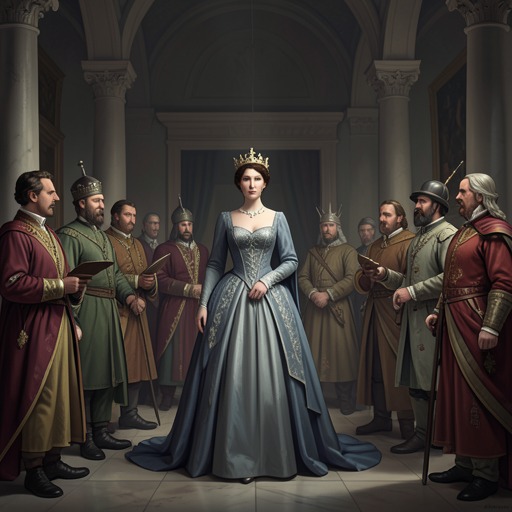
The court appears in full display at a royal ball in a white-marble ballroom, its floor decorated with gold designs of ships, sea creatures, and mermaids. Ten crystal chandeliers illuminate a gathering of a hundred guests in jewel-colored gowns, velvet capes, embroidered clothes, and polished shoes. The scale and finery make court life a public spectacle, where dress, attendance, and companionship invite scrutiny.
Meira’s dance with King James becomes a subject of that scrutiny. The pair move together without needing words, reading one another through looks, laughter, and signals; their improvised dance draws the other dancers to a halt. Nearby guests call them a beautiful couple and pass along reports that the king is smitten with Meira. They note that she is a Curse-Breaker, whose standing is said to exceed even royalty, and speculate that she may become queen. Their conversation shows how court reputation is produced as much through observation and rumor as through official announcements.
The court’s response to Meira is also visible in the guests’ clothing and attention. Many of the other women wear dresses similar in style to hers, decorated with flowers, while guests later part to let her and Galahad approach the king and offer her compliments. Such details present influence as something displayed and recognized collectively, even before any formal declaration settles a person’s position.
Succession and Public Ceremony
King James’s accession is announced beyond the palace as well as within it. In the town square, a herald reads a proclamation to a crowd of roughly a thousand people: the coronation will take place three days later, and the king invites the people of Metern to the royal festivities. Trumpets, a scroll, and the crowd’s cheering turn a legal transfer of authority into a public event, joining the island’s population to the new reign through ceremony.
The court’s formal rituals make royal status legible through ordered movement and symbols. At King James and Queen Beatrix’s wedding, a bell signals the guests to separate into the bride’s and king’s sides, then another, deeper bell announces the king’s entrance. The assembled guests sit as he appears in a sea-themed doublet and a silver crown set with shells and jewels. The marriage is formally declared a bond between King James and Queen Beatrix of the royal house of Mhuirlan; his kiss and the guests’ applause complete the public recognition of the pair as king and queen.
Magic, Law, and the Limits of Court Power
The court’s political world overlaps with obligations the palace does not fully understand. Galahad comes from the Fortress of Maith to tell Prince James that the masters there watch over the Seven Seals (Edel’s Seven Seals), protections laid down by the first Curse-Breakers against Curse-Makers from other shores. The prince already knows that a seal lies in the sea outside his window, a vast circle of dark stone, but is startled to learn that each seal has a guardian whose life is bound to it and whose duty is to keep it strong. He asks whether the guardian is supposed to be a member of the royal family, revealing a gap between the court’s knowledge of its visible realm and the magical responsibilities connected to it.
Meira’s fate brings another supernatural condition into the orbit of royal marriage. She indicates that she must marry Prince James in order to speak again and live out her life as a human. The court’s romantic expectations therefore intersect with a coercive magical bargain: what guests interpret as a possible royal match is also bound to Meira’s survival and future form. The contrast makes courtship more than a matter of personal preference, while leaving the court’s social rituals unable by themselves to resolve the spell’s terms.
The court’s rules also sit beside other systems of binding obligation. Myrkur denies having cursed Meira, insisting that she willingly came for a spell; Galahad counters that the spell deprived her of any real chance to fulfill her side of the bargain and was designed to make her die through a choice of her own. At a later ceremony, the officiant explains that a Curse-Breaker’s wife will live as long as he does, potentially for centuries, but will die instantly if he dies. These magical terms are not the same as Mhuirlan’s succession laws, yet both govern lives through binding rules and shape the consequences of marriage.
The Court as a Theater of Transition
The Mhuirlan royal court repeatedly turns change into something witnessed: a herald proclaims the accession, a coronation is prepared for the whole island, and a wedding publicly names a new king and queen. Ballroom gossip anticipates royal change before it is official, while formal bells and declarations confirm it before the assembled community. Across these scenes, the court is both a governing institution and a theater in which private affection, inherited authority, and public identity become visible—and in which the limits of political knowledge are exposed by forces beyond the palace.