British Army
TrespassesThe British Army appears throughout the novel not as an abstract institution but as a presence encountered at roads, barracks, and civilian gatherings. Its soldiers and vehicles mark the landscape, interrupt ordinary journeys and celebrations, and stand within a conflict whose vocabulary has become familiar even to children. The novel also keeps the limits of what it shows in view: a bomb intended for a patrol kills two boys when it explodes prematurely, and a later news report describes a fatal shooting by a soldier. These are distinct incidents, not a single chain of events, but together they place the Army inside the novel’s account of violence and its consequences for civilian life.
Checkpoints and the Militarized Landscape
At the bottom of the Antrim Road, where gaps left by the Blitz still scar the streets, Gerry Devlin stops at an army checkpoint. A soldier approaches the car with a rifle at his waist and asks where they are going; Gerry answers that they are heading to a party, and the soldier asks for an address. Music plays in the car, a traditional air arranged with drums and electric guitar. In this encounter, the checkpoint makes a private journey subject to questioning, while the music becomes part of the charged exchange between the occupants and the soldier. The scene presents military authority through a routine act of stopping and asking, rather than through a battle.
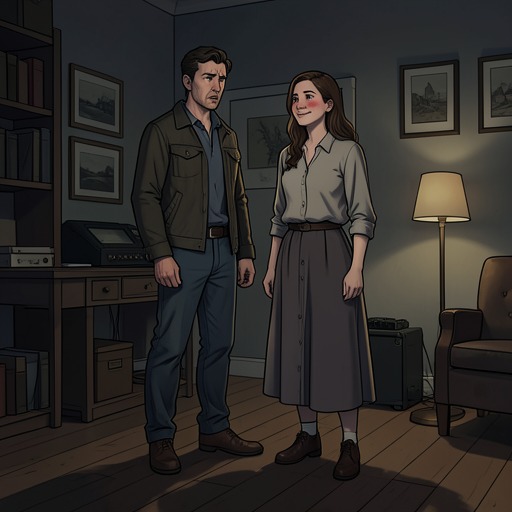
The Army’s barracks also form part of the terrain around the town. On the road past the cemetery where Cushla Lavery’s father is buried, she and Michael Agnew pass high fences topped with barbed wire. The route continues away from the town and into the hills, placing the guarded installation alongside the ordinary landmarks of family memory and travel. Later, at a valley overlooking the city and the water, Michael explains that the valley can carry the sound of bombs, depending on the wind. Cushla recalls seeing army helicopters above the streets and flats from the mountains on the other side of Belfast. She compares their presence to an invasion; Michael responds that living with that level of security must be intrusive. The exchange records both the visibility of military activity and the unease of discussing it across social boundaries.
Conflict and the Vocabulary of Childhood
The Army enters the novel’s account of violence through an incident near the border. A booby-trap bomb intended for a British Army foot patrol explodes prematurely, killing two boys. The boys are not presented as soldiers or as the intended targets; their deaths demonstrate how an attack directed at a patrol can strike others instead. The abruptness of the reported event reinforces the instability of a conflict in which intended targets and actual victims may differ.
Elsewhere, the vocabulary surrounding the conflict has already entered childhood. A list that includes booby traps, incendiary devices, explosives, petrol bombs, rubber bullets, Saracens, internment, the Special Powers Act, and Vanguard is described as vocabulary known to a seven-year-old. The list ranges across weapons, military equipment, state powers, and political organization. It does not make these terms interchangeable, or attribute every item to the Army; instead, its accumulation conveys how the conflict’s language has become part of a child’s ordinary knowledge. The Army is one element in a wider political and security environment that children encounter through words as well as through soldiers and checkpoints.
Military Presence in Civilian Spaces
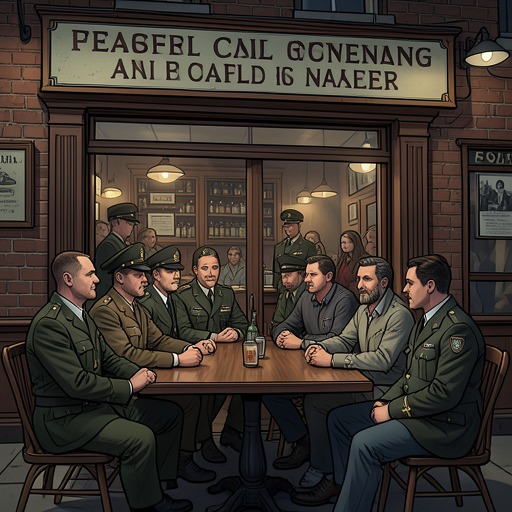
A wedding reception shows how military activity can enter a civilian gathering without becoming a direct confrontation. The original hotel venue has been firebombed, so Gerry’s friends hold the reception in a leisure centre. Outside, soldiers patrol in formation, and military vehicles pass the building; a slogan has been daubed on a wall. Inside, guests eat and listen to speeches. As the best man begins, the sound of a helicopter grows overhead. The doors open and soldiers move through the hall, their weapons swinging as they pass among the tables. A helicopter is hovering above to guide their passage.
The intrusion unsettles the ceremony at the point when attention should be on the wedding party and speeches. One soldier glances at Cushla as he passes; she begins to greet him by instinct, then lowers her gaze, concerned that others may have noticed. The soldiers leave without identifying guests or ordering anyone out. A cheer follows their departure, while one guest calls the episode harassment. The distinction matters: the scene depicts a forceful interruption of civilian space, but it does not show an arrest or a search of the guests. Its effects are registered in the broken rhythm of the reception and in the guests’ reactions.
Violence, Law, and Institutional Boundaries
The novel places the British Army within a broader security landscape but does not treat it as synonymous with the police or the courts. Michael criticizes the treatment of Republican prisoners and the operation of courts without juries, describing the system as unfair. His remarks concern judicial procedure, not Army command. Similarly, records Cushla discovers in Michael’s files document allegations of police abuse in custody; the material identifies a police process, not an Army action. Keeping these institutions distinct prevents the novel’s different forms of state power from collapsing into one another.
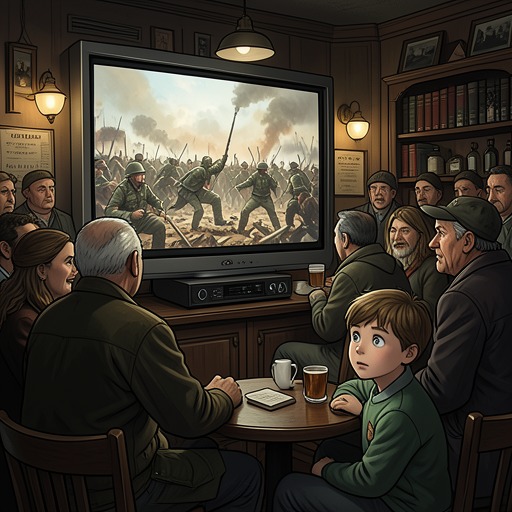
A radio report offers a separate, direct account of military lethal force. As Cushla and her family travel, the news reports that a twenty-one-year-old man has been shot dead by the British Army while attempting to booby-trap a bar in south Armagh. The report identifies the man’s activity and the location, but provides no further account of the encounter. It arrives alongside other reports of killings and news of Michael Agnew’s funeral, placing the shooting within a sequence of public violence rather than isolating it as a complete explanation of the conflict. In combination with the checkpoint, the barracks, and the interrupted wedding, the broadcast makes the Army’s presence part of both the physical landscape and the daily circulation of news.
Narrative Significance
The British Army’s appearances are varied in scale: a soldier asks for an address, helicopters hang above the city, patrols move through a wedding reception, and a radio report announces a death. This range gives military presence a civilian measure. It is encountered not only in moments of lethal violence but in travel, conversation, family memory, and public celebration. The narrative also resists suggesting that every event involving the Army has the same cause or outcome: the boys killed by the premature explosion are not the intended targets, the soldiers at the wedding leave without identifying or removing anyone, and the reported shooting concerns a separate attempted bombing. Through these distinct episodes, the Army becomes a recurring marker of the conflict’s reach without standing in for every institution or every source of violence.