Catholic Church
TrespassesThe Catholic Church appears in the novel as both a structure of everyday belonging and a source of local authority, most sharply embodied by Father Slattery. The parish shares its land with the school and parochial house, placing religious oversight close to children’s education. Mass, catechism, confession, and devotional objects recur in ordinary family life, but Slattery’s conduct makes those practices inseparable from the fear and pressure he brings into the classroom.
Parish Authority and School Life
The school stands on parish land shared with the church and parochial house. Father Slattery moves through its playground and corridors, entering classrooms without notice to deliver catechism. Cushla has complained to Bradley that these visits unsettle the children; Bradley’s response, that Slattery is the priest, treats his office as sufficient justification for his presence. Cushla also resents Slattery for persuading her delirious father in hospital to write him a cheque for a colour television after praying with him. The episode places pastoral access beside a personal use of authority, without presenting the priest’s conduct as representative of every Catholic practice.
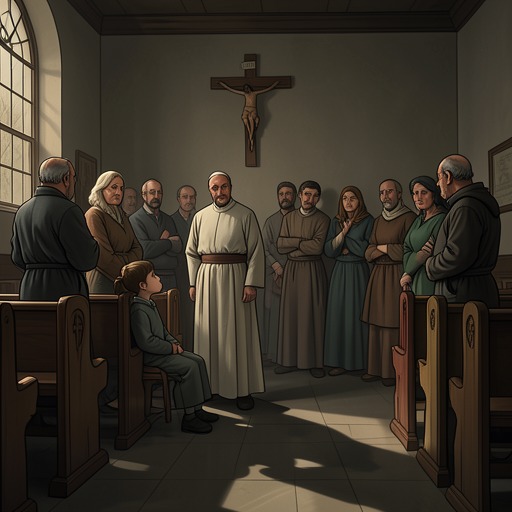
In the classroom, Slattery turns religious instruction into an exercise in intimidation. When Cushla’s pupils are gathered after a fight, he recites prayers and tests them on Catholic teachings, treating their silence as evidence of ignorance. He singles out Davy McGeown, asks his age, and tells the children a story of sectarian violence before using it to assert that Protestants hate Catholics. Davy questions whether the girl in the story was his age; Slattery dismisses the question and redirects the lesson toward communal hostility. Religious language here does not simply teach doctrine: in Slattery’s hands, it gives institutional weight to fear and division.
Mass and Family Practice
The Church also occupies a more habitual place in family life. At Easter, Cushla attends a crowded Mass with Gina Lavery, among families in new clothes and older women who attend daily. Gina goes to Sunday Mass but avoids holy days of obligation. She blames Vatican II for the changes she dislikes, especially the abolition of the Latin Mass, although Cushla knows that Gina does not speak Latin. Their attendance and disagreement suggest a faith sustained partly through routine and inherited expectations, even where enthusiasm is limited.
The church’s devotional setting reaches Cushla through its images and music as well as its services. During Mass, she and Gina sit near the confession boxes beneath paintings of the Stations of the Cross. At school, the children rehearse hymns for Communion: Slattery favours one associated with the suffering and death of earlier believers, while the children prefer another. Cushla recognizes that adults can interpret a song about children’s suffering through the Troubles, showing how religious observance becomes entangled with the conflict surrounding the parish.
Catechism, Confession, and Control
Slattery’s preparation of the children for First Confession makes guilt a matter of both doctrine and discipline. Cushla has advised them that, being young, they can offer minor everyday faults, but Slattery teaches them about original sin, remorse, and guilt and warns them to expect no leniency. He tells them that the length of their penance in the pew will reveal the extent of their sinfulness. The rite is thus presented not only as a religious practice but as a public measure of culpability, with the priest controlling how its seriousness is interpreted.
Slattery gives each child a picture of Padre Pio and describes the saint’s wounds. As he hands one to Davy, he bends to speak privately to him; Cushla hurries toward the boy, but Slattery has already walked away. Later, Cushla finds Slattery speaking to Davy beside her car. Davy asks whether he has to attend private catechism with the priest, and Cushla takes him home. These incidents leave the child’s question, and Cushla’s protective response, as a counterpoint to the priest’s claimed authority.
Devotion Beyond Institutional Authority
Cushla’s own actions show that religious objects and prayers can retain personal meaning apart from Slattery’s methods. In Dublin, she buys Davy a navy-blue missal embossed in silver, plain rosary beads, and a novena to Saint Joseph that her grandmother used to recite when someone was in trouble. She recognizes the items as mass-produced religious goods and feels their purchase is compromised by the circumstances of her trip, but she has chosen them for Davy. The objects carry a connection to care and inherited practice even as she questions her own conduct.
During a later crisis, when she fears that Tommy McGeown may have been arrested, Cushla prays silently for the situation to prove mistaken and promises to change her life if she and the family are spared. The prayer is urgent and transactional, unlike Slattery’s formal lessons in sin and penance. Together, these moments distinguish the Church’s institutional authority from the varied uses of faith within the novel: religious life can serve discipline and sectarian pressure, but its prayers and objects also provide Cushla with a language for care, fear, and hope.