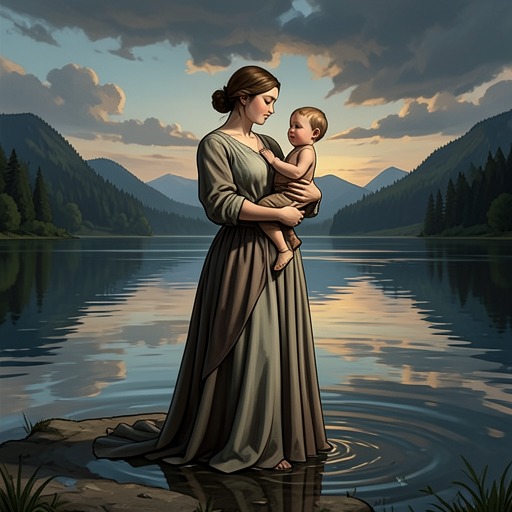
Sir Huldbrand of Ringstetten
UndineSir Huldbrand of Ringstetten is a knight whose choices join the human and water-spirit worlds, first giving Undine the loving human bond through which she gains a soul, and later ending in his death in her embrace. His story turns on a promise of fidelity that begins in tenderness but is strained by the disturbances of Undine’s kind and by his growing resentment of their effects.
Identity and Introduction
When Huldbrand arrives at the Fisherman’s Cottage, he is a noble guest far from his own home, Ringstetten Castle, which he says lies near the source of the Danube. He gives his name as Sir Huldbrand of Ringstetten and tells the fisherman and his wife about his travels. The conversation is warm and familiar, although the fisherman avoids discussing the Haunted Forest as night approaches. Huldbrand has already heard splashes against the cottage window; when a shower of water comes through its decayed frame, the fisherman calls out to Undine, identifying her as the couple’s foster-child and explaining that she is nearly eighteen and remains given to childish pranks.
The household’s welcome makes an impression on Huldbrand. The fisherman’s wife keeps the most comfortable chair for herself, according to the custom that it belongs to the oldest person in the house, and directs him instead to a small chair with a weak leg. He fetches it carefully and sits without taking offense. The scene leaves him feeling almost related to the household, as though he had returned from abroad. That sense of belonging provides an intimate counterpoint to his status as a traveling knight and to the increasingly strange world he is about to enter.
Marriage and Undine’s Soul
Huldbrand’s attachment to Undine becomes decisive when Father Heilmann is present. The old woman has just spoken of the sadness of being irrecoverably separated from other people, while Undine nestles close to Huldbrand and urges him to remain with the household. As he listens, the forest beyond the river recedes in his imagination and the island where he is living grows vivid and beautiful; Undine appears to him as its fairest rose. When the old woman looks disapprovingly at their closeness, Huldbrand makes his decision public: he tells Father Heilmann that he and Undine are pledged to one another and asks to be married that very evening, provided she and the foster-parents consent.
The proposal surprises the older couple, who had privately entertained the possibility but had never spoken of it. Undine, suddenly grave, looks down thoughtfully while Father Heilmann asks about the circumstances and seeks the couple’s consent. Once the marriage is agreed, the old woman prepares the bridal chamber and brings out two consecrated tapers she considers necessary for the ceremony. Huldbrand examines the gold chain he wears and chooses two rings to exchange with his bride. These practical preparations mark how quickly his inward vision becomes a binding, public commitment.
Afterward, Undine explains what that commitment has changed. She describes her people and beings of the other elements as similar to humans in form and culture, but without souls: when they die, body and spirit vanish, leaving no trace, while mortal humans may awaken to a purer life. Her father, a powerful water-prince in the Mediterranean Sea, had wished his only daughter to gain a soul, though doing so would expose her to suffering. According to Undine, a being like her can acquire a soul only through the closest union of affection with a human. She tells Huldbrand that she now possesses one because of their bond, and that his rejection would make her life miserable; nevertheless, she offers to leave rather than keep him through deception.
Huldbrand answers her disclosure with an embrace and carries her back to shore. Only once they reach it does he swear through tears and kisses that he will never forsake her. He compares his good fortune to that of Pygmalion, whose statue received life and became his beloved. Undine returns to the cottage leaning on his arm, newly able to feel that the loss of her father’s crystal palaces is not something she must regret. Their marriage is therefore both a personal union and the means by which Undine crosses into a more vulnerable human condition.
Voyage and Strain
During the first days of the party’s voyage down the Danube, Huldbrand and Undine are happy, and the landscape grows more beautiful as they travel downstream. That happiness is repeatedly interrupted by Kuhleborn, whose interference appears through teasing disturbances: agitated waves and contrary winds. Undine rebukes them, and the attacks subside, only to return and require her intervention again. The repeated disruptions spoil the travelers’ pleasure. The boatmen whisper in dismay, and the servants begin to watch their superiors with suspicion, making the disturbances a source of social unease as well as physical inconvenience.
Huldbrand increasingly interprets the trouble as a consequence of joining a human life to a water-spirit’s. He tells himself that he did not know Undine was a sea-maiden and that the wild caprices of her people are not his fault. This reasoning briefly strengthens him, but it does not preserve his affection from change: the more he dwells on the interference, the more ill-humored he becomes, until he feels almost animosity toward Undine. His angry looks tell her that he blames her, although she is the one repeatedly trying to restrain Kuhleborn’s power. Worn down by those efforts and by Huldbrand’s displeasure, she falls asleep one evening in the gently moving boat. The voyage thus reverses the sheltered closeness of their early days together: the bond that had given Undine a soul is tested by the world from which she came, and Huldbrand’s self-exculpation deepens the distance between them.
Return and Death
On the night of Huldbrand’s death, the narrative brings Undine back to Ringstetten Castle. She has passed through its familiar stairs and halls in silent tears, a contrast to the happiness with which she once moved through them. Huldbrand, partly undressed and alone after dismissing his attendants, stands before a mirror beside a dim taper. He is dejected and thinks that he must go to his nuptial bed. A gentle tap at the door recalls Undine’s former playful way of teasing him, but the figure who enters tells him that the spring has been opened and that he must die.
Huldbrand feels that death cannot be avoided, yet asks not to be made mad with terror by seeing a hideous face. He says that if Undine is as beautiful as when he courted her on the promontory, he would wish to die in her loving embrace. She unveils her face, which remains beautiful, and kisses him. Holding him close, she weeps; his breathing ceases, and he falls back upon the pillows, dead. When servants meet her in the ante-chamber, Undine tells them that she has wept him to death, then goes slowly toward the fountain.
Huldbrand’s ending gives a terrible final form to the promise he once made never to forsake Undine. Their marriage had transformed her by giving her a soul, but it also placed their lives across a boundary neither could make harmless: her grief and return bring about his death, while his last wish is still for closeness with her. The contrast between the rings exchanged at their wedding and the solitary, death-marked nuptial chamber gives his trajectory its sharpest reversal—from a knight who chooses an unexpected marriage in a fisherman’s home to a husband whose final reunion with his bride is inseparable from loss.