Kuhleborn
UndineKuhleborn is a water spirit who moves between human guise and elemental force, acting at once as Undine’s uncle and guide and as a recurring threat to her household. His transformations make him difficult to recognize, but Undine’s account identifies a deeper limitation: he can observe outward behavior without understanding the inward feelings that give it meaning. That blindness turns him into both an intimate family presence and a destructive intruder.
Identity and Kinship
Kuhleborn introduces himself with comic self-importance as Lord of Kuhleborn, or free Lord of Kuhleborn, claiming a freedom greater than that of the birds in the forest. He then reveals that he is Undine’s uncle, and recalls having carried her on his back through the region. His grand titles do not make him a human noble: they are a courtesy he says he might claim, while his actual nature is that of a water spirit capable of taking human appearance and commanding water.
His earlier interventions have included aid as well as menace. He tells Undine that he is accompanying her as a guide because the earth spirits haunting the area might otherwise play tricks on her. He also recounts rescuing Father Heilmann after the priest fell out of a boat: Kuhleborn was the waterspout that carried him out of the water and washed him safely ashore in time for Undine’s wedding. Father Heilmann had recognized him as familiar, though he had not understood why. The rescue makes Kuhleborn’s power over water protective in one circumstance, even as his later use of floodwater makes that same power terrifying.
Intrusion into Undine’s Household
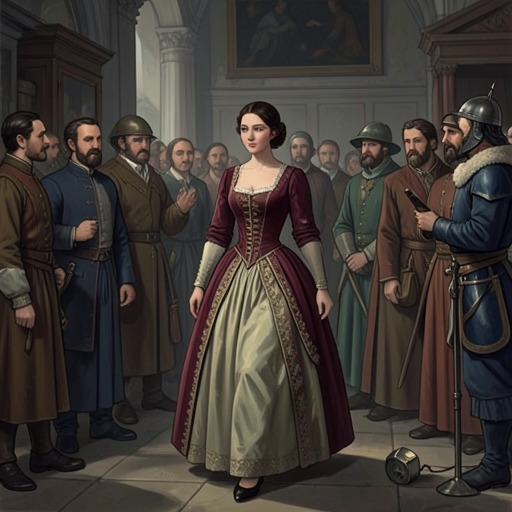
Kuhleborn’s kinship does not make his presence welcome. When he approaches Undine after her marriage, he stretches past Father Heilmann to whisper to her. She turns away in alarm and tells him she wants nothing more to do with him. She fears that her husband may begin avoiding her if he sees her with such strange company and relations. Her request that Kuhleborn disappear is therefore not a denial of their relationship, but an attempt to keep his unsettling presence from further damaging her marriage.
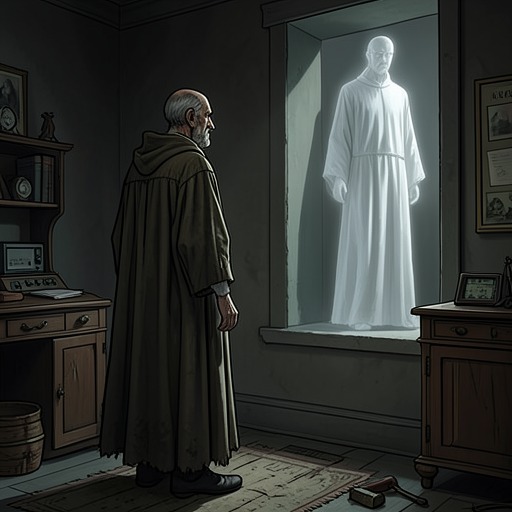
Undine later explains why he has repeatedly intruded into life at Ringstetten Castle. He has appeared in its galleries and frightened Bertalda into illness several times. In Undine’s account, Kuhleborn is devoid of a soul: an elemental mirror of the outward world, unable to reflect the inward one. He sees Sir Huldbrand of Ringstetten dissatisfied with Undine, and sees her weeping while Bertalda may be laughing; from these outward contrasts he imagines discrepancies in the household and intervenes without invitation. He cannot comprehend that love’s joys and sorrows may be closely bound together, so that tears can coexist with a smile. His intrusion follows from a failure of interpretation as much as from malice: he mistakes visible differences for evidence that the relationships around him are incomprehensible or false.
Transformations and Threats
Kuhleborn’s human guise never offers reliable safety. When he angrily confronts Undine after she asks him to leave, Sir Huldbrand of Ringstetten leaps to her defense and strikes at his head. The sword passes through a waterfall rushing from a high crag; the water splashes over the company with a sound like laughter. The scene turns the attempted defense into a demonstration that ordinary weapons cannot reach the being behind the appearance.
His most sustained attack comes during the journey with Sir Huldbrand of Ringstetten and Bertalda. The valley fills with a rising flood, and Sir Huldbrand recognizes Kuhleborn as the water spirit he believes intends to drown them. Their wagoner first claims to know a charm but says he cannot use it until Sir Huldbrand knows who he is. He then reveals himself as Kuhleborn. At once the wagon and horses dissolve into foam, while Kuhleborn rises as a gigantic billow and draws the struggling horse beneath the water. The swelling wave towers over the two endangered travelers, threatening to engulf them. The delayed revelation makes the apparently ordinary guide part of the danger: recognition arrives only when the vehicle and the safe passage it promised have vanished.
Limits and Narrative Role
Kuhleborn’s power is formidable but not absolute. Undine appears above the flooded valley in the moonlight, rebukes and threatens the waters, and the tower-like wave subsides. She descends like a white dove, carries Sir Huldbrand of Ringstetten and Bertalda to a green hillside, and helps them recover before they return to Ringstetten Castle. Kuhleborn’s attack thus ends not in their deaths but in a rescue accomplished by the very person whose feelings he has repeatedly failed to understand.
Across these encounters, water changes from a means of rescue into a weapon and then, under Undine’s command, back into a danger that can be quieted. Kuhleborn’s shape-changing and his power to animate the landscape give physical form to his inability to read the inner life of others: he can expose, confuse, or overwhelm what people see, but he cannot grasp the emotional bonds behind their outward expressions. The contrast with Undine is decisive. His intervention threatens her marriage and the travelers’ lives; her intervention preserves them. The narrative leaves Kuhleborn’s ultimate fate unstated, but shows that his influence, however frightening, can be resisted.