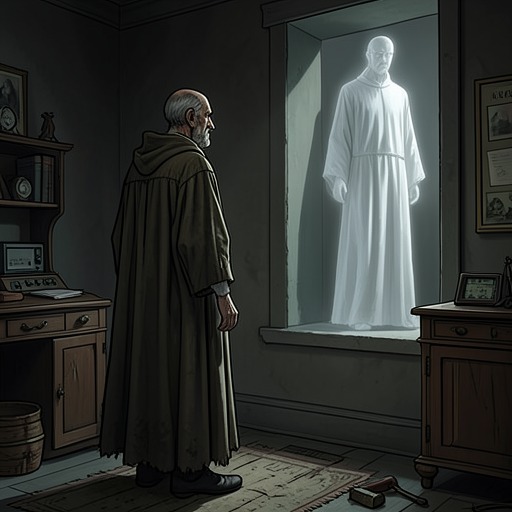
Father Heilmann
UndineFather Heilmann is a priest of the Monastery of Our Lady whose faith is expressed through both ritual and action. He baptizes Undine, attends her marriage to Huldbrand, and, when he believes that marriage to Bertalda would violate Huldbrand’s existing bond, makes an urgent attempt to stop it. His story repeatedly places religious judgment beside what remains mysterious: he welcomes Undine into the Christian community without claiming to understand her nature, and later acts on a dream whose warning the others refuse to heed.
Identity and Religious Service
Father Heilmann comes from the Monastery of Our Lady, which lies across the lake. His life as a clergyman involves more than ceremonies at the monastery: when floods threaten the monastery and its tributary villages, he sets out to inform the bishop, and the flood forces him onto a long, circuitous journey. His path eventually brings him to the fisherman’s cottage on a storm-lashed peninsula.
His connection to Undine begins with the question of baptism. After the fisherman and his wife take in the child, they cannot discover whether she has already been baptized. Undine says she was created for God’s praise and glory, but cannot answer their question about the rite. The fisherman consults a priest in the city, who agrees to cross the mysterious forest to baptize her at the cottage. Undine resists the proposed name Dorothea, insisting on the name she remembers, and the priest ultimately accepts Undine as her baptismal name. In this early scene, the priest’s willingness to perform the rite answers the foster parents’ religious concern, while his eventual acceptance of the unfamiliar name shows that he does not make the child’s difference a reason to exclude her.
Arrival at the Fisherman’s Cottage
Years later, amid a violent storm and rising floodwaters, a knock at the cottage door startles its occupants. Father Heilmann announces that he is not a spirit but a man still living in an earthly body, and asks them to open the door if they fear God and will help him. Undine opens it with a lamp. The aged visitor is soaked through: water drips from his dark clothes, beard, and gray hair. The household gives him dry clothes, and he declines Huldbrand’s splendid mantle in favor of the fisherman’s old gray overcoat. The fisherman’s wife yields her comfortable chair, while Undine places beneath his feet the little stool she usually uses beside Huldbrand.
These small exchanges establish the character of his reception as well as his own. He accepts humble help rather than the knight’s fine garment, and the household responds to his exhaustion with practical care. Once refreshed with food and wine, he explains that he had set out from his monastery to report the floods. An overflowing arm of the lake and the sudden tempest overwhelmed the boat carrying him and two boatmen; the oars were swept away, the craft spun in the waves, and he was carried helplessly to the island. The same waters that make the journey dangerous have also made the cottage difficult to reach, turning an unexpected knock into a test of hospitality.
Undine’s Marriage and the Question of the Soul
Father Heilmann is present when Undine and Huldbrand marry. During the ceremony, he notices a tall man in a white mantle watching through the window and asks why the household had claimed to be alone on the island. The fisherman and his wife react with alarm; Huldbrand sees what may be a white streak, but it vanishes. The priest registers the unexplained presence without resolving it, an instance of the uncertainties that surround Undine’s life.
After the ceremony, Undine’s playful and unruly behavior returns. Seeing that Huldbrand is displeased, Father Heilmann gently urges her to attune her soul to her husband’s. Undine replies that she has no soul. Her ensuing distress changes the mood of the room: she wonders whether a soul is beautiful but terrible, and whether its approach is a burden. When she kneels, repeats the sacred words, and declares her goodwill toward the world, the priest does not pronounce her evil. He tells Huldbrand that she is mysterious but that he has found nothing evil in her, then commends the knight to prudence, love, and fidelity.
His response is significant because it neither explains away Undine’s difference nor treats it as proof of wickedness. He recognizes the limits of what he can discern, but still gives Huldbrand concrete counsel about how to live with his wife. Undine’s own account later explains that beings of the elements lack souls unless they form a close union of affection with a human. Her marriage to Huldbrand has given her a soul, with suffering as well as love. Father Heilmann’s earlier advice about the soul’s harmony with a spouse thus stands beside a more troubling reality: the marriage has changed Undine’s condition, but cannot guarantee Huldbrand’s fidelity.
Warning Against a Second Marriage
When Huldbrand prepares to marry Bertalda, Father Heilmann hurries to the castle after receiving the knight’s letter. He explains that for a fortnight Undine has appeared in his dreams, wringing her hands and pleading with him to prevent the marriage because she is still alive. He does not claim to know the exact nature of her existence, but takes the dream as a warning. He urges Huldbrand and Bertalda to separate, arguing that Huldbrand still belongs to his first wife and that his grief remains visible in his face.
The warning is an act of pastoral urgency, not merely a formal objection. Father Heilmann refuses to delay speaking privately with Huldbrand, saying the matter concerns Bertalda and the fisherman as well. When all three resist him, he leaves with a sad heart and refuses both the shelter offered at the castle and the refreshments brought to him. Huldbrand dismisses his warning as fanciful and summons another cleric, who agrees to perform the ceremony. The others’ refusal does not make Father Heilmann’s concern less consequential: his dream identifies Undine as living and in anguish, while his appeal to the visible grief on Huldbrand’s face gives the supernatural warning a human sign.
Burial and Narrative Role
Father Heilmann returns to the castle when Huldbrand’s death becomes known. He arrives at the same moment that the monk who married Huldbrand and Bertalda is fleeing in terror. The priest says that his duties have now begun, and turns from the failed effort to prevent the marriage to the work of consoling Bertalda, now a widow. His pastoral care meets little response from her: she abuses Undine as a murderess and sorceress. The old fisherman, by contrast, grieves but accepts the death as an act of divine judgment, and recognizes that Undine herself suffers most deeply from having caused it.
Across these scenes, Father Heilmann acts at moments when religious forms meet uncertain or painful realities: baptism for a child of unknown origins, marriage to a bride who says she has no soul, and a warning about a first wife whose life cannot be understood in ordinary terms. He offers rites, judgment, and counsel, but the story does not make him omniscient. His authority lies instead in taking responsibility under uncertainty—welcoming the stranger at his door, speaking when he believes a marriage must be stopped, and remaining to tend the bereaved when his warning has gone unheeded.