Cam’s fallen-angel state
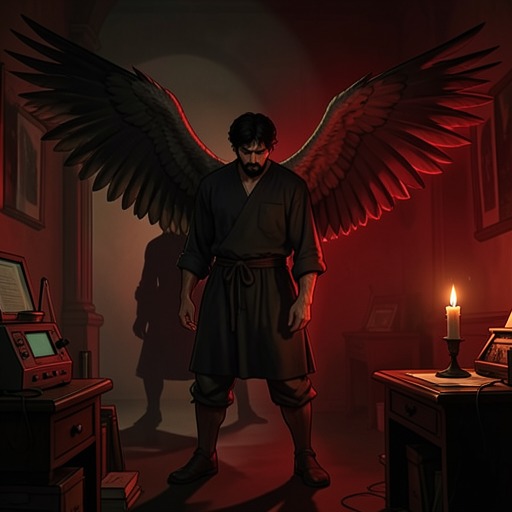
UnforgivenCam’s fallen-angel state is both a supernatural condition and the mark of a choice that helped destroy his relationship with Lilith. His allegiance to Lucifer places him among the fallen, but his return to Lilith’s Hell forces him to confront what that allegiance means: betrayal, concealment, and the fear that the person he loves would reject his real nature. At the end of the story, his wings become white again, yet Cam still calls himself a fallen angel. The change restores a visible part of his original angelic appearance without making his history disappear.
Identity and the meaning of the Fall
The story sets Cam’s status within a larger transformation of angelic identity. Before the Fall, angels’ wings were made of empyreal light and were perfect, with one pair indistinguishable from another. In the era afterward, wings express their bearers’ personalities, mistakes, and impulses. Allegiance gives that difference a visible form: fallen angels who serve Lucifer bear golden wings, while those who have returned to Heaven bear a hint of silver in their feathers. Lucinda’s and Daniel’s purely white wings stand apart as a sign of what remained unspoiled in them. Cam’s later description of his own restored wings as their original white connects his present state to that lost, earlier condition.
The Fall also has practical consequences in the story’s supernatural world. Fallen angels cannot enter a sanctuary of God: crossing its threshold would set the place ablaze and incinerate any mortals inside. Cam enters the chapel through a broken window, but the building has been desanctified after Miss Sophia moved in. The distinction makes the restriction specific rather than absolute: the chapel’s changed status permits his entrance, while the rule clarifies the danger associated with being fallen.
Allegiance, betrayal, and the wager
Cam’s state is inseparable from his history with Lilith. He admits that letting her go in Canaan was his greatest mistake, greater even than joining Lucifer’s ranks, and identifies losing her love as his only regret. That comparison makes his allegiance more than a classification of his wings: it is one of the choices by which he measures the damage between them. Lilith, meanwhile, has been trapped in a succession of Hells fashioned by Lucifer. Each time she dies, she returns to a food court where she is reminded of Cam’s betrayal before Lucifer sends her into another specially made torment.
When Cam learns what has happened to Lilith, he makes a deal with Lucifer and spends fifteen days trying to make her love him again. The wager offers a conditional end to her bespoke Hells if Cam can overcome her hatred and win her love within the time limit. It does not erase the original betrayal; instead, it makes Cam’s return another test of whether he can repair what his earlier choice broke. He later tells Lilith that he thought she was dead, did not know she was in Hell, and came as soon as he learned the truth. He also admits that he made the deal and has spent the past fifteen days falling in love with her again, hoping she might do the same. Lilith hears the wager as evidence that he remains selfish, so his effort to save her initially deepens the distrust it was meant to overcome.
The revealed form and the failure of concealment
At the Colosseum, Lucifer exposes Cam before Lilith and the remaining witnesses. He insists that Cam is still withholding his true nature, then forces open Cam’s wings. The transformation is painful: Cam’s wings appear leathery, limp, and charred, while his body twists and his hands become scaly claws. He recognizes that the aging, monstrous appearance leaves him with nothing to hide, and for the first time he welcomes that exposure. The scene turns the fallen state from an abstract allegiance into a visible body that Cam cannot pass off as unchanged.
The disclosure also identifies the fear beneath his concealment. Cam tells Lilith that he was afraid she would not love him if she knew who he really was. Her answer is not that his appearance makes him unlovable, but that he never trusted her enough to give her the chance to accept him. The conflict therefore reaches beyond the spectacle of his demon-like form: Cam’s secret has deprived Lilith of a choice, repeating the lack of trust at the heart of their estrangement. In this moment, the truth of his state becomes something he must own in front of her rather than manage for her.
Sacrifice and the return of the white wings
As Hell begins to collapse, Cam refuses Lucifer’s demand that he serve as second in command. Instead, he offers a new deal: he will remain in exile and take Lilith’s place as Lucifer’s subject if Lucifer sets her free. Lilith asks why he would sacrifice himself for her; Cam answers through the offer itself, and she does not pull away when he reaches for her hand. His response contrasts with his earlier failure in Canaan: rather than leave her to bear the cost of his decision, he proposes to bear the cost himself.
After Lilith is freed, Cam’s damaged wings begin to change. The leathery material sloughs away as new filaments grow; white appears beneath the charred surface and spreads until his wings are restored to their original incandescence, strong and brilliant. The story presents this restoration after Cam has exposed his true form and offered to take Lilith’s place, linking the renewed appearance to a changed relationship without stating that the past has been annulled. Lilith tells him he is an angel; Cam corrects her: “A fallen angel,” he says, “And I’m yours.” His words preserve the name of his condition even as his white wings recall the angel he was before his choices altered him.
Significance and ending
Cam’s restored wings do not function as a simple erasure of his fall. He remains a fallen angel in his own account, and the ending keeps the distinction between appearance, allegiance, and remembered action intact. The white feathers show a return to an original form, while his words retain the history that form alone cannot explain. His redemption is relational as well as supernatural: Lilith accepts him without regard to his appearance, and he acknowledges the betrayal and fear that had kept her from knowing him fully. Their renewed kiss closes the immediate confrontation, while Cam’s final suggestion that their story has only begun leaves their future open rather than presenting restoration as the end of consequence.