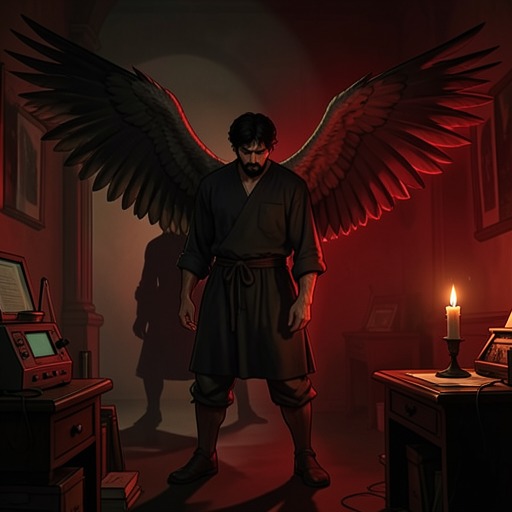
Cam’s fallen-angel status
UnforgivenCam’s fallen-angel status is both a spiritual allegiance and a visible record of choice. After the Fall, his wings turned from white to gold, identifying him with Lucifer’s side; much later, a single white filament appears among the gold. That small change gives physical form to Cam’s uncertainty about the destiny he had long accepted, and foreshadows the eventual return of his original white wings.
Identity and the Meaning of the Wings
Before the Fall, angels’ wings were made of empyreal light: perfect, alike, and undivided by individual history. In the era that followed, their appearance began to express personality, mistakes, and impulses. The color of a fallen angel’s wings also registered allegiance. Those who served Lucifer bore gold; those who had returned to Heaven bore a hint of silver from The Throne in their feathers.
Cam’s status belongs to this system of visible distinctions. Gold marks his association with Lucifer, while the earlier white of his wings connects him to a self that existed before his consequential choices. Lucinda’s wings remained purely white, as did Daniel’s—the only other fallen angel described as having preserved that color. Their exceptional whiteness is associated with innocence of the choices the others had made. Against that contrast, Cam’s gold is not merely a change in appearance: it registers a history and a position among the fallen.
A Status Made Visible
The wings make allegiance legible even in places where no one explains it. At a chapel that had been desanctified, Cam spread his wings and entered through a broken window. The distinction mattered because fallen angels could not cross into a sanctuary of God: doing so would set the entire place ablaze and kill any mortals inside. Miss Sophia’s occupation had removed the chapel’s consecrated status, allowing Cam to enter without triggering that destruction. His presence there nevertheless belongs to a world in which spiritual affiliation carries physical consequences.
Later, when Cam is in Hell, Lucifer’s own wings provide a grotesque counter-image. They are huge, stiff, and greenish gold, like tarnished jewelry, with a musty smell and small black damned creatures nesting in their folds. Lucifer notices the white fissure still glowing in Cam’s gold wings and treats it as a sign worth questioning. The contrast makes Cam’s mark conspicuous: his wings still identify his former allegiance, but they are no longer wholly uniform.
The White Filament and the Wager
The first clear sign of change is minute: near the tip of Cam’s left wing lies one tiny white filament. It is only a fleck against a field of gold, but it recalls for Cam the moment his wings changed from white to gold. The sight makes him imagine, for the first time in millennia, that he might have another destiny. The text links this opening to Lucinda and Daniel: because of them, Cam has a fresh start, though he still carries one regret.
That possibility sharpens the stakes of Lucifer’s wager. Lilith’s current Hell is due to expire in fifteen days, and Lucifer proposes that Cam use the remaining time to free her heart of hatred and make her fall in love with him again. If Cam succeeds, Lucifer will stop creating bespoke Hells for her. If he fails, Cam must return to Lucifer permanently, serve at his right hand behind the Wall of Darkness, and lose any remaining white in his wings. The bargain turns the white filament into more than an unexplained alteration: it stands against the future Lucifer threatens, even as Cam’s gold continues to declare where he has belonged.
Exile and Restoration
At the later confrontation, Cam rejects Lucifer’s expected role as second in command and proposes a different bargain. As the stage shakes and the crater’s edge nears his boots, he offers to remain in exile and take Lilith’s place as Lucifer’s subject, in exchange for her freedom. He frames the offer as a sacrifice for her; Lilith grasps his jacket and asks why he would do it. Cam reaches for her hand, and she does not pull away. His choice therefore places his fallen status under immediate pressure: rather than secure his own release by claiming authority beside Lucifer, he offers himself to the condition of Hell.
Afterward, Cam’s wings begin to change. They thicken and spread as leathery pieces slough away and charred fragments fall; new, strong filaments grow beneath them. White appears first in patches, then spreads until his wings are restored to their original incandescence. The change reverses the gold that had marked his fallen allegiance, but the text distinguishes this return from the golden glamour to which he had grown accustomed: the restored wings are white, strong, and brilliant.
Narrative Significance
Cam’s wings give an inward conflict a changing outward form. Their original white, their gold after the Fall, the single filament, and the final restoration create a sequence in which allegiance and possibility can be seen rather than merely asserted. The white fleck does not erase the past; it appears within the gold and makes Cam remember how that gold came to be. Likewise, the wager makes the potential cost of his choices explicit: renewed service to Lucifer would mean not only captivity but the loss of white from his wings.
The ending connects the alteration of Cam’s status to his decision to put Lilith’s freedom before his own advancement. His wings’ restoration follows his offer of self-substitution, giving the return to white a place in a narrative of changed allegiance and sacrifice. The contrast with the angels whose white wings endured also matters: Cam does not begin as an untouched exception. His whiteness returns only after the history registered by the gold, the wager, and his choice to take Lilith’s place.