Cam’s restored angelic state
UnforgivenCam’s restored angelic state becomes visible when his wings change from their damaged, leathery condition to their original white brilliance, and his body regains its former appearance. The change follows his offer to remain in Hell in Lilith’s place; in the scene’s closing movement, the restoration and their return to the Aevum food court give a physical form to a turning point defined by sacrifice and love.
Identity and Background
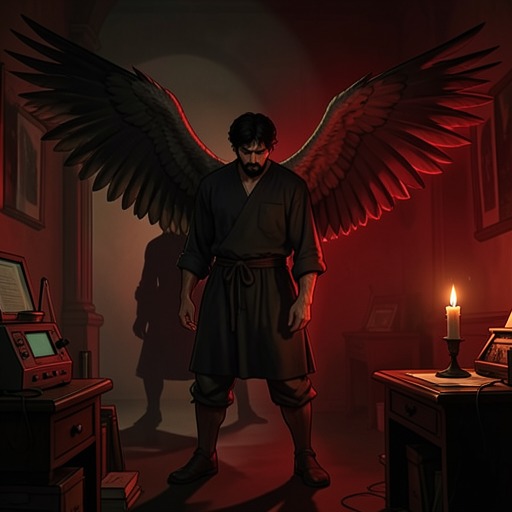
The state is defined most clearly by Cam’s wings. Earlier in the history of the angels, wings were made of empyreal light and shared a uniform perfection. After the Fall, they came to express the angels’ personalities, choices, and impulses. Allegiance to Lucifer was visible in golden wings, while those who had returned to Heaven bore silver threaded through theirs. Against this system of outward signs, Cam’s restored wings are notable for being neither golden nor silver: they return to white.
White wings had already carried a particular meaning in the story. Lucinda’s had remained purely white, described as unspoiled and innocent of the choices the other angels had made; Daniel was the only other fallen angel said to have preserved his white wings. Cam’s return to that color therefore contrasts with the golden glamour to which he had grown accustomed. The scene does not say that he formally rejoins Heaven. Instead, it presents a visible restoration to his original angelic appearance, set apart from both Lucifer’s golden allegiance and the Throne’s silver.
The Stakes of Restoration
The change occurs against the history of Cam’s betrayal of Lilith. Lucifer explains that Lilith’s repeated Hells are built around that betrayal: when she dies in one, she returns to a place where she is made to remember it, before Lucifer sends her into another Hell designed for her. Her anger and hatred sustain her through the cycle. In her current Hell, school continues every day of the year, and Lucifer says the cycle is due to expire in fifteen days.
Lucifer turns that deadline into a wager. If Cam can make Lilith’s hatred give way to genuine love within the remaining fifteen days, Lucifer promises to end the bespoke Hells imposed on her. The restoration scene comes after this contest has brought Cam and Lilith to the brink of the collapsing Hell. When Cam refuses to serve as Lucifer’s second-in-command, he proposes a different bargain: he will stay in exile and take Lilith’s place as Lucifer’s subject if Lilith is set free. His offer makes the state of his own body part of a choice with consequences for someone else; the change follows his willingness to accept her punishment in her stead.
The Physical Transformation
The restoration unfolds first through Cam’s wings. He notices them thickening and spreading. Leathery pieces slough away as new, strong filaments grow beneath them, while charred remnants flake off. White appears only in patches at first, then spreads. Within moments his wings are restored—not to the golden glamour he had become accustomed to, but to their original, incandescent white: strong and brilliant.
The change is not only a color shift. The scene emphasizes new growth replacing damaged material, making the transformation legible as a renewal of the wings themselves. Its decisive description identifies their new allegiance as love alone. That formulation distinguishes the restored state from the visible signs of the angels’ political and spiritual affiliations: Cam’s wings are no longer presented as golden, and they do not take on the silver associated with the Throne’s fold.
His body changes along with his wings. Cam cautiously touches his hair, which has become thick and lustrous again. His body returns to a lithe, muscular form, and his skin is once more smooth and pale. The paired restoration of wings and appearance makes the shift unmistakably bodily rather than merely a change in what Cam says or intends. The narrative gives the transformation a sequence the reader can see: deterioration falls away, the original white emerges, and his former physical form returns.
Lilith and the Return
Lilith touches Cam’s restored wings, running her fingers along their ridges and laying her palms against them. Her touch reaches the sensitive tissue behind his neck, and he trembles with pleasure. Cam tells her he loves her. The exchange binds the visual change to their immediate relationship: the wings are not only displayed as a sign of his altered condition but are touched by Lilith at the moment they acknowledge their love.
Then the world turns white around them. Cam feels pressure around his body before his feet touch ground, and he and Lilith find themselves back in the Aevum food court where Cam first made his deal with Lucifer. The place has been cleaned: the trash is gone and the burned-out food-court signs have been restored. Lilith recognizes Aevum, though she is unsure how she knows it. This return follows the restoration without explaining a mechanism for either change; the scene presents them in immediate succession, leaving the food court as the threshold between the collapsing Hell and the world to which they have been brought.
Significance
Cam’s restored state reverses the story’s earlier visual association between his wings and Lucifer’s side. The white wings recall the angels’ original form and the rare preservation of white by Lucinda and Daniel, but the scene gives Cam’s return its own stated emphasis: he is allied to nothing but love. That language makes restoration an ethical and relational image as well as a physical one, while keeping its circumstances concrete in his offer to suffer in Lilith’s place.
The return of Cam’s wings and appearance does not by itself establish that every consequence of his history has been settled. What it does establish is a marked change in the story’s final crisis: after proposing his own exile as the price of Lilith’s freedom, Cam’s damaged wings become white and his former body returns. Lilith’s touch and their return together to Aevum connect that transformation to the possibility of life beyond the Hell that Lucifer had made to repeat her memory of betrayal.