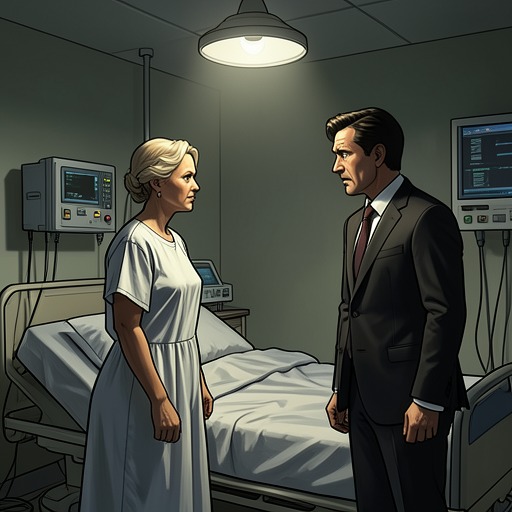
Emma and Sergei decide to try couples therapy
UpEmma and Sergei decide to try couples therapy in a closing scene that makes no promise of cure or easy reconciliation. Instead, the decision places their relationship inside the life Emma is choosing to continue: one shaped by recurring illness, mutual responsibility, friction over safety, and the possibility of spending many more years together. The exchange begins with Rajid’s suggestion and ends with Sergei’s concealed medication and Emma’s renewed insistence that therapy will be necessary.
The proposal and the hesitation
The subject arises while Emma and Sergei are together near the end of the book. Emma asks whether Rajid’s suggestion of couples therapy appeals to him. Sergei agrees, then explains that he finds the prospect interesting because it might let him know Emma better. His answer surprises her. To Emma, therapy is not an entertaining experiment; she questions whether she wants to attend with someone who describes it as interesting. Her resistance is wary and practical: agreement alone does not mean they understand the same thing by seeking help.
Sergei lets the tension ease by making clear that his first response was a joke, but he does not withdraw from the proposal. When Emma checks whether he genuinely wants to go, he confirms that he does and connects that willingness to wanting to know her better. Emma points out that they have already been together for six years. The difference between their statements matters: shared history has not made further understanding redundant. Sergei’s response looks beyond the immediate conversation, expressing a wish for many more years together. Couples therapy thus becomes both a concrete proposal and a way of acknowledging that a long relationship can still contain things to learn.
Illness, safety, and the relationship
The decision follows a conflict over Emma’s medication. Rajid had asked Sergei to remove the pills while Emma was in hospital, but Sergei resisted and delayed for more than three weeks, despite two conversations with Rajid. Emma experienced his reluctance as evidence that he might not take her difficulties seriously, or might not believe their danger. Sergei’s actions therefore stand at the intersection of intimacy and protection: he is involved in managing a potentially lethal risk, but his response also leaves Emma feeling misunderstood.
Someone close to Emma offers a possible interpretation of Sergei’s denial. If he treats her problems as less serious, perhaps he can avoid facing how near he came to losing her. This is presented as a possibility, not as a settled explanation of his motives. The distinction matters: the couple’s difficulty is not reduced to a lack of love, but neither is love enough to resolve the disagreement about how grave Emma’s illness can become. Their decision to try therapy follows this unsettled terrain rather than a scene in which it has already been repaired.
A decision within a continuing illness
Emma’s own account of her mental states helps explain why the relationship cannot be separated from the work of living with illness. She has described a depression followed by an overwhelming conviction that she had to die; at the time, she did not experience that thought as a suicide plan carrying the meaning others attached to it. She also describes depression as capable of draining feeling and narrowing life around a single idea. Elsewhere, her reflections distinguish the all-consuming present of mania from depression’s collapse of past and future into despair. These descriptions do not establish that couples therapy will change her condition. They show why mutual understanding and responsibility matter within a life where perception, feeling, and risk can shift profoundly.
The late decision also sits beside Emma’s assertion of agency. When she asks to be allowed to go, she recognizes that people around her may see her principally as a patient for whom they are responsible, while insisting that she must live her own life. Her acknowledgment that things may worsen again is not a claim that the danger has disappeared; it is an acceptance that worsening is possible without surrendering authorship of her life. Trying therapy with Sergei belongs to that same forward movement: it is a shared step, not a declaration that either partner can guarantee what comes next.
The medication revelation and the ending
The couple’s agreement is immediately complicated by a disclosure about the pills. Emma realizes that Sergei kept the medication he was supposed to remove. He explains that otherwise she would not have had pills that evening. Emma responds by striking his side and declaring that they will indeed need couples therapy, with an emphatic sense that the sessions will be interesting. The exchange is comic in its physical teasing, but the underlying fact remains serious: the earlier conflict about controlling access to medication has not simply vanished. Their laughter lets them speak together without making the disagreement inconsequential.
The scene’s ending widens beyond the argument. Siem runs beside the bicycle, and Emma looks back at the sand where the PAAZ once stood. The institution is gone, but her life continues; she puts an arm around Sergei and rests her head against his coat. Her final sense of being home does not resolve the illness, the medication dispute, or the work ahead. It gives the decision its measure: couples therapy is a tentative commitment within an ongoing life together, and the ending’s promise is not a cure but continued presence.