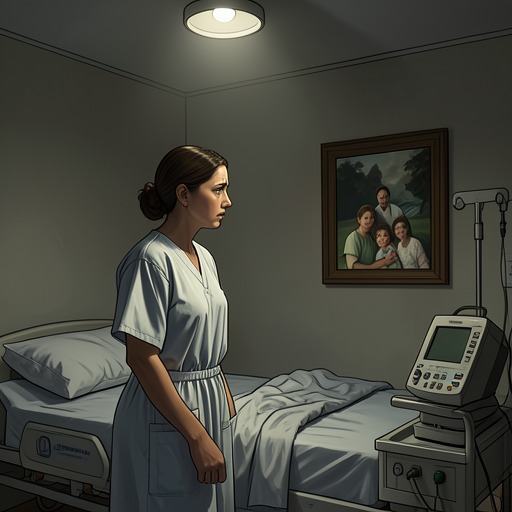
Emma agrees to accompany her mother to visit David
UpEmma’s agreement to accompany her mother to visit David is a small but consequential family decision made during her own psychiatric hospitalization. It does not resolve David’s situation or signal that Emma has recovered; instead, it opens a way for her to take part in family life from within an illness she is still learning to live with. The offer makes her experience inside psychiatric care useful to someone she loves, while her unhesitating acceptance brings mother and daughter briefly out of the roles of patient and worried parent.
The family situation
David has been hospitalized and then transferred to a psychiatric hospital, where he knows nurses from earlier day programs and appears comfortable. He no longer speaks and cannot live independently in a room. His parents do not think they can provide what he needs at home; he will remain in the hospital until a place becomes available in a residential group for autistic adults. His mother calls this prospect long-stay, giving the situation a weight that reaches beyond a temporary admission.
Emma takes in this news while facing her own vulnerability. Her mother holds her hands as she describes David’s future, and Emma recognizes the helplessness she imagines her mother experienced throughout her childhood, not only with David but with Emma too. She pictures her mother fighting like a lioness against an invisible enemy, while the person in danger may not want help. The recognition does not make her mother’s worry disappear, but it lets Emma understand it from the other side: as a witness to a family crisis, rather than only as its subject.
A request made at the car
After they leave the hospital building, Emma’s mother asks her to consider accompanying her on a visit to David. She stresses that Emma need not say yes and that the visit would be for later, after Emma has left the hospital and feels ready. Her reason is practical as well as intimate: Emma knows how a psychiatric ward works from the inside, while her mother feels like an outsider and wants to know what to watch for. She asks for Emma’s time and knowledge, not for her to take responsibility for David’s care.
The request comes after an earlier conversation in which Emma explains the conflict with Sergei over the medication she had stockpiled. Rajid had insisted that the medication and remaining prescriptions be removed because they left her means of suicide readily accessible; Sergei initially resisted, believing Emma was doing better and might need the medication again. Emma tells her mother that the dispute made her feel he did not take her difficulties seriously. Her mother offers a more charitable interpretation: perhaps acknowledging the danger would mean facing how close he had come to losing Emma. That exchange gives the later invitation added significance. Her mother is not simply asking for help; she has listened to Emma describe what care, risk, and being believed mean to her.
Emma’s answer
Emma first feels her muscles tighten when her mother says the request concerns David. She lets the tension go, reminding herself that the crisis belongs to the past, and waits for her mother to explain. When she understands that her knowledge as a former or current patient could help her mother navigate the ward, she is unexpectedly moved. She has repeatedly understood her admission as something she must undergo for herself. Now she sees that being there may also give her a way to help her brother, her mother, and the rest of her family.
Her answer is simply yes. Her mother swallows, embraces her, and Emma feels, for a moment, no longer like a lost child. The change is relational rather than clinical: no treatment outcome is announced, and the visit has not yet happened. What changes is Emma’s sense of where she stands in her family. She can accept care for herself and still offer something in return, without pretending that she is well or that David’s needs are hers to solve.
Significance
The episode turns psychiatric experience into situated knowledge. Emma’s mother sees her as someone who understands the ward from within, not merely as someone who must be protected from it. That does not erase the asymmetry between them: Emma remains hospitalized, David remains unable to return home, and their mother is still carrying fear and grief. But the request creates a limited, concrete form of participation. Emma can accompany her mother and help her notice how a ward works; she is not asked to guarantee David’s future.
The agreement also revises the image of Emma as only a danger to herself or a patient under other people’s responsibility. Earlier, suicidal intent and the stockpile of medication had made safety measures urgent: Rajid presented surrendering her medicines or being admitted as the available choices. Here, the movement is not from illness to cure, but from crisis toward a role she can choose within her family. Her mother’s embrace seals that modest change. Emma does not become the family’s rescuer; she feels found, and agrees to go with her mother when she is ready.