Emma’s stockpile of medication
UpEmma’s stockpile of medication is both a concealed practical means of suicide and a material expression of the crisis she cannot recognize as one. She has gathered roughly two hundred pills, using prescriptions left over when appointments came sooner than expected, and plans to grind and swallow them. Though she insists that she is not depressed and experiences the plan as a way to preserve her intense well-being, Rajid Panjani recognizes the danger and makes surrendering the medication a condition of avoiding admission. The supply remains consequential after Emma enters hospital: its removal is delayed, disputed, and repeatedly brought back into view as a test of whether those closest to her understand the immediacy of the risk.
Accumulation and concealment
Emma’s stockpile did not originate in a single new prescription. In recent weeks, she had been given only seven days of medication at a time to reduce the risk of suicide. But earlier prescriptions had covered the period until her next appointment, and when an appointment occurred sooner than expected, the unused medication and prescriptions accumulated. Emma explains that she has already collected most of the remaining supply and means to fill one last prescription that afternoon. The system’s attempt to limit access has therefore not accounted for medication retained from earlier dispensing.
The quantity is approximate rather than a precise inventory. Thinking through the packets and boxes in her kitchen drawer, Emma estimates about two hundred pills. The strips and boxes fit the cutlery drawer so exactly that the space seems, in her perception, as if it had been made for them. That domestic detail makes the stockpile more than an abstract clinical risk: medication has become an organized household reserve, quietly gathered in a familiar place.
A plan Emma does not call suicide
When Rajid asks what she intends to do with the pills, Emma describes a sequence: buy a mortar, collect the remaining medication, grind it, and take it the next morning with yogurt. She presents the preparation as a task to be carried out carefully, not as an impulsive possibility. The ordinary details and planned timing sharpen the contrast between the calmness of her account and the lethal purpose she discloses.
Emma rejects Rajid’s interpretation that the plan is suicidal. She says that she feels well, has a week off, and has work and editing to do; she does not want to lose her current state. In her account, dying would make that state permanent and free her from the feelings and difficulties that obstruct productivity. Her conviction that everything has become clear does not make the danger less real. It is precisely the certainty with which she treats the plan as a solution, rather than as an act of self-destruction, that reveals the gulf between her own understanding and Rajid’s assessment.
That gulf is also present in her way of describing her experience. Earlier, Emma reaches for an image of an eternal mist lifting: what had been obscured now appears to her as reality, stripped of the distortions through which ordinary perception sees the sky and moon. Yet she cannot explain this apparent clarity to a psychiatrist. The stockpile gives that private conviction a concrete form. It joins an altered sense of certainty to a specific means, preparation, and intended time.
The choice between surrender and admission
Once Rajid accepts that Emma means to act, he gives her two options: go home and hand over all her medication and prescriptions, or be admitted. Emma laughs at the proposal and points out that some pills at home have already been partly ground, while one prescription is at the pharmacy and cannot simply be returned. Her objection is not a withdrawal of the plan; it shows that she has already begun preparing and that the supply is distributed across more than one step in the process.
The prospect of surrendering the medication provokes anger. Emma experiences the pills as her escape route, a solution found after months of depression and suicidal thoughts. From inside that conviction, Rajid’s intervention seems to take away the one thing she believes will make the suffering end. The decision nevertheless places immediate safety above her stated confidence that she is doing well, and her admission changes where she is and what she can access, without resolving what has happened to the medication at home.
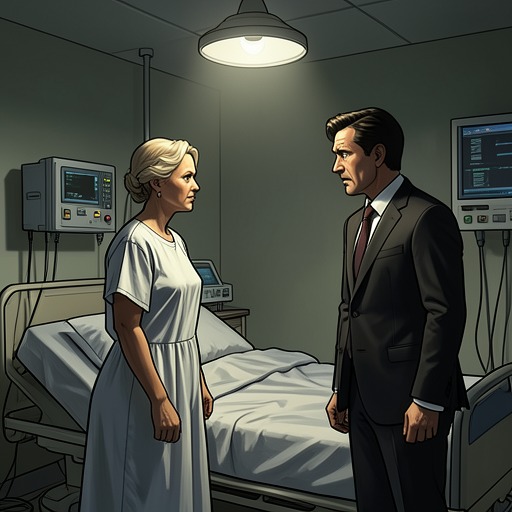
At the point of admission, Rajid asks Sergei to arrange for Emma’s medication to be cleared away. Sergei hesitates over whether this is necessary while Emma is in hospital and cannot reach the pills. That question exposes an important distinction between removing immediate access in the ward and reducing access after discharge: being temporarily out of the house does not make a supply stored there disappear from Emma’s life.
Delay, disagreement, and means restriction
The stockpile continues to trouble Emma after admission. During an intimate moment with Sergei, she remembers the pills and asks whether he has dealt with them. His initial response is that he may not have gone, and that it could be wasteful to remove medication Emma might later use when she returns home. Emma cannot fully explain why this reasoning frightens her. She recognizes that, with Sergei, her thoughts about life and death feel less like distant plans and more like feelings she does not want him to see.
Rajid later explains the clinical concern in practical terms. Emma had gathered as much medication as she could and intended to take it all at once. The aim of suicide prevention, he tells Sergei, is to raise the barriers to acting; the stockpile has nearly eliminated them. Without it, Emma might have to visit pharmacies over a period of days to collect medication. With it, she could have the means within reach and act in minutes. Rajid does not treat the location of the pills as a sufficient safeguard: keeping them at Sergei’s home would still leave them present in Emma’s life. They must be disposed of, taken to a pharmacy, or handed in at the hospital—what matters is that they are gone.
The disagreement lasts more than three weeks and requires two conversations with Rajid before Sergei finally removes the pills, and then not wholeheartedly. Emma later describes the delay to another patient as painful evidence that Sergei may not take her difficulties seriously, or may not believe how severe they have been. The other patient offers a more charitable possibility: downplaying the danger might protect Sergei from facing how close he came to losing Emma. The stockpile thus becomes a point of conflict not only over physical access but over how a loved one can acknowledge a threat that is terrifying to take seriously.
Recurrence and significance
Removal does not erase the stockpile from Emma’s attention. In the medication routine on the locked ward, as she watches another patient carefully take her pills, Emma wonders whether Sergei has collected the supply at home or still intends to do so. The question returns amid the ward’s ordinary pill-taking, where medication is at once treatment, routine, and a reminder of the means she had accumulated. Her uncertainty shows that a safety measure has to be completed and understood, not merely requested once.
The episode also clarifies the limits of treating a crisis as over simply because Emma is now in hospital or appears to be feeling better. Sergei initially reasons from her apparent improvement and anticipated return home; Rajid reasons from the accessibility and speed created by the stockpile. For Emma, meanwhile, the plan arose from a conviction that the present feeling should never be lost. The pills connect those competing understandings to a concrete risk. Their significance lies not in any one medication named in the narrative, but in the quantity already gathered, the preparations already under way, and the way leaving that reserve intact would preserve a rapid path back to danger.