Cattle
UtopiaCattle have two sharply contrasting roles in Utopia: they are carefully managed as working animals and a source of food, but in England they figure in a market distorted by enclosure, concentrated wealth, and shrinking rural labor. The contrast makes livestock more than a measure of agricultural production; it shows how the organization of land and work shapes who can obtain necessities.
Husbandry in Utopia
Utopian farmers breed cattle as part of a deliberately abundant agricultural system. They produce more livestock than their own communities require, just as they sow more grain than is needed for local consumption, and give the surplus to neighboring peoples. This planned overproduction is paired with the regular movement of workers between town and country: farm residents cultivate the land, raise livestock, and transport their produce to the towns.
Cattle also determine how labor is allocated. The Utopians keep few Horses, reserving them for young people’s riding practice rather than ploughing or carriage. Although Horses are stronger, Cattle are preferred for farm work because they can work longer, are less prone to illness, and cost less to keep. When they are no longer fit for labor, they remain useful as food. The account presents this as a practical sequence in which an animal’s role changes over time rather than ending when its working capacity declines.
Provision and civic rules
The abundance of agricultural goods underpins a system in which families obtain what they need from public stores without payment or exchange. Markets include Cattle alongside other provisions, and the arrangement is described as removing the fear of want that might otherwise encourage people to accumulate more than they need. Livestock production is thus connected to a broader principle of access: its social purpose is to supply the community, not to create private advantage through scarcity.
That provision is governed by a restriction on who may kill animals and where the work takes place. Utopians do not slaughter Cattle themselves, on the grounds that killing animals weakens pity and kindness. Slaves perform the task at designated places outside the towns, near running water, where waste can be washed away. The rule links the treatment of animals to civic character and public health, while also revealing that the community’s restraint depends on assigning this labor to people who are not free citizens.
Cattle in England’s rural economy
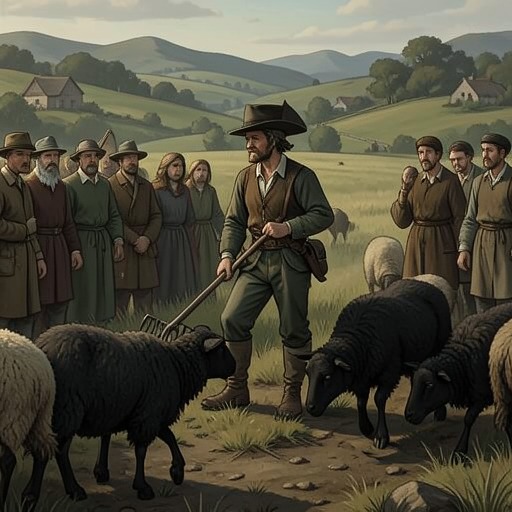
In England, the expansion of pasture and the enclosure of land are described as part of a chain of social and economic harms. Landowners turn inhabited areas and farmland over to sheep, displacing households whose work and livelihood depended on the countryside. As villages are pulled down and agricultural labor neglected, fewer people breed Cattle. The wealthy instead buy them lean and cheaply, fatten them on their own land, and sell them at high prices.
This trade does not simply raise the cost of livestock. The account warns that if Cattle are consumed faster than the regions supplying them can breed replacements, stocks will fall and scarcity will follow. At the same time, rising grain prices press families to reduce their households, while displaced rural workers find fewer opportunities in the work for which they were trained. The availability and price of Cattle therefore belong to a larger critique of how land consolidation weakens production and intensifies poverty.
Comparative significance
The contrast is not between a society that uses livestock and one that does not: both depend on animals for food and work. It lies in the rules governing their use and distribution. In Utopia, Cattle are integrated into planned production, shared provision, and a stated limit on citizens’ direct involvement in killing. In England, the account connects livestock prices to concentrated ownership, declining husbandry, and the possibility of depleted supplies. Cattle make that difference concrete: the same kind of resource can sustain broad provision or become a sign of an economy in which control of land and markets narrows access.