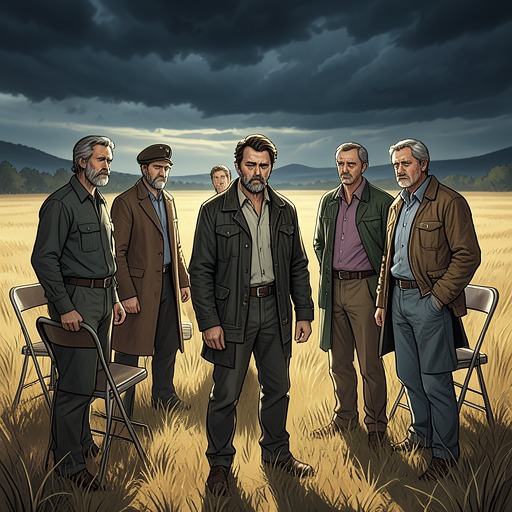
Chi si è salvato
VinelandChi si è salvato? is the question Hector Zuñiga presses on Zoyd Wheeler as they reckon with the aftermath of their former political circle. More than a request to identify who is still alive, it becomes an exercise in facing what survival has actually meant: some are dead, others have disappeared into fugitive lives, and Zoyd himself seems stranded far from the life the group once shared. His answer, Hector, briefly makes the question intimate; Hector’s response makes it painful.
The Question as an Exercise
Hector asks Zoyd not to grow up, but to ask himself, every so often, “Chi si è salvato?” The casual framing as an easy little question does not make it easy to answer. Its repetition gives it the shape of an instruction: not a request for an immediate roll call, but a thought Zoyd is supposed to return to. Hector even presents it as a kind of Zen spiritual exercise, making self-examination—not simply the recounting of the dead—the point.
The question shifts in form as it moves between them. Hector first asks who was saved; after listing the fates of their companions, he asks who among them was saved. Zoyd answers with a single person: “Tu, Hector.” That reply identifies Hector as a survivor, but it also exposes how much is compressed into the word. The answer cannot settle whether surviving means merely being present, having escaped the worst fate, or having retained something of oneself. The exchange leaves those possibilities in tension rather than supplying a definition.
The Lost Circle
Hector gives the question its force by recalling a series of distinct outcomes. One person died of an overdose in the restroom of a fast-food restaurant; another struck up a conversation with the wrong man in a parking lot; another went to die in a distant land. More than half, he says, are now fugitives. The roll call ranges from a specific, ordinary setting to violence and exile, then to lives still in progress but lived beyond the reach of ordinary security. Survival, in this account, has no single shape.
Zoyd’s own condition completes the picture. Hector tells him to look at himself, so far out to sea that he cannot see the shore, and connects his present isolation to the fate of their once-happy family. The image does not describe a triumphant escape. It places Zoyd at a distance from the group and its former life, with no visible return point in the comparison Hector uses. Hector’s mention that they might as well have faced a SWAT team sharpens the contrast between the circle’s scattered outcomes and a direct, collective confrontation with force.
Hector’s Answer and His Decline
Zoyd’s answer names Hector, but Hector rejects the comfort implicit in it. He tells Zoyd to go ahead and break his old friend’s heart, then says he had thought Zoyd knew everything, only to discover that he knows nothing. The response turns a seemingly plain identification into a rebuke: being the one still there does not mean being understood, or that the question has been answered in any reassuring sense.
The narration places this exchange against Hector’s decline. He once had investigative skills and professional standing; over the years, he came to rely on bursting in and using an arsenal of attacks, from stunning people to annihilating them. He recognizes that this is unlike the samurai’s readiness to die, a state of mind he himself had experienced only a few times, long ago. With his old fighting spirit extinguished, what might look like impulse and will could just as easily be self-hatred. The contrast gives Hector’s reply a deeper edge: he is alive, but the passage refuses to equate that fact with an intact or settled sense of survival.
Memory, Risk, and the Meaning of Being Saved
Zoyd, described as a great idealist, believes Hector remembers everyone he has shot, hit or missed; everyone he arrested, interrogated, mistreated, or deceived through double dealing. In Zoyd’s theory, every face remains filed in Hector’s conscience. Hector’s willingness to take risks with his own cruelty, raising the stakes as his career nears its end, becomes a way of living with that record. This is Zoyd’s understanding of Hector, not a confirmed account of Hector’s private thoughts, and its uncertainty matters: the question of who was saved cannot be answered simply by counting the living.
The expression therefore gathers several kinds of survival without resolving them. It begins as Hector’s challenge to Zoyd, becomes a tally of the scattered group, and turns personal when Zoyd names Hector. The reply is immediately contested by Hector’s pain and by the account of his diminished professional and fighting capacities. At the same time, Zoyd’s belief that Hector carries the faces of his past gives survival a moral dimension: to remain alive may also mean remaining exposed to memory and to the consequences of one’s actions. The question endures because the exchange offers no clean boundary between having survived and having been saved.