Ant
WaldenThe ants in Walden are small, observed creatures whose struggle becomes one of the book’s most vivid encounters with violence. A battle discovered among the chips of the narrator’s wood-yard draws him from looking closely at animal life into staging a limited observation of its outcome. The ants remain real combatants, but the narrator also describes their opposing ranks as political armies and measures the scene against human warfare. His intervention yields a stark result for the fighters under glass, yet not an answer about the larger battle: he never learns its cause or which side prevailed.
Discovery in the wood-yard
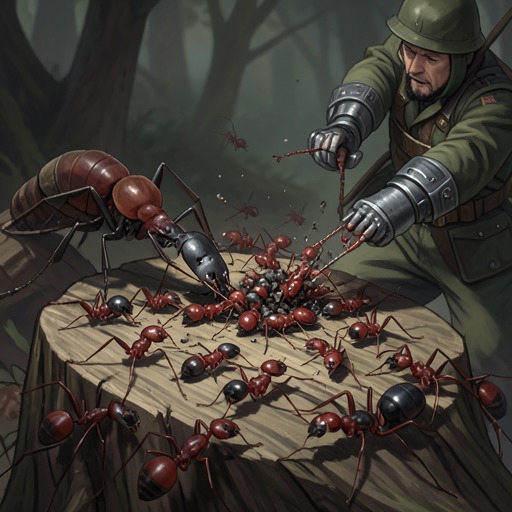
The encounter begins when the narrator goes out to his wood-pile, more accurately a pile of stumps, and notices two large ants locked together. Looking farther, he discovers that this is no isolated duel: the chips are covered with combatants. Red ants are repeatedly pitted against black ones, often with two red ants against one black. Their forces spread over the hills and hollows of the wood-yard, while dead and dying ants already lie across the ground.
The scene is striking partly because it is both extensive and quiet. The narrator calls it war between two races, but hears no sound from the fighting. The absence of noise does not make the combat less fierce: on every side ants are engaged in deadly struggle, and the little battlefield contains the same contrast between an ordinary setting and lethal action that gives the episode its force. The ant conflict is not introduced as a fable; it begins in a specific place, among the narrator’s wood chips, with creatures he can inspect at close range.
Combatants and human analogy
The narrator gives the red and black ants political names, calling the red side republican and the black side imperialist. That language enlarges the scene without turning the ants into mere symbols. Their positions and movements remain the basis of the account, while the human comparison offers a vocabulary for the organized, factional character of their violence. The armies meet across the wood-yard as antagonists, although the narrator does not discover what caused their war.
One smaller red champion holds fast to a much larger opponent. Clamped to the black ant’s front like a vice, it keeps gnawing at a feeler near the root even as the two tumble across the field. The disproportion between the fighters and the persistence of the smaller one make the conflict legible as an individual struggle within the larger clash. At the same time, the narrator refuses any easy account of victory: the scene offers ferocity and endurance, not a known purpose or a secure moral lesson.
The experiment under glass
To see what will happen to three ants he has particularly described, the narrator lifts the chip on which they are struggling, carries it into his house, and places it beneath a tumbler on the window-sill. The move changes the conditions of observation. Outside, the wood-yard battle sprawls across the chips; beneath the glass, a few combatants are confined within a space the narrator can revisit. His watching becomes a small experiment, though it cannot reveal the cause of the war or the outcome of the larger fighting.
After another half hour, the black soldier has severed the heads of its foes from their bodies. One of the defeated ants survives in a crippled state, with feelers and only the remnant of a leg, and struggles for another half hour to free itself from its attackers. At last it succeeds. The narrator raises the glass, and the injured ant goes over the window-sill. The episode records both a grim result inside the tumbler and a boundary to what observation can establish: the narrator does not know whether the survivor lives, and he never identifies the victorious party in the wider battle.
What the battle leaves unresolved
The narrator’s response makes clear that watching is not emotionally neutral. For the rest of the day, he feels as though the ferocity and carnage of a human battle had stirred and harrowed him. The ants’ struggle has not become human warfare, but its scale, factions, bodily damage, and uncertain outcome have made it a powerful occasion for thinking about war. The comparison works through attention to the observed details rather than through a claim that the two kinds of combat are identical.
The episode ends with unanswered questions rather than a settled allegory. The narrator does not know the war’s cause, which side won, or whether the injured ant survived. His brief act of lifting the glass releases that one creature from the experiment, but does not repair its wounds or disclose its future. The ants thus retain a life beyond the narrator’s interpretation: he can watch, describe, compare, and feel the force of the struggle, but the battle’s motives and final consequences remain beyond his knowledge.