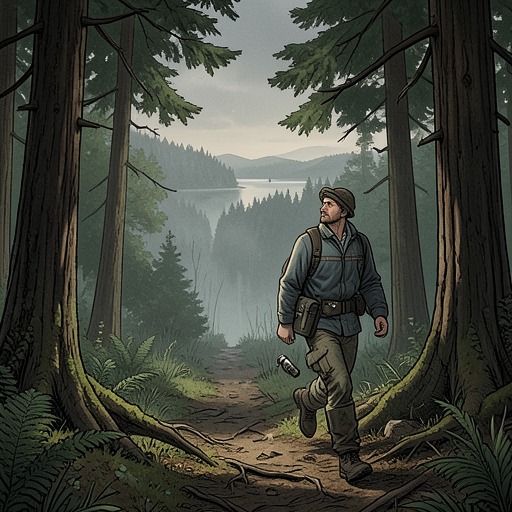
Ducks
WaldenDucks give Walden Pond a recurring, seasonal life and help make its changing landscape legible. They appear in the narrator’s reflections on the pond’s imagined antiquity, in direct observations of spring and fall migration, and in an old fisherman’s recollection of a waterfowl-rich past. Their movement across the seasons connects the intimate natural history of the shore to a wider account of ecological change: the birds remain part of the pond’s beauty, even as the wooded setting that once sustained a richer abundance is cut away.
Seasonal Presence
In the narrator’s imaginative account of the pond’s beginnings, Walden may already have existed on the spring morning when Adam and Eve left Eden. He pictures it breaking up in gentle rain, mist, and a southerly wind, its surface covered with countless ducks and geese that had not heard of the Fall. The image places the birds within a vision of nature older than human history, and makes the pond’s spring life seem complete in itself, beyond the moral drama associated with humanity.
The more immediate record is seasonal rather than mythic. Ducks and geese frequent the pond in spring and fall, recurring visitors whose passage marks the year. The narrator also describes disturbing a great mud-turtle hidden beneath his boat overnight when he pushes off in the morning; in the same account, the pond’s animals occupy the shore and water as active inhabitants, not merely scenery arranged for human enjoyment. Ducks share this seasonal setting with white-bellied swallows skimming over the surface and peetweets moving along the stony shore through summer.
Pond, Shore, and Observation
The birds’ setting is described at a particular, modest scale. The scenery of Walden is beautiful but not grand, and its appeal depends on familiarity with the place: it matters especially to someone who has spent time there or lived along its shore. That local character gives the ducks’ seasonal visits their force. They belong to a landscape known through repeated attention rather than through spectacle.
The shore itself is a belt of smooth, rounded white stones, like paving stones, interrupted by one or two short sand beaches. In many places it falls so steeply that a single leap would carry a person into the water. This abrupt meeting of land and pond gives the birds’ habitat a sharply defined edge: waterfowl arrive at a shore that is stony and steep, while the narrator’s observations remain grounded in the precise physical features of the place.
The act of observation also has limits. The narrator surveys the long-lost bottom of Walden carefully before the ice breaks up, using a compass, chain, and sounding line. This is a deliberate effort to know the pond’s hidden structure, but it does not turn the natural record into an exhaustive inventory. The ducks are encountered in seasonal visits and remembered abundance, and the account keeps that distinction between what the observer directly sees and what he reconstructs through imagination or another person’s testimony.
Memory of Abundance
An old man who had frequented the pond nearly sixty years earlier recalls a very different surrounding landscape: in his day, forests darkened the shore, and the water was sometimes alive with ducks and other waterfowl. He also remembers many eagles and says that he came there to fish in an old log canoe found on the shore. His testimony enlarges the birds’ significance beyond the narrator’s own seasonal observations. Ducks belong to a remembered community of wildlife, associated with extensive woods, fishing, and a canoe that was itself part of the pond’s material history.
The remembered scene is not simply a claim that the birds once existed there. It records how human use and perception were woven into the place: the old fisherman came to fish, traveled in a canoe, and saw the waterfowl against a dark forest. By setting this account beside his own experience, the narrator makes the pond a site where different periods can be compared. The birds are a living presence in the seasonal present and evidence, through memory, of an earlier landscape.
A Changed Landscape
The narrator says that after he left the pond’s shores, woodchoppers further laid waste to the woods. For years, he expects, there will be no more wandering through wooded aisles with occasional views of the water. The loss is expressed not only as a change in scenery but as a consequence for the life associated with it: the narrator asks how birds can be expected to sing when their groves have been cut down. The damaged woodland thus bears directly on the presence and perception of wildlife, including the waterfowl remembered from the older pond.
The change is made concrete in a list of absences. The tree trunks on the bottom, the old log canoe, and the dark woods are gone; villagers scarcely know where the pond lies, and instead of going there to bathe, they have turned to other uses of the area. The contrast does not establish that ducks disappear altogether—the narrator has already described their recurring spring and fall visits—but it places those visits within a landscape whose former abundance and human familiarity have been diminished.
Ducks therefore occupy two complementary roles in Walden’s environmental history. Their seasonal return belongs to the narrator’s close attention to the pond as a living place, while the old man’s recollection situates them in a wooded past that later cutting has altered. The birds do not serve only as symbols: they are observed inhabitants with a recurring pattern of visitation. Yet their presence also helps the prose measure what cannot be reduced to a single sighting—the changing relation among water, shore, woodland, and the people who use the pond.