John Field’s poverty
WaldenJohn Field’s poverty is not merely a lack of money: it is a daily economy in which strenuous work, household needs, and inherited habits leave little room to change course. In the visit to his family’s leaking cabin, the narrator treats Field’s predicament as a vivid local instance of a wider argument about labor and want, though the scene also exposes the distance between an ideal of simplicity and the burdens borne by a poor household.
The household and its circumstances
The narrator encounters Field, an Irishman, in a cabin where Field lives with his wife and several children. The roof leaks, and rain drums outside while the family shelters within. The account makes the cabin’s vulnerability concrete: shelter exists, but it offers no secure refuge from the weather. Field’s household is not an abstraction in an argument about poverty; its members share the confined domestic space and its demands.
Field is described as honest and hard-working, but also as shiftless. That combination matters to the portrait: the narrative recognizes his labor and honesty while judging his ability to direct his circumstances harshly. His wife, meanwhile, cooks successive meals at a large stove, and the children move through the household as part of its daily life. The narrator’s picture of poverty therefore includes domestic work as well as the paid labor that brings money into the home.
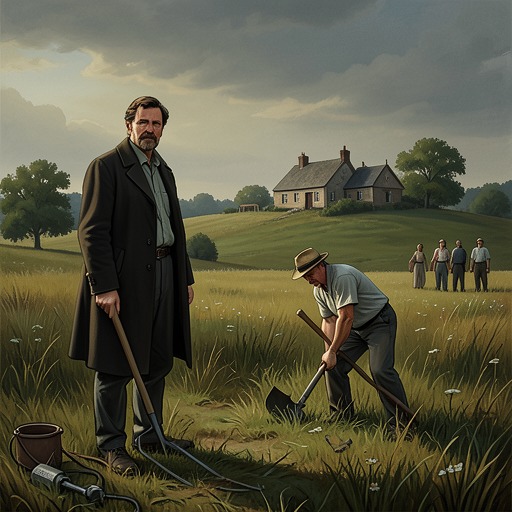
Field explains that he works at “bogging” for a neighboring farmer, turning meadow with a spade or bog hoe for ten dollars an acre, together with use of the land and manure for a year. His young son cheerfully works beside him, not understanding how poor a bargain his father has made. The arrangement binds family labor to a return the narrator considers inadequate; the boy’s willing assistance sharpens the contrast between his energy and his lack of knowledge about the terms of the work.
Labor, consumption, and the narrow margin
The narrator compares Field’s economic choices with his own deliberately reduced needs. Field begins with tea, coffee, butter, milk, and beef, so, in the narrator’s account, he must work hard to pay for these goods and then eat heartily again to repair the bodily expenditure of that work. The sequence forms a cycle: consumption requires labor, and labor generates further need. The narrator, by contrast, claims that because he does not work hard, he need not eat hard, and his food costs little.
This contrast is presented as practical arithmetic, not simply as a difference in character. The narrator says that a person who lives simply could spend two days supplying a want or earn enough money to support a week; he imagines Field and his family huckleberrying in summer for pleasure rather than working under pressure. Field sighs, and his wife stands with her arms akimbo. Their reaction registers the distance between the proposal and their actual capacity to adopt it: they appear to wonder whether they have enough capital to begin such a course. The scene makes clear that an ideal of leisure and simplicity does not, by itself, remove the material barrier to reaching it.
The narrator nevertheless places much of the explanation in habits and inherited practices. He calls Field’s struggle an enterprise to be undertaken with a “moral bog hoe,” and says Field is living without arithmetic, a phrase that treats calculation and planning as missing tools. He later describes him as trying to live by an old-country mode in a new country, likening the mismatch to catching perch with shiners. Such images turn economic criticism into a story of methods poorly suited to circumstances, but they also reveal the limits of the narrator’s diagnosis: Field’s difficult bargain, meager margin, and family obligations are visible in the same scene as the habits the narrator faults.
Poverty as a wider social condition
The book places Field’s circumstances within a broader division between those raised above subsistence and those pushed below it. Considering the farmers of Concord, the narrator says that many have toiled for twenty, thirty, or forty years. He asks how the poor minority fares when some people’s material circumstances have risen above those of the savage, and answers by directing attention to a degraded poor. The rhetorical movement widens the frame from one cabin and one laborer to the distribution of hardship around him.
Railroad-side shanties provide another image of that degradation. The narrator points to them as places where poor inhabitants live alongside what is called the latest improvement in transportation. The contrast complicates any simple equation between technological progress and general well-being: signs of civilization can coexist with severe poverty. Field’s cabin belongs to this same inquiry into who benefits from improvement and who continues to live with precarious shelter and labor.
A further comparison appears in the account of the narrator’s own life at Walden. He says that he could avoid trade and barter for food, having shelter already, and need only obtain clothing and fuel. His inexpensive furniture includes a bed, a table, a desk, three chairs, and a small looking-glass; elsewhere he emphasizes that some of it was made by himself and the rest cost him nothing for which he had not accounted. The spare inventory gives physical form to his argument that reduced wants can lessen dependence on exchange. Set beside Field’s family, however, this is a contrast between the narrator’s chosen economy and a poor household’s constrained one, not proof that the two have equal freedom to choose.
Domestic work and the meaning of economy
The discussion of clothing also broadens the meaning of poverty beyond wages. The narrator observes that clothing brings sewing, an apparently endless task, and remarks that a woman’s dress is never done. In the account of Field’s home, the wife’s repeated cooking supplies a parallel image of labor that sustains household life. These details make domestic work part of the book’s argument about the cost of ordinary comforts, even as the narrator’s own comparison gives less attention to how that work is distributed or to the choices available to Field’s family.
Field’s poverty thus carries two connected meanings in the narrative. It is a material condition, evident in the leaking roof, the low-paid meadow work, and the family’s uncertain ability to begin living differently. It is also a test case for the narrator’s claim that simplifying needs can reduce labor. The encounter gives that claim both force and friction: the arithmetic of fewer wants is clear, but the sigh, the arms akimbo, the son at work, and the question of starting capital keep poverty from dissolving into a lesson about personal discipline alone.