Winter of 1846–1847
WaldenWinter of 1846–1847 is the season when Walden Pond’s frozen surface became a worksite on an industrial scale. Each day roughly one hundred Irish laborers came from Cambridge under Yankee overseers to cut out the ice; in the observer’s account, the operation turns a familiar pond into an immense agricultural-looking scene of tools, teams, and human effort. Yet its commercial ambition meets a longer natural timetable: a heap estimated at ten thousand tons outlasted the market that was meant to receive it, and the pond eventually recovered most of the ice.
A Season of Work on the Pond
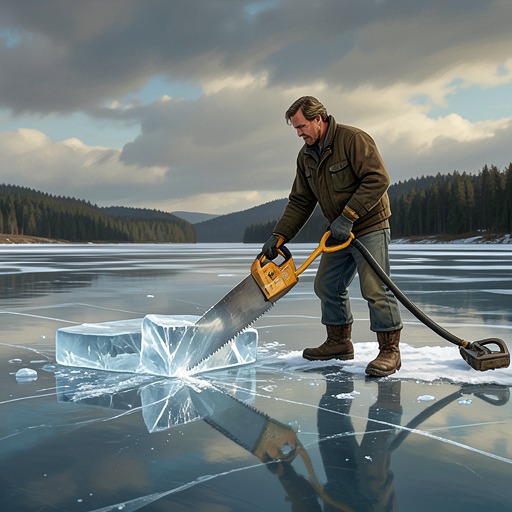
In the winter of 1846–1847, about a hundred men of what the narrator calls Hyperborean extraction descended on the pond one morning with carloads of farming implements. The list—sleds, plows, drill-barrows, turf-knives, spades, saws, and rakes—makes the frozen water appear less like a landscape than a field to be worked. The tools’ resemblance to agricultural equipment is more than visual: the laborers cut the ice into cakes, then sledded them to shore for removal.
The narrator makes the scale concrete by identifying the workers as a hundred Irishmen who came from Cambridge each day, supervised by Yankees. He watches them for sixteen days from his window, where the operation resembles the labor of husbandmen, with teams, horses, and implements of farming. The comparison registers how completely human work can impose familiar patterns of cultivation on a body of water: the pond is harvested as if it were acreage, even though the material being taken is frozen water.
Extraction, Transport, and Failed Commerce
The ice was carried to shore and arranged in a vast heap, row upon row, like the solid base of an obelisk intended to pierce the clouds. The workers reportedly could remove a thousand tons on a good day, roughly the yield of an acre. The figure sets the operation’s remarkable daily productivity against the singularity of the site: a pond’s winter surface is treated as a measurable crop, cut and stacked for a distant destination.
But extraction did not guarantee successful sale. The operators calculated that fewer than twenty-five percent of the ice would reach its destination, with another two or three percent wasted in the cars. A still greater part of the heap never went to market: the ice was found to contain more air than usual, or for some other reason did not keep as expected. The sequence turns a spectacle of efficiency into one of uncertainty. Labor and transport could move enormous quantities, but they could not ensure that the material would survive its commercial passage in usable condition.
The Heap and the Pond’s Recovery
The heap made in the winter of 1846–1847 was estimated at ten thousand tons. It was covered with hay and boards, then left partly exposed: it was unroofed the following July, some of it was carried away, and the remainder stood in the sun through that summer and the next winter. It was not quite melted until September 1848. The long persistence of the stored ice gives the season an afterlife well beyond the cutting operation itself, extending the winter’s material presence into successive seasons.
The account ends not with a market destination but with a return to the pond. Because so much of the heap remained and melted away, the pond, in the narrator’s phrasing, recovered the greater part. The sentence reverses the apparent direction of the harvest: ice removed from the water and assembled as property eventually returns to water. Commercial extraction is real and extensive, but it is not the final measure of what happened.
Seasonal Time and a Changing Landscape
The pond’s winter work sits within a broader pattern of attention to seasonal duration. The narrator associates the season with watching a hundred men at labor from his window, but elsewhere in the winter landscape he notes a swamp where skunk-cabbage continues to put forth green growth even amid snow, and a hardier bird awaiting spring. Such observations distinguish the season of human schedules and commerce from the slower recurrence of natural processes. Ice can be cut, transported, stored, and abandoned; living growth and the return of spring follow another rhythm.
That contrast matters because the pond is not described as an interchangeable resource. Its scenery is humble in scale, the narrator says, and its beauty becomes legible through long familiarity with its shore. He describes a shoreline of smooth, rounded white stones, with only one or two short sand beaches, steep enough that in many places a single leap would carry a person into the water. The ice harvest therefore takes place in a particular, closely observed landscape, not an abstract supply of frozen material.
The season’s industrial activity also belongs to a history of alteration and loss. The narrator recalls that woodchoppers have further laid waste the woods around the shore: the old wooded aisles and occasional views of water have diminished, while tree trunks on the bottom, an old log canoe, and the surrounding dark woods are gone. Against this remembered landscape, the harvest becomes one more instance of human use changing the setting. Yet the ice heap’s eventual melting supplies a counter-image to permanent transformation: the pond’s water reclaims much of what labor had taken from it.