Winter
WaldenWinter in Walden is not simply a stretch of cold between the more visible seasons. It is a condition that reorganizes work, perception, memory, and time. Snow and ice make the pond available for human use even as they conceal its depths; frost slows the landscape but prepares it to change. The season’s defining movement is therefore double: it binds the world, and it reveals how much is already stirring beneath the surface.
Weather, Work, and Seasonal Time
Winter announces itself through contrasts between human schedules and natural rhythms. On the morning of the Great Snow, the storm still rages, chilling the air, while the narrator hears the muffled engine bell of the railroad through fog. The sound makes industrial movement audible at the very moment weather seems to envelop the world. Winter does not stop work: the railway’s iron engine continues through conditions that test both its machinery and the people who labor with it.
The season also has an intimate, practical scale. In winter, the narrator encounters a man who warms coffee in a kettle over a fire at noon, sitting on a log to eat; chickadees sometimes come close and peck at the food. Fire, a simple meal, and birds at an arm’s reach make cold-weather life a scene of adaptation rather than deprivation alone. The smallness of the act matters: winter’s demands are answered through a modest routine, close to the woods and their inhabitants.
The narrator recasts a day itself as a miniature year. Night corresponds to winter, morning and evening to spring and autumn, and noon to summer. This analogy makes seasonal time something experienced in recurring daily transitions rather than only counted on a calendar. Winter is both a phase in the year and an image for the hours when the day is least open to light; spring and summer are already implicit in the rhythm that follows.
Ice, Extraction, and the Changing Shore
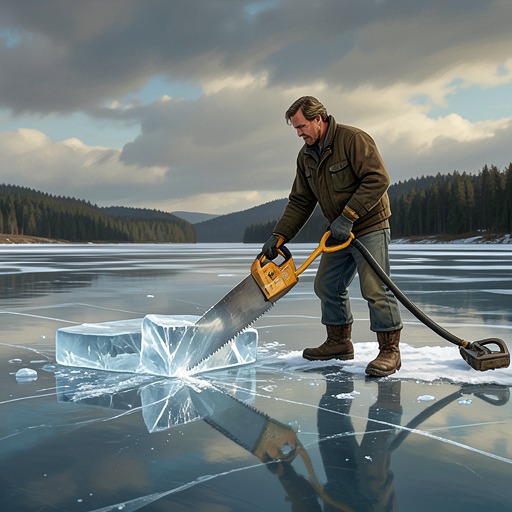
The frozen pond becomes a workplace on a large scale during the winter of 1846–47. One morning, a hundred men of Hyperborean extraction descend on the pond with carloads of farming tools, including sleds, plows, and drill-barrows. For sixteen days the narrator watches a hundred men at work from his window, with teams, horses, and implements that make the ice field resemble cultivated ground. The comparison is pointed: a winter surface becomes a field of labor, and the tools of agriculture are brought to bear on the lake.
This episode belongs to a wider history of human alteration. The narrator recalls the woods and shores as they once were, then observes that woodchoppers have further laid waste to the landscape. The trunks on the pond bottom, an old log canoe, and the dark woods around the water have disappeared. The loss is not just a change in scenery: with the trees gone, the old routes of rambling and the views through the woods to the water vanish as well. Winter’s exposed and transformed landscape thus carries traces of settlement, commercial use, and what those practices have removed.
Against this history, the narrator’s account of Walden’s scenery is deliberately intimate rather than grand. The pond is beautiful on a humble scale, and its significance belongs especially to those who have frequented it or lived by its shore. Its waters, like those of Concord, show at least two colors: one at a distance, governed more by light and sky, and another seen close at hand. Winter’s ice and the seasonal changes around it belong to this sustained attention to a particular place, not to a scenic spectacle detached from experience.
The Season as Observation and Memory
The narrator does not treat Winter as a blank interval in which nature has ceased. Even in midwinter, a warm, springly swamp can be found where skunk-cabbage keeps its perennial verdure, and a hardier bird may already be awaiting spring. Such observations complicate the season’s apparent stillness: winter’s conditions vary across nearby ground, and signs of life appear before the general return of green.
That attentive practice has a temporal cost and a reward. The narrator reflects that the seasons spent on the pond’s shores were not wasted in the workshop or at a teacher’s desk, even though the woods have since been cut down. He cannot expect birds to sing from groves that no longer remain. Winter and the other seasons are consequently remembered through a landscape that has changed; what once could be encountered directly may survive only in recollection. The vanished trees and canoe make environmental change part of the season’s meaning, while the narrator’s memory preserves the relationship between the old woods and the water.
Winter also enters the account through deliberate acts of recovery. Desiring to recover Walden Pond’s long-lost bottom, the narrator surveys it carefully before the ice breaks up, early in 1846, using a compass, chain, and sounding line. The frozen surface is not merely an obstacle over hidden depths: it provides the seasonal setting for a measured effort to understand them. The work joins physical observation to the larger pattern of the book, in which attentive looking turns a familiar landscape into something newly legible.
Thaw and Renewal
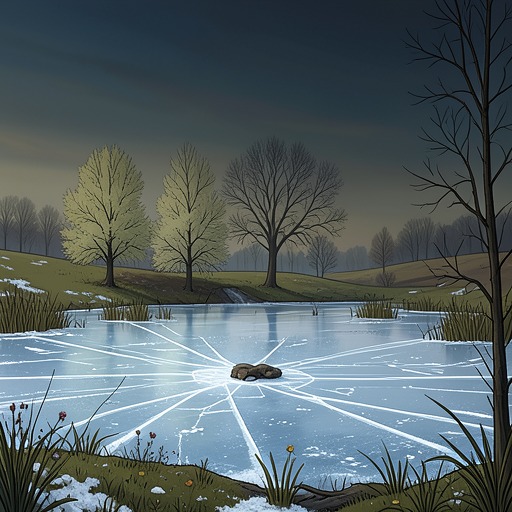
The attraction of living in the woods, the narrator says, included having the leisure and opportunity to watch spring arrive. That anticipation gives Winter a direction. The pond’s ice eventually begins to turn honeycombed, a visible change in its structure that marks the season’s hold weakening. The transition is observed as a process, not declared as an abstract change of mood: the surface that seemed solid starts to alter from within.
Thawing sand and clay provide another record of change. The narrator watches their forms flow down the sides of a deep railroad cut, where meltwater makes the ground’s movement visible. He interprets the sandy overflow as if it were the earth’s living interior, and the emerging forms as fresh designs. The natural observation expands into a vision of creative force: Spring begins not only when the landscape turns green, but when frost leaves the ground and its hidden materials move again.
The narrator explicitly distinguishes this first Spring from the green and flowery spring that follows. Frost coming out of the ground is an earlier renewal, preceding the season of flowers as mythology precedes regular poetry. This image makes winter’s ending a threshold rather than a simple reversal. The ground must first release what the cold has fixed; only afterward does visible verdure arrive.
Winter’s Moral and Poetic Pressure
Winter’s apparent severity is repeatedly unsettled by tenderness and delicacy. The narrator observes that many phenomena of the season suggest a fragile gentleness, despite the familiar description of Winter as rude and boisterous. The contrast resists reducing the season to hardship. Its forms invite attention to subtlety, just as thaw discloses movement in ground that had seemed inert.
The seasonal imagery also turns toward moral time. People, the narrator says, loiter in winter while spring is already present; on a pleasant spring morning, sins seem forgiven, and the day becomes a truce to vice. The claim does not make Winter a simple moral failure. Rather, the changing season tests whether people notice renewal when it begins, or wait until its signs become unmistakable. The repeated emphasis on attention links seasonal observation to a way of living: the morning and the thaw matter because they must be perceived while they are happening.
Winter’s significance in Walden lies in this tension between arrest and emergence. It brings railroad bells through storm, fires and coffee in the woods, men cutting the pond’s ice, and memories of trees no longer standing. It also shelters early growth, preserves a surface beneath which the pond’s depths remain, and gives way by degrees to thaw. The season becomes a way of seeing time itself: not as empty delay, but as a changing condition whose concealed possibilities are disclosed to those who watch.