Kaitempi prisoner requisition form
WaspThe Kaitempi prisoner requisition form turns the prison’s own paperwork into a means of escape. Stolen from the jail’s filing system and altered by James Mowry, it lets him demand the release of three prisoners under the appearance of an official transfer for interrogation. The document’s force lies in its partial continuity with the record it replaces: Mowry changes identifying details but preserves the signature, and the prison’s procedure supplies a receipt that completes the transaction on paper as well as in practice.
Provenance and Original Function
The form enters the plan as a purloined piece of the jail’s administrative machinery. Mowry has arranged to obtain information about Gurd, including the number and location of his cell and the timing and routine of Kaitempi visits. The document serves a different but complementary purpose: rather than merely locating a prisoner, it can be presented to prison staff as authority to transfer one. The evidence identifies its source as the jail’s own filing system, not as a document newly issued for Mowry’s operation.
When Mowry examines it, he finds a used form dated three weeks earlier. In its existing state, it calls for the release to the Kaitempi of one prisoner, whose name is cut off in the available account. Its age and completed administrative character matter to the deception: this is not a blank sheet fashioned to look official, but a record already drawn from the institution’s paperwork. Mowry recognizes that he cannot reproduce the form itself, even with the forgery instruments available in the cave. The plan therefore depends on altering this particular document rather than manufacturing a substitute.
Alteration and Intended Use
Mowry studies the form again and judges that he can erase its date, name, and number while leaving its signature intact. That division between changeable particulars and a preserved mark of authorization defines the scheme. The form is to retain enough of its official appearance to pass through the prison’s routine, while its identifying information is rewritten to serve a new demand.
The alteration changes the scale of what the document requests. Its original entry concerns one prisoner; Mowry intends to use it to demand the release of three. He presents the altered paper as a requisition for three prisoners required immediately for interrogation. The plan is bluntly conditional: either the altered form will be accepted, or it will not. Its success depends on the document being treated as more persuasive than the mismatch between the old record and the new request.
The intended use also joins paperwork to a performance of authority. Mowry does not rely on the form alone: he presents it officiously, claims urgency, and behaves as though the transfer is routine business. The document gives that performance a material anchor. Rather than asking prison staff to believe an unsupported story, he places before them an existing form whose surviving signature and institutional provenance can carry the demand.
Presentation and Administrative Effect
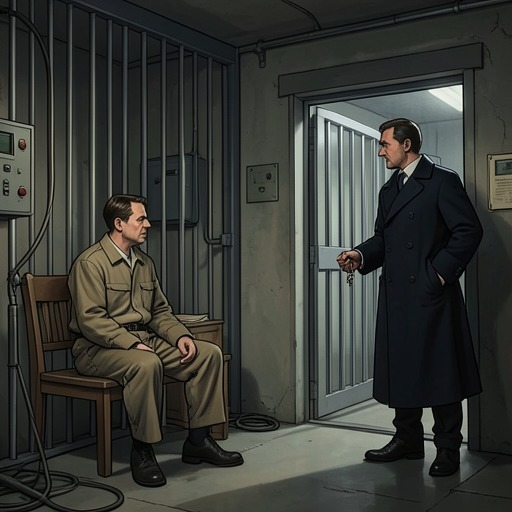
At the prison, Mowry hands the requisition to Commandant Tornik and says that three prisoners are needed for immediate interrogation. Tornik scrutinizes the papers and acknowledges that the requisition is in order, although he also notes that the matter is irregular. The exchange shows the form doing its work at the point where the prison’s rules could obstruct the extraction: Tornik examines the paperwork, but the document provides a basis on which the transaction can proceed.
Tornik then draws up a receipt by copying details from the requisition. This step creates a second record derived from the first. Mowry signs the receipt confidently, and Skriva adds his hurried signature beneath it. The three prisoners wait silently while the paperwork is completed; Gurd is still moping, while the other two are also present. The document has thus moved beyond a deceptive demand: it has generated an official-seeming acknowledgment of the transfer, with signatures attached to the prison’s own copied record.
Significance in the Extraction
The requisition form makes the prison’s administrative routine usable against itself. Its power is neither physical nor independent of the people handling it. It works through a chain: a form taken from the jail’s files, selective erasure and alteration, a presentation to Tornik, and a receipt copied from the altered requisition. At each stage, the operation depends on written records being treated as instruments of authorization and accountability.
The detail that the signature remains intact while the date, name, and number are changed concentrates the deception in the form’s material structure. Mowry cannot duplicate the document, so he preserves the part he judges useful and revises the particulars that define its original request. Tornik’s scrutiny and the receipt he produces show the risk as well as the advantage: the paper is examined, but its official appearance still carries the process forward. In the extraction of Gurd and the two other prisoners, the form is not mere proof after the fact. It is the device that lets a false transfer enter the jail’s ordinary chain of paperwork.