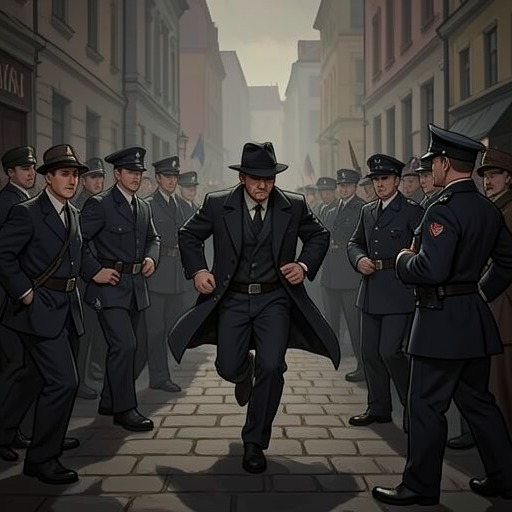
Kaitempi identification card
WaspThe Kaitempi identification card is a Secret Police credential whose authority James Mowry converts into a weapon of disguise. Ornate and formally certified, it announces the bearer’s rank while concealing the bearer’s identity. In a regime where the card alone can frighten civilians into submission, that omission is more than a bureaucratic oddity: it lets Mowry borrow the institution’s power and pass, at least briefly, through the suspicion its symbols ordinarily provoke.
Design and Authority
The card is set in thin plastic and bears signs, seals, and signatures certifying that its bearer holds the rank of major in the Secret Police. Yet it gives no name and no personal description, substituting a code number. Its visual form offers the reassuring weight of official authentication; its missing personal particulars make the credential strangely impersonal. The card establishes what authority the bearer possesses without offering an ordinary way to check who that bearer is.
That arrangement reflects the Kaitempi’s own secrecy. Its members, the narration observes, may be guarded even with one another. For Mowry, this institutional habit creates an opening: a credential that does not identify its holder can be detached from its original owner and used by someone who can convincingly claim the rank. The card’s usefulness therefore comes from the same culture of concealment that gives it prestige.
The credential also belongs to a wider landscape of bureaucratic oversight. William Wolf explains that Terrans are recorded on punched cards, while an order under the War Emergency Powers Act requires organizations and other corporate bodies on Jaimec to register. Those systems classify people and groups through records and official procedure. The Kaitempi card works differently but belongs to the same administrative world: it condenses an institutional identity into a portable, legible object. Its authority is not an argument; it is something Mowry can carry in his wallet.
Acquisition and Deliberation
Mowry obtains the card by searching the body of the officer he calls Pigface, after coveting it since the man had basked in admiration aboard a train. The recovery marks a change in the image of the Wasp. He has previously seemed to be making plenty of noise without demonstrating a sting; now, with the credential in hand, he has secured a practical instrument from the enemy’s own apparatus. The card is not merely a trophy taken from a defeated officer. It is a means of extending the consequences of that defeat into later encounters.
After returning to his apartment, Mowry undresses but does not immediately sleep. He lies in bed, examining the card repeatedly and considering its potential. The pause is significant because possession does not settle the question of use. He weighs whether to keep it, aware that its value is inseparable from the danger of retaining an object taken from a dead officer. His hesitation turns the card into a compact decision: an opportunity powerful enough to invite careful thought, and a trace that may expose him if its recovery becomes known.
Mowry’s deliberation is sharpened by what he understands about the card’s effect on civilians in the Sirian Empire. On any planet held by the Empire, a Kaitempi card is a prime instrument of intimidation; its mere sight is said to make ninety-nine percent of civilians get down on their knees. That extraordinary estimate expresses the reach of the symbol rather than a routine exercise of force. The officer need not explain the state’s power if the credential has already made it visible. Mowry’s card carries that threat with it, even when he is the one relying on it for protection.
Impersonation and Use
The card’s most direct test comes when a Kaitempi agent looks inside Mowry’s open wallet and sees it. The agent’s tough expression disappears, replaced by surprise at finding one of his own officers there. He asks whether Mowry is an officer, then studies him and admits that he does not recognize him. The sequence shows both sides of the card’s authority: it immediately changes the agent’s attitude, yet the absent name and description leave room for a challenge based on personal recognition.
Mowry answers that challenge by performing the confidence the card appears to authorize. He tells the agent that recognition is unlikely because he has arrived that day from headquarters on Diracta, and complains about the reception he has received. Rather than retreating or offering a detailed explanation, he uses an official-sounding origin and an arrogant manner to make the agent’s doubt seem misplaced. The agent apologizes. The credential has not made Mowry truly known to the Kaitempi; it has helped him make uncertainty work in his favor.
The exchange reveals that the card is effective in combination with Mowry’s conduct. Its seals and rank provide an immediate basis for the agent’s deference, but Mowry supplies the missing personal context through an improvised claim of recent arrival. The same omission that might make the card vulnerable to scrutiny thus enables the impersonation: without a printed name or description to contradict him, Mowry can present himself as an unfamiliar officer from another headquarters. The scene makes the deception a joint product of institutional design and individual nerve.
Political Meaning
As a physical object, the card brings together two contrasting forms of power. To ordinary civilians it is a dreaded emblem, carrying the threat of the Secret Police without requiring any further explanation. Within the police itself, it is a credential whose secrecy can leave its holder unrecognized. Mowry exploits the gap between those audiences: the agent respects the office represented by the card, while Mowry supplies a plausible story to bridge the distance between that office and his own face.
Its movement from the dead officer’s body to Mowry’s wallet also reverses the expected direction of authority. The card was designed to certify an agent of the state; in Mowry’s hands, it helps a hostile infiltrator appropriate that certification. The Kaitempi’s secrecy, which helps preserve the institution’s control, also weakens verification when its symbols circulate without personal identifiers. The credential therefore functions not only as a disguise but as a small demonstration of how a system built on fear and classified identity can be manipulated through its own procedures.
The card’s significance lies in this double life. It is a badge of rank, a civilian scare-device, a personal temptation Mowry studies before deciding to retain it, and the prop around which he constructs a convincing encounter with a suspicious agent. Its power does not come from identifying its bearer. It comes from making the bearer’s claim to authority difficult to challenge—and from Mowry’s ability to act as though that claim were already accepted.