Pertane Under Martial Law
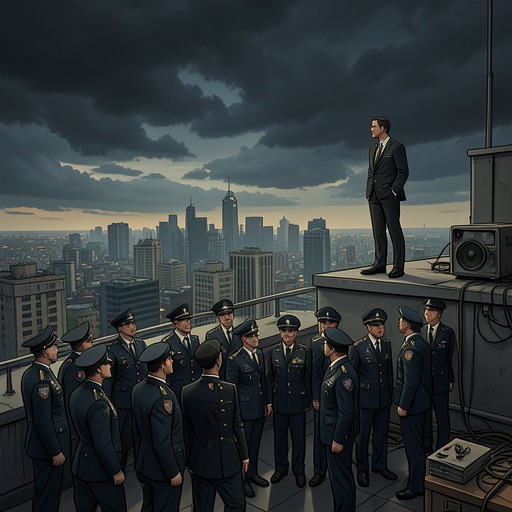
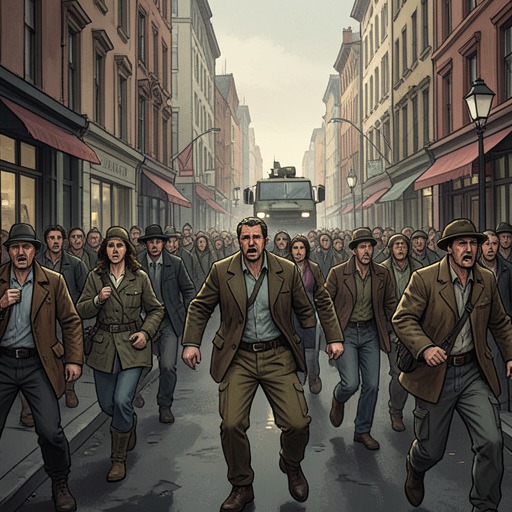
WaspPertane Under Martial Law is presented as both a public emergency and a physical enclosure: the city is placed under a travel ban, its residents are told they will stand firm, and the roads leading out become obstacles for anyone seeking freedom beyond the perimeter. The regime belongs to a wider climate of wartime repression in which legal orders and official accounts cast supposed internal opposition as a threat, with consequences extending from registration and arrest to the threat of death.
Declaration and Legal Context
A newspaper headline announces that Pertane is under martial law, pairs the declaration with a travel ban, and reports the mayor’s insistence that the population will stand firm. Another headline calls for drastic action against Dirac Angestun Gesept. The juxtaposition makes the crisis legible as a struggle over both movement and political allegiance: the city’s residents are not simply asked to remain, but are represented as a population to be held in place while authorities act against an alleged internal enemy.
The surrounding legal campaign includes an order issued under the War Emergency Powers Act by the Jaimec Ministry of Defence. It requires organizations, societies, parties, and other corporate bodies to register; the accompanying passage says that movement will constitute a treacherous offence punishable by death. The text presents this as a countermove against Dirac Angestun Gesept, forcing it toward confession or the metaphorical strangling-post. Yet the organization’s membership is described as unaware of its own status, leaving the government little prospect of recruiting informers from within. The Phantom Army is therefore politically useful as an accusation but difficult to penetrate as an actual network.
The City as a Trap
The restrictions become concrete in the geography around Pertane. Roughly sixty routes radiate from the city’s perimeter, but the principal roads—including the broad, well-used roads to Shugruma and Radine—are expected to be more heavily guarded. The number of routes suggests apparent choice; the disparity in surveillance makes the most obvious choices dangerous. A person trying to leave must seek a less prominent way out rather than trust the main roads.
Mowry cuts through the suburbs toward such a lesser road, about half an hour’s drive from his usual forest entry point. The houses thin out and give way to market gardens before a police cruiser appears. The episode shows how martial law reaches beyond the city centre: the journey out passes through changing terrain, but the search for an unguarded route remains shaped by the possibility of police interception. The state of emergency is thus experienced not only in the headline or decree but in the calculations required to move through the outskirts.
Arrests, Reports, and Uncertainty
The broader atmosphere of emergency is reinforced by the news. A newspaper reports that forty-eight members of the Sirian Freedom Party have been seized by forces of law and order and will be dealt with appropriately. The account offers no reassuring legal process: the forty-eight are described as doomed, and the possibility that their next of kin might not even receive their ashes underscores the severity of the implied punishment. At the same time, the narrative leaves open whether the report is true or an officially concocted lie. Its force lies partly in that uncertainty: readers and residents cannot readily distinguish a real roundup from a story manufactured to justify repression.
That uncertainty resonates with the stated technique of first establishing the existence of an internal opposition, whether real or imaginary, so that the enemy becomes convinced it exists. The text does not establish that every official report is fabricated, but it places state claims, arrests, and the manufactured appearance of organized resistance within the same political field. Under martial law, an accusation can shape events even when its truth remains unsettled.
Political Effect and Significance
Pertane’s martial-law condition joins a legal clampdown to a restriction on escape. Registration rules define organizations through state decree; reports of mass arrests give that threat a public face; and the travel ban converts the city’s perimeter into a test of whether individuals can evade official control. Mowry’s search for a lesser road gives the policy its immediate human consequence without suggesting that every route is sealed: the roads differ in risk, and escape depends on reading that difference.
The state of emergency also sharpens the novel’s contrast between an actual membership and an opposition produced in the public imagination. The Phantom Army cannot readily supply informers because its supposed members do not know their status, yet the government can still act against named organizations and publish accounts of seized traitors. Martial law therefore operates not only through barriers and patrols but through the power to declare who counts as an enemy—and to make that declaration dangerous before its truth is known.