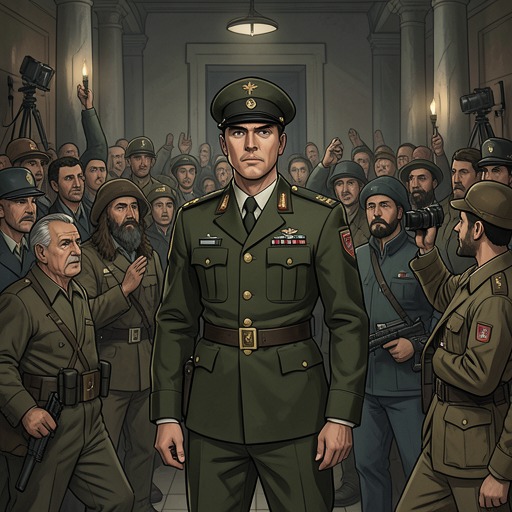
Terran military control of Jaimec
WaspTerran military control of Jaimec is presented less as a single formal declaration than as a shift made tangible by overwhelming force, administrative procedure, and the rapid growth of a guarded prisoner-of-war compound. The arrival of four thousand Terran ships changes the scale of power in the sky; on the ground, military authority is encountered through permits, paperwork, confinement, and the uncertain claims of people who expect the conquerors to reward them.
Arrival and the Visible Transfer of Power
The clearest image of Terran control is also its largest. Mowry stands in an empty road as the stars disappear beneath the passage of fleets described as thrice wrecked and ten times decimated, yet still four thousand strong. Their thunder overhead turns the arrival of Terran force into a spectacle of survival after catastrophic losses. The number matters: these are not a handful of scouts or a token presence, but a fleet vast enough to blot out the sky.
Below that spectacle, Mowry dances in the road, shouting and screaming upward. The contrast between the fleets’ immense movement and one man’s unrestrained response gives the transfer of power a personal scale without making it an orderly ceremony. Jaimec’s new military condition is registered through what can be seen and heard: the sky occupied by ships, the road momentarily empty, and a man reacting to the arrival. The scene establishes Terran dominance as a material fact before the account turns to the institutions and people caught within it.
Paperwork, Permits, and Administrative Authority
The novel places military power alongside rules that make authority legible in documents. Under the War Emergency Powers Act, an order from the Jaimec Ministry of Defence requires organizations, societies, parties, and other corporate bodies to register. The measure identifies groups as objects of official recordkeeping; it is not simply a military presence in the streets, but a state effort to make collective life administratively visible.
Other encounters show how paperwork can both obstruct and enable action. When Mowry presents requisition papers, Tornik scrutinizes them and calls the transaction irregular, but accepts that the requisition form itself is in order. Tornik then prepares a receipt by copying details from it. The exchange turns on the distinction between a document that appears valid and a procedure that is not quite regular: official business proceeds through forms even as uncertainty persists about what the rules require.
At a road checkpoint, a sergeant asks Mowry for an exit permit. Mowry replies that he does not need one, speaking with the authority of a four-star general and opening his wallet. The scene shows control at its most immediate—a question posed by an armed official to someone seeking passage—and the possibility that performed rank can challenge a checkpoint’s routine. The excerpt does not establish the outcome of this encounter; its significance lies in the test of authority itself.
The Prisoner Compound and the New Order
Military control also appears in the experience of captivity. Mowry spends twelve days moving around a prisoner-of-war compound that is already very large, very full, and becoming fuller. Its conditions are described in spare, institutional terms: prisoners are fed regularly and guarded constantly, and little else is said to happen. The pairing of provision and surveillance defines the camp’s basic order. Food is supplied, movement is bounded, and the prisoners remain under watch.
The compound’s rapid increase in population gives the arrival of Terran power a continuing consequence beyond the fleet overhead. The new military presence is not only an image of ships passing above Jaimec; it also reorganizes lives on the ground through enclosure. Mowry’s twelve days in the camp make that change a lived interval, while the account’s compressed description of feeding and guarding emphasizes how narrow life there has become.
Collaborators, Claims, and Unsettled Authority
Among the prisoners, at least fifty men boast that they have long been secret leaders of Dirac Angestun Gesept. They expect the Terran conquerors to sort the worthy from the unworthy, raise them to power, reward their friends, and punish their enemies. Their confidence is evidence of how quickly military victory invites competing claims to legitimacy. They present themselves not as ordinary captives but as concealed political actors whose past service should determine their future position.
That expectation is not confirmed by any grant of office or reward. Instead, the boasting stops after three of the men are strangled in their sleep. The account gives no perpetrator or motive, so the deaths do not resolve who truly holds authority within the compound. They puncture the prisoners’ confident forecast without explaining the violence. Terran control thus appears alongside a less settled human order: the conquerors possess overwhelming force, but the prisoners’ rival claims and unexplained deaths leave the camp’s internal relations clouded.
The Reach and Limits of Control
The scattered scenes distinguish control as a combination of scale and procedure. Four thousand ships make Terran strength visible; a registration order, requisition receipt, or demand for an exit permit brings authority down to the level of organizations, documents, and individual movement. These details do not amount to a complete account of Jaimec’s post-arrival administration, but together they show the forms through which power is asserted and encountered.
A parallel glimpse of Terran recordkeeping sharpens that emphasis without proving that the systems are identical. William Wolf says there is a punched card for every Terran in existence and treats the scrutiny as part of the price of survival. The detail presents comprehensive records as a feature of Terran institutional life; set beside Jaimec’s registration order and the paperwork scenes, it makes bureaucracy a recurring instrument of governance rather than a neutral backdrop. Yet the checkpoint exchange and the irregular requisition also show that procedure can be negotiated, simulated, or exploited. Military control is overwhelming in the sky and durable in the camp, but its everyday operation still passes through rules and people whose authority can be tested.