Sirian Empire secret-justice policy
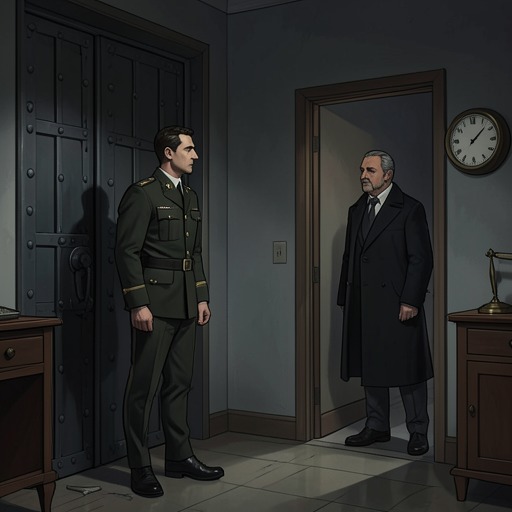
WaspThe Sirian Empire secret-justice policy is a system in which suspicion can lead to disappearance without a public hearing, stated charge, or reliable account of what follows. Its defining feature is not simply harsh punishment but the removal of legal proceedings from public view: across the Sirian Empire, there are no judges and juries conducting public trials. The passage’s blunt alternatives for the arrested—release in a weakened condition or no trace at all—make secrecy itself an instrument of rule.
Definition and Scope
The narrative describes the policy as normal within a society governed by a secret judicial system. A suspect may be taken from the street and never seen again. The account gives no public process by which the suspicion is tested, no court appearance through which a charge becomes known, and no judgment available for observers to assess. It is explicit about the absence of judges and juries holding public trials anywhere in the Sirian Empire, but does not specify the internal procedures, officials, or rules that replace them. The distinction matters: the evidence establishes the system’s secrecy and consequences, not a detailed account of its hidden machinery.
That secrecy leaves the arrested person’s fate radically uncertain. If fortunate, the person is eventually released physically enfeebled, without apology or compensation. If unfortunate, the person’s next of kin do not receive so much as a jar containing the ashes. These outcomes are presented as the range of possibilities under the system, not as a predictable sentence or a transparent progression from arrest to punishment. Release does not restore the person’s strength or provide redress; disappearance denies even the family the certainty and material trace that a death might otherwise leave.
Secrecy and Administrative Control
The policy sits within a wider setting of official scrutiny and formal controls. In a separate conversation, William Wolf describes the need to know about people as part of the price of survival and says that a punched card exists for every Terran. That exchange concerns Terran record-keeping, not the workings of Sirian justice, but it gives the novel a useful contrast: one form of state knowledge is represented by an extensive, legible file system, while the Sirian policy is characterized by what cannot be publicly known about a suspect’s case or fate.
On Jaimec, another form of official control appears in the Defence Ministry’s order under the War Emergency Powers Act requiring organizations and other corporate bodies to register. The order is a visible administrative command directed at organizations; the secret-justice policy, by contrast, leaves the treatment of individuals beyond public scrutiny. The text does not say that registration and secret justice are the same measure. Set alongside one another, however, they show how the novel places public rules, documentary procedures, and unaccountable coercion within the same wartime political landscape.
The plot also depicts how paper procedures can become points of encounter with authority. During a prison extraction, James Mowry presents a requisition form that is described as in order, and an official prepares a receipt by copying its details. At a road checkpoint, a sergeant asks Mowry for an exit permit; Mowry answers that he does not need one, speaking with the authority of a four-star general. These episodes are not accounts of a secret trial, and they do not establish how the justice system handles a particular prisoner. They do show a surrounding apparatus in which forms and permits matter—and in which Mowry can exploit official expectations to move through it.
Consequences for Suspects and Families
The policy’s consequences extend beyond the person seized. Because an arrest may end in permanent disappearance, relatives cannot rely on a public proceeding to establish what happened or on the return of remains to confirm a death. The passage makes that deprivation concrete through its reference to the jar of ashes: the missing object measures how completely the state can withhold even the most basic confirmation from a family. The threat therefore reaches into private life without requiring a public sentence or an announced execution.
The alternative of eventual release does not amount to a meaningful safeguard. The released person is described as physically enfeebled and receives neither an apology nor compensation. The text does not explain how long detention lasts or what causes one person to be released and another to vanish. It does make clear that survival alone does not correct the injury, and that there is no stated public remedy for it. In this system, the uncertainty surrounding arrest is joined to the absence of recognized redress.
Narrative Significance
The policy is introduced through a general account of how the Sirian system works rather than through a public trial or a named judgment. That framing makes opacity part of the reader’s understanding of power: officials can announce that people have been dealt with while withholding names, charges, and details, and the surrounding society has no public court record to resolve the silence. The narrative describes such missing information not as an exception requiring explanation, but as a familiar condition of life under the Empire.
This background sharpens the contrast between visible bureaucracy and hidden coercion. Registration orders, requisitions, receipts, and permits give authority a paper face; the secret-justice policy marks the point at which a person may disappear beyond public accounting. Mowry’s ability to pass through checkpoints by manipulating official procedure does not undo that system. Instead, the contrast underscores how the plot’s acts of evasion depend on navigating controls whose consequences for ordinary suspects are far less recoverable.