Snap-searches
WaspSnap-searches are a method of sudden, collective street policing on Jaimec: uniformed police seal off an area with lines of officers and search the people caught within it. The tactic nearly traps Mowry on his way to a rendezvous, recurs as he moves through the city, and becomes more threatening once the authorities have a description of him. Its force lies not only in the frisk itself but in the uncertainty of when and where the next cordon will appear.
Definition and Political Setting
The novel presents the snap-search as a countermove by Jaimec’s authorities, distinct from the new administrative measure appearing in the same period. Under the War Emergency Powers Act, an order from the Jaimec Ministry of Defence requires organizations, societies, parties, and other corporate bodies to register. The snap-searches extend pressure from the regulation of organized groups into the streets, where police can stop and search people without Mowry knowing in advance what place or moment is at risk. The text does not establish that the registration order legally authorizes the searches; it places both measures within a widening climate of official intervention.
The narration describes the technique as dangerous precisely because its next application cannot be predicted. Mowry cannot know where the next blow will fall, and the uncertainty deprives him of a dependable route through the city. A search might be aimed at finding subversive propaganda carried on a person; Mowry also considers whether the authorities could be looking for a dynocar renter named Shir Agavan. Neither possibility is confirmed. That unresolved purpose matters: the police action is legible as a threat even when its immediate target remains obscure.
How the Cordon Works
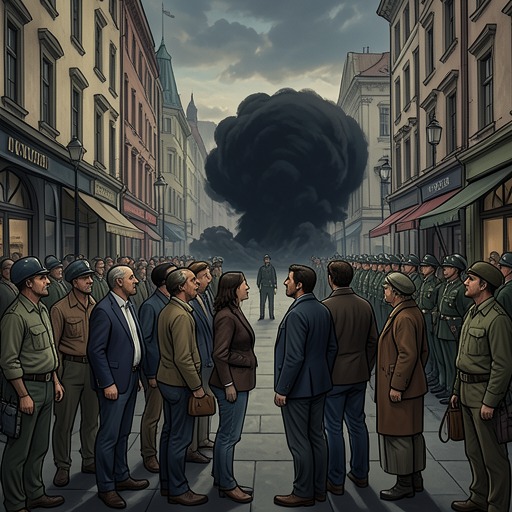
Mowry encounters the tactic while heading for a rendezvous. A line of uniformed police suddenly stretches across the street, while a second line forms four hundred yards farther on. The placement turns a stretch of ordinary city space into a trap, enclosing the area between the two barriers rather than merely stopping one visible suspect. Within it, the police keep their attention directed inward, watching to prevent anyone from ducking into a doorway and running through a house to escape the mass-frisk.
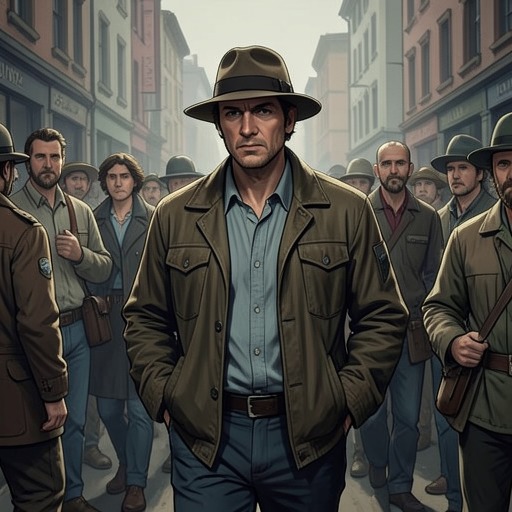
The first search almost catches Mowry. He is outside the trap, is being ignored, and fades into the background rather than drawing attention to himself. His escape depends on his position relative to the cordon and on the officers’ failure to single him out—not on knowing what the search is for or having a reliable way to defeat it. He continues through the streets with the uneasy impression that the hunt has at last picked up his scent. At Cafe Susun he reaches the rendezvous and finds Butin Arhava and two others, but reaching them does not make the tactic less threatening: the police have already demonstrated how quickly movement can be enclosed.
Repetition and Escalation
The searches recur. On another occasion, police stand across the street a hundred yards away, while a second line watches from the opposite direction with equal indifference. The narration identifies this as another random trap sprung. The measured distance and the second line make clear that the danger is not confined to one checkpoint or one confrontation. For Mowry, each appearance of the cordon renews the practical problem of deciding whether a street remains passable.
The threat sharpens after a Kaitempi agent can be relied upon to recognize Mowry on sight. He expects innumerable eyes to watch for anyone resembling him and anticipates that the snap-search technique will be intensified, spread wider, and used more frequently. This is an expectation within Mowry’s assessment, not confirmation that every predicted expansion occurs. Even so, it changes the meaning of the searches: an indiscriminate dragnet that once threatened him by chance may now become a more effective means of finding a known fugitive. He concludes that he will have to carry incriminating-looking material during the day, a grim indication of how the tactic distorts even the objects he must choose to carry.
Function and Significance
Snap-searches make state power visible as a sudden arrangement of bodies and blocked streets. The police need not explain their purpose to those caught in the enclosure; the lines themselves impose the immediate choices of submission, concealment, or attempted escape. Because the officers watch for anyone slipping into a doorway, even a building entrance becomes part of the search’s perimeter. The procedure reaches beyond the moment of frisk by making ordinary movement feel exposed to interception.
The tactic also changes the rhythm of Mowry’s flight. He must reach appointments and move through Jaimec without knowing where a cordon will appear, and the recurrence of the searches turns successful passage into temporary luck rather than proof of safety. As the authorities acquire a description of him, that uncertainty acquires a sharper personal edge. The snap-search is therefore both a police method and a narrative mechanism: it converts open streets into unstable terrain, repeatedly testing whether Mowry can remain unnoticed in a city increasingly arranged to catch him.