Nutrient processor
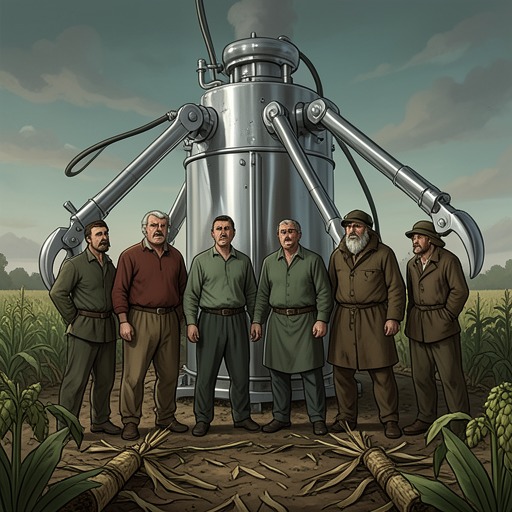
WatchmenThe Nutrient processor is the Terran Empire’s industrial answer to Shinar’s worsening food and population problem, but its installation becomes the immediate material trigger for the Shinar Rebellion. By replacing cultivated farmland with factories that manufacture synthetic foodstuffs, it joins technological necessity to imperial coercion: a device intended to preserve Shinar’s future is experienced by farmers as the destruction of their present.
Definition and Operation
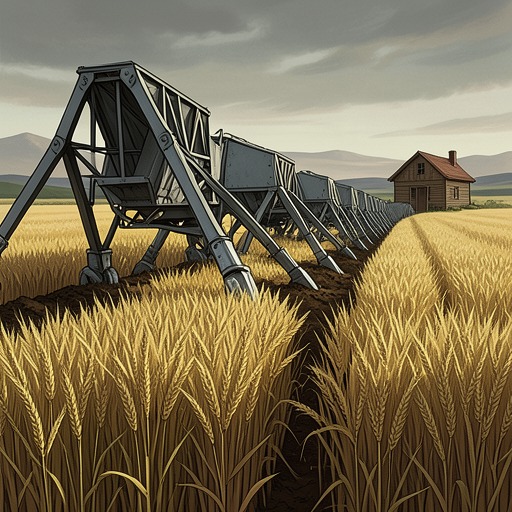
The Nutrient processor is a Terran factory system that produces artificial protein rather than relying on ordinary agriculture. Its method is described as extracting elements directly from soil and air, then converting them into synthetic foodstuffs through the addition of chemicals and enzymes. To Merdon, this process represented an intolerable acceleration of production: it displaced the accumulated knowledge of planting, growing, and harvesting with an industrial procedure designed for speed and yield.
The device therefore embodies a sharp contrast between two food systems. Traditional farming depends on land, seasons, and inherited agricultural practice; the Nutrient processor treats soil and air as sources of convertible inputs. Its stated advantage is not merely convenience but scale. The Terran governor’s proclamation claimed that the processing plants would multiply Shinar’s food output many times over and allow the planet to reopen trade with neighboring worlds. The technology’s potential was consequently planetary and economic, not limited to the factories themselves.
Demographic and Economic Context
The processors are introduced against a long crisis produced by Shinar’s changing population. Under the Masters, Shinar’s population had been held at approximately 500 million, and the planet fed itself as well as the worlds within fifteen light-years of it. After the Terrans defeated the Masters and liberated Shinar, that equilibrium disappeared. Population growth first proceeded slowly and then accelerated explosively: when Clanthas was Merdon’s age, Shinar had two billion inhabitants; by the time of the rebellion, it had three billion.
This growth placed pressure on both food security and trade. Shinar was not yet unable to feed itself, but it had to consume practically everything it produced, leaving almost nothing for export. Its commerce with surrounding worlds was dying, and the planet was becoming bankrupt. From the imperial perspective, the decline also threatened neighboring worlds that had once depended on Shinar’s agricultural surplus. The Nutrient processor was thus presented as compensation for a real material constraint: greater output could feed the enlarged population while restoring the exports on which regional economic relations depended.
Yet the technological response did not address the political meaning of the crisis. The people already resented the Empire because population growth had left them overcrowded and impoverished under Terran rule. The factories did not create that resentment; they gave it a visible object. Their construction made the abstract pressures of demography, trade, and imperial administration concrete in the form of farms taken from their owners.
Introduction and Political Backlash
The first farmers began arriving in Katan about a year before the major rebellion, reporting that Terran authorities had driven them from their own soil so that factories producing synthetic foodstuffs could be built. Clanthas, whose business depended on buying and selling farm produce, appealed to the Terran governor. He was told that the Nutrient processors were necessary, even vital, but the official assurance did not resolve the farmers’ immediate loss of land or the absence of trust between the population and the occupying power.
Instead of quietly accepting the change, Clanthas organized the farmers and held a demonstration in Katan. He arranged similar demonstrations in Shinar’s major cities. The larger protests repeatedly developed into riots; troops were summoned, shots were fired, and unarmed civilians were killed. As tempers rose, violent men acted, the Terran governor was murdered, the Imperial Marines arrived, and Komani warriors landed on the planet. The processors therefore stand at the point where an economic intervention becomes a chain of political violence.
The failure was also communicative. The Terrans issued a proclamation explaining the plants’ purpose, but made little effort to explain the transformation to the farmers themselves. What officials described as a necessary increase in food production was understood by those affected as forced removal from ancestral work and land. The technology’s relative advantage could not overcome its lack of compatibility with the farmers’ way of life, and its complexity remained politically opaque because the people who were expected to bear the cost were not persuaded that they would share the benefit.
Conflicting Interpretations
Clanthas and Merdon represent opposing readings of the Nutrient processor and the rebellion surrounding it. Clanthas recognizes the food problem but resists the notion that an urgent solution is therefore desirable in every form. His position gives priority to social continuity, consent, and the dignity of people whose whole way of living cannot be changed overnight. Merdon, by contrast, sees the factory as evidence of Terran domination and regards force as the only effective answer to imperial power. His disgust at the machines expresses rejection of a system that seems to make human cultivation obsolete.
The disagreement does not divide simple knowledge from simple ignorance. Clanthas understands that Shinar’s population has grown beyond the old equilibrium, while the Terran argument identifies a genuine need to increase food output. The conflict lies in who controls the remedy, who must surrender land for it, and whether efficiency can justify coercion. The Nutrient processor becomes politically explosive because it is simultaneously a practical response to scarcity, an instrument of industrial relocation, and a symbol of the Empire’s confidence that Shinar can be reorganized from above.
Narrative and Historical Significance
Within the story, the Nutrient processor converts a slow structural crisis into an immediate revolutionary encounter. Population growth, declining exports, overcrowding, and impoverishment develop over time, but the factories supply a concrete cause that farmers can see and resist. Their presence turns economic decline into displacement, displacement into demonstrations, and demonstrations into killings, assassination, imperial intervention, and the arrival of an external armed power.
The object also exposes the limits of technological solutions under colonial rule. The processors may have been capable of multiplying food production, yet their introduction worsened the political conditions in which that capacity had to operate. They could not be separated from the Terran garrison system, the governor’s authority, or the forced conversion of farmland into industrial sites. Their importance is consequently double-edged: they are the proposed means by which Shinar might escape hunger and bankruptcy, and the immediate sign through which Shinar experiences imperial control.
The Nutrient processor’s deepest significance is therefore not that it is ineffective. The evidence suggests the opposite: it may have been materially effective, even necessary. Its failure is social and political. By treating a population’s land, labor, and inherited practices as obstacles to be rapidly redesigned, the Empire turns a technology of abundance into an emblem of dispossession. The rebellion begins not because Shinar lacks a possible solution, but because the solution arrives without sufficient explanation, consent, or regard for the people required to live with its consequences.