Dueling machine
WatchmenThe Dueling machine is the central technological paradox of the novel: a device designed to make violence harmless, yet powerful enough to reshape law, psychology, warfare, and personal identity. By amplifying thought into a shared dream, it lets opponents fight out hostility without ordinary physical injury, but its later failures and breakthroughs reveal that the machine does not merely contain aggression. It also mediates responsibility, exposes personality, and can connect minds with consequences no designer fully controls.
Origin and Intended Purpose
The machine emerged from Dr. Leoh’s crisis of conscience. After recognizing that his earlier work had contributed to mounting tensions and conflicts across civilized space, Leoh left physics and electronics rather than retiring. He entered psychology as a beginner, became a student, researcher, and professor of psychophysiology, and sought a way to restore balance to what he understood as humanity’s collective mentality.
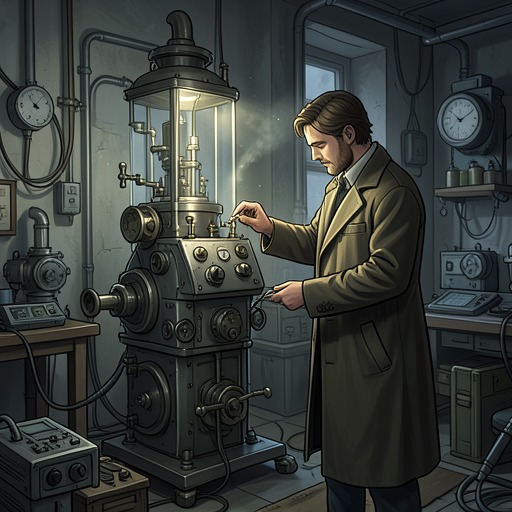
His solution combined an electroencephalograph with an autocomputer. The resulting psychonic device, also called a dream machine, amplified a person’s imagination until the user could inhabit a world created by the mind. Leoh intended this capacity to discharge hostility and tension safely. Psychiatrists and psychotechnicians used the machines with patients, but Leoh pursued a broader social application: if mental pressure could be released before it became disorder or violence, the device might prevent conflict rather than merely treat its aftermath.
Operation and Social Function
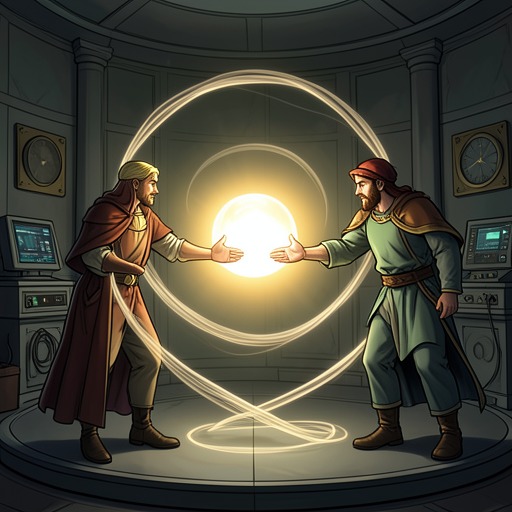
The Dueling machine allowed two people with a serious disagreement to enter an imagined contest instead of proceeding directly to court. Inside the shared mental environment, each participant could fight as violently as desired without physically harming either combatant or anyone outside the machine. The duel therefore transformed aggression into a controlled procedure, while preserving the participants’ sense that they had actively confronted the dispute rather than passively submitting it to legal bureaucracy.
On most civilized worlds, properly monitored results were accepted as legally binding. The machine was thus more than a private therapeutic appliance: it became an institutional intermediary linking imagination to law. Its authority depended on supervision, rules, medical monitoring, and public confidence that the apparent violence remained confined to the artificial environment. The device redistributed power among disputants, doctors, technicians, courts, and governments that installed it as a preventive instrument.
Its setting underlined both its prestige and its clinical character. In Acquatainia, the capital planet of the Acquataine Cluster, the machine stood within the Cluster’s oldest university, in an antiseptic-white chamber containing bulky consoles and power conditioners. The Cluster itself comprised roughly three hundred stars and more than a thousand inhabited planets, making the machine’s location at once local and politically consequential: a technological procedure developed in one university could influence legal and social practice across a large interstellar region.
Experimental Use and the Discovery of Personality
Dr. Leoh later tested the machine by operating it in actual mental combat with Hector H. Hector. The project began as a systematic effort to push the machine to the limits of its performance. During their first stage, the two men played hide-and-seek, choosing environments and attempting to locate one another in jungles, cities, glaciers, and interplanetary voids while remaining inside the booths.
Once Leoh was satisfied that the machine reproduced and amplified thought patterns faithfully, they began light duels. They fenced with blunted foils, then used pistols, sonic beams, and grenades while imagining protective equipment. The machine did not improve either participant’s knowledge or physical ability; it projected those existing capacities into a shared dream. Hector possessed superior training and faster reflexes, yet Leoh won most of their direct bouts. This contrast led Leoh to conclude that the machine projected more than thoughts: it projected personality.
The experiment became physically and psychologically demanding. Leoh and Hector worked in the booths for twelve or more hours a day, driving themselves and the regular Acquatainian staff toward exhaustion. They ate hurriedly between duels, grew physically ragged and irritable, and often fell asleep in Leoh’s office while discussing the day’s results. The machine therefore functioned as an experimental partner rather than a passive instrument: its responses compelled new interpretations, and the labor of interpreting them altered the investigators’ understanding of human conflict.
Safeguards, Failure, and Expansion of Possibility
The machine’s apparent safety was challenged by Major Par Odal, who had actually killed people through it. In response, Leoh added three safeguards. A psychonic isolation circuit prevented a duelist from contacting the outside world while the machine was operating. A second circuit recorded and monitored the entire duel so that the chief meditech could review the record if either participant requested an investigation into rule violations. A third system connected the medical monitoring equipment to an automatic override, stopping the duel at the first sign of actual medical danger.
These measures made the machine more accountable without making it absolutely safe. Leoh acknowledged that no mechanism could protect people from every external catastrophe, such as an earthquake, or guarantee that a sudden medical crisis could never become fatal. The exchange also clarifies the machine’s ethical problem: safety is not a natural property of the technology but an ongoing institutional achievement involving isolation, surveillance, medical expertise, and enforceable rules.
The device eventually became a platform for psychonic teleportation. Hector first practiced by moving from one booth to another. On the first day he completed the jump twelve times; Leoh measured an average transit time of four picoseconds and found that the energy drain was approximately equivalent to that of a starship’s drive engines pushing a mass equal to Hector’s weight. The machine had moved beyond staging imaginary combat. It now provided a measurable channel through which a human body could cross space.
Catastrophic Mind Fusion
The most extreme consequence came when Hector and Major Par Odal became connected through the machine. Odal was in the Acquatainian Dueling machine, thinking about Geri Dulaq, when he instantaneously became aware that he was in Kerak and that Hector was in the machine with him. Because the machine had amplified and cross-linked their open minds, the two consciousnesses fused inescapably. Their bodies reacted as though subjected to an enormous electrical discharge, with every nerve and muscle arching under the shock.
This event exposes the machine’s deepest danger. The same amplification that makes a harmless shared duel possible can erase the boundary between participants when the system’s psychonic connections exceed their intended scope. The Dueling machine no longer mediates a contest between separate individuals; it creates an involuntary composite of two minds. Its ultimate threat is therefore not simply death or physical malfunction, but the dissolution of the distinction on which consent, responsibility, and legal judgment depend.
The machine’s history also throws the novel’s wider conflicts into sharper relief. Imperial negotiations, prisoner claims, religious shelter, and Star Watch authority all depend on competing rules and institutions; the machine offers a technological alternative to those conflicts by relocating them into a controlled mental arena. Yet the machine’s own accidents show that no technical procedure escapes politics or moral responsibility. It can restrain violence, make aggression legally actionable, reveal hidden dispositions, and enable unprecedented movement, but it can also become the instrument through which human boundaries fail.