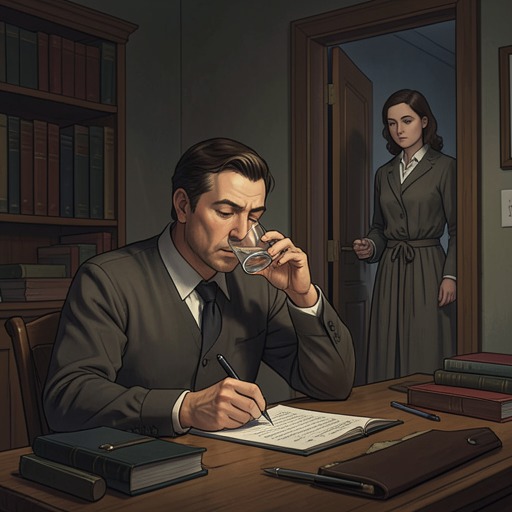
“If you want to drink, drink; if you want to fuck, throw the bottle away”
Women“If you want to drink, drink; if you want to fuck, throw the bottle away” is Lydia Vance’s practical, sharply divided rule for choosing between alcohol and sexual intimacy. Its force comes from the choice it demands: Henry Chinaski repeatedly treats drinking and sex as simultaneous comforts, while Lydia’s maxim insists that one must be set aside for the other.
The Rule and Its Occasion
The maxim returns to Chinaski after a night with Cassie. In the morning, the two are quiet as they drive back to The Lancer; he thanks her, kisses her on the cheek, and leaves her without an answer. He recalls Lydia’s formulation, then names the conflict it exposes: his problem is that he wants to do both. The rule thus serves less as a successful guide than as a concise statement of the appetite he cannot resolve.
Drinking as Habit and Response
The surrounding episodes show why the choice is difficult. While trying to write his first novel, Chinaski drinks whiskey and beer nightly, types until dawn, and sets himself a ten-page goal; the next morning, he checks what he has produced after vomiting. Drinking is woven into his routine of writing, not confined to moments of celebration or crisis.
He also describes alcohol as a response to every circumstance: when something bad happens, he drinks to forget; when something good happens, he drinks to celebrate; when nothing happens, he drinks to make something happen. That circular logic makes the maxim’s demand for a choice especially pointed. Alcohol is not simply one pleasure beside another; it is a recurring answer to distress, success, and emptiness alike.
Intimacy, Conflict, and Consequences
The relationship with Lydia makes the rule more than an abstract aphorism. After an argument, Chinaski writes her a four-page letter, signs it in blood, and mails it; later, a struggle over a bottle ends with it breaking during a fall. Lydia drives away, while Chinaski remains focused on obtaining the drink that is left and then buying another pint when the liquor store opens. The scene exposes the persistence of drinking even amid conflict and separation.
Alcohol also affects Chinaski’s physical condition and public work. He travels to Houston with a heavily bandaged leg and is taking antibiotics for an infection; his doctor warns that drinking would cancel their benefit. At the reading, he appears sober, and when someone asks why, he answers that Henry Chinaski could not make it and that he is his brother Efram. The episode briefly presents abstinence as necessary, while turning that necessity into a performance.
Meaning and Limits
The maxim offers a compact measure of Chinaski’s divided impulses, but the surrounding evidence does not show him consistently following it. His own summary after the Cassie encounter makes the gap plain: he wants both drinking and sex, even when the rule frames them as alternatives. Its significance lies in that contrast between lucid phrasing and repeated behavior. The sentence can name the choice; it cannot make the choice for him.