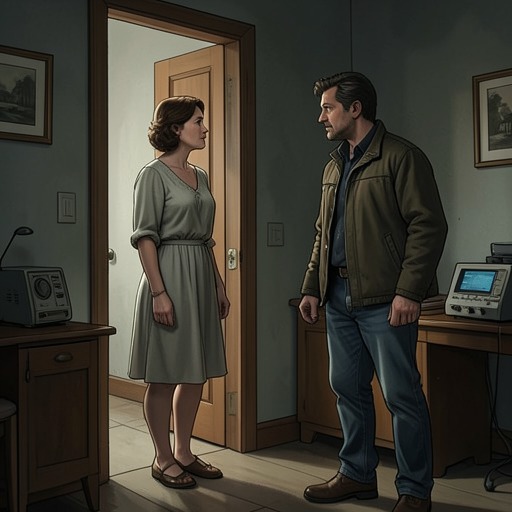
New Year's Eve
WomenNew Year’s Eve functions in the narrative as a charged annual ritual: a night publicly devoted to celebration that Henry Chinaski experiences through memories of family revelry, distaste for compulsory cheer, and the precarious companionship of Sara. In the particular New Year’s Eve recounted here, an unexpected musical visit interrupts the couple’s drinking, and the holiday ends with a renewed private closeness between them. The episode balances the familiar spectacle of collective celebration against an intimate relationship whose future remains uncertain.
The Holiday as Repetition
Chinaski recalls his parents welcoming the new year by following its arrival on the radio, city by city, until it reached Los Angeles. The memory expands into a catalogue of holiday excess: firecrackers, whistles, horns, intoxicated revelers, flirtation, and midnight kissing, followed by family arguments and the Tournament of Roses Parade and Rose Bowl game. The sequence presents the holiday not as a quiet threshold but as a noisy social performance whose pleasures carry their own aftermath.
That inherited picture sharpens Chinaski’s dislike of being wished a happy new year by a stranger on television. His deliberately extreme example of what the broadcaster could not know about a viewer exposes the distance between a stock greeting and the private realities hidden behind it. The holiday’s universal good wishes therefore arrive with a comic, darkly skeptical edge: celebration is assumed, but no stranger can know what another person’s life contains.
Sara and the Evening’s Mood
Sara arrives early, and Chinaski notices the contrast between her enthusiasms and her practical judgment. She is excited by Magic Mountain, outer-space films, Star Trek, certain rock bands, creamed spinach, and pure food, yet he regards her as possessing better basic common sense than any woman he has known. He also considers her more attractive and more faithful than his other current partners, which briefly makes the coming year seem less bleak.
The couple begin celebrating and drinking, but Chinaski remarks that getting drunk is difficult when half the world is trying to do the same. Their exchange turns the holiday’s mass participation into a small private joke. Sara answers his boast that nobody murdered him during the year by pointing to the routine that has survived: he still drinks every night and gets up at noon. His hope of lasting another year, and her description of him as an old alcoholic bull, leave the moment affectionate but unsentimental. Their companionship takes place within, rather than outside, his established drinking pattern.
The Unexpected Visit
A knock brings an unplanned change in the evening. Dinky Summers, a folk-rock musician, arrives with his girlfriend Janis, and Chinaski greets him enthusiastically. Dinky explains that they have simply decided to drop by. Their arrival shifts the occasion from a private holiday between Chinaski and Sara to a gathering whose duration and shape are determined by music.
Dinky sings all his songs, with rests between them, and the performance lasts through the arrival of the new year. Chinaski, Sara, Dinky, and Janis are still together at midnight. The guitar case is at last closed, and the narrator’s phrase about a hung jury leaves the musical visit suspended between endurance and verdict: the songs have occupied the celebration, but the account does not turn their presence into an uncomplicated triumph. Dinky and Janis depart at about one in the morning.
Midnight and Private Reconnection
After the guests leave, Chinaski and Sara go to bed and begin hugging and kissing. The narrative marks kissing as unusually important to him; he regards genuinely satisfying kisses as rare and poorly represented in films and on television. Sara responds with a freedom he says has characterized their intimacy before, and the account moves from kissing toward sexual contact. The shift is significant less as a resolution than as a return: after the noise of the holiday and the prolonged performance, the couple find their way back to one another in private.
The scene also places Sara’s religious restraint in the background. Chinaski frames their intimacy in relation to Drayer Baba, whose influence Sara understands as forbidding sex before marriage; the New Year’s Eve encounter thus belongs to a pattern in which desire and that prohibition coexist. The holiday does not settle their relationship or erase its tensions. Instead, it closes on a moment of renewed closeness, set against the annual passage of time and Chinaski’s joking uncertainty about whether he can simply hold out another year.