Christmas Eve
WomenChristmas Eve is an uneasy domestic occasion for Henry and Sara: an attempt to make the holiday cheerful gives way to Sara’s anger and distress after a visitor arrives. The evening’s shift from decorations and family calls to jealousy shows how little the rituals of celebration protect their relationship from conflict.
The holiday at home
Henry is reluctant to look for a Christmas tree, explaining that Christmas has long been unhappy for him because of his childhood. When the couple finds the tree lots empty, he is not troubled by the failure to find one, but Sara is unhappy on the drive back. Once home, a few glasses of white wine lift her spirits, and she hangs ornaments, lights, and tinsel around the room, with some of the tinsel ending up in Henry’s hair.
The preparations do not make the evening feel conventionally festive to Henry. He recalls reading that suicide occurs more often on Christmas Eve and Christmas Day than at any other time, and doubts the holiday’s connection to the birth of Christ. He and Sara find the radio music and television unpleasant and turn them off. Sara phones her mother in Maine, and Henry speaks with his own mother, whom he judges not to be so bad. The quiet, imperfect family contact offers a brief alternative to the holiday’s public cheer.
An unexpected visitor
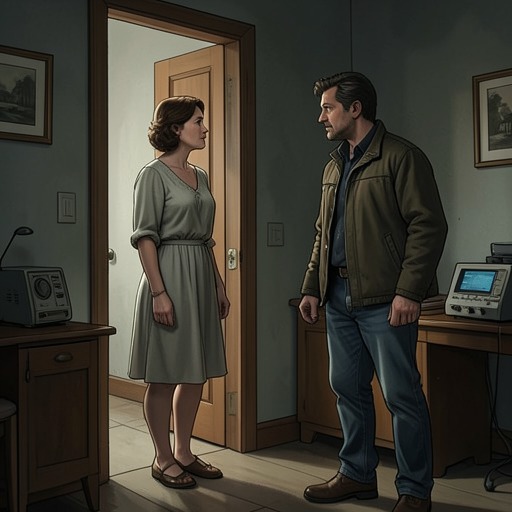
Thirty or forty minutes after a conversation about having too many or too few, someone knocks at the door. Sara answers, and a woman whom Henry does not recognize enters, dressed in a tight black outfit. She greets him as Hank, making clear that she knows him, while he initially does not know who she is. She says she was looking for Bobby and thought he might be there; Henry invites her to sit and have a drink.
The visitor, Edie, sits close to Henry, smokes, and talks with him. Her presence catches and holds his attention: he watches her as she leans forward and admits to himself that he is unsure how he might react if her outfit shifted. He says that he had usually been more attracted to women’s legs, but that Edie knew how to command attention. She also asks whether he had met Manny at Bobby’s, placing the encounter within a network of acquaintances rather than presenting it as a planned visit between the two of them.
Conversation and departure
Edie tells Henry about losing another job. In her account, a man who had a wife pursued her, offered money, and rushed at her; she resisted and was dismissed from the job. Henry responds that it is a sad story. The conversation therefore includes a report of unwanted advances and their employment consequence, even as Henry’s attention to Edie has already become a source of tension in the room.
Edie ends the visit by saying she has to go, wishing them a merry Christmas, and thanking them for the drinks. Henry walks her to the door and returns to sit down. Her departure does not settle the evening: Sara immediately calls him a son of a bitch, and accuses him of having slept with Edie had Sara not been present. Henry does not affirm or deny what would have happened; he says he cannot know.
The rupture in the evening
After Henry’s uncertain answer, Sara stands and screams, begins to sob, and runs into the other room. Henry pours himself a drink while colored lights blink on and off on the walls. The decorations that had marked Sara’s renewed holiday spirits remain in view, but now accompany her departure and his drinking rather than a shared celebration.
Christmas Eve thus turns on a change in the couple’s emotional situation. Sara had been unhappy about the absent tree and then had taken the lead in decorating; the unexpected arrival gives Henry an occasion to focus on another woman, and Sara interprets that attention as evidence of what he would have done if she had not been there. The scene does not establish that Henry and Edie had an affair. Instead, it leaves the accusation unanswered and makes uncertainty itself part of the conflict, ending this stretch of the holiday with Sara in distress and Henry alone with his drink.