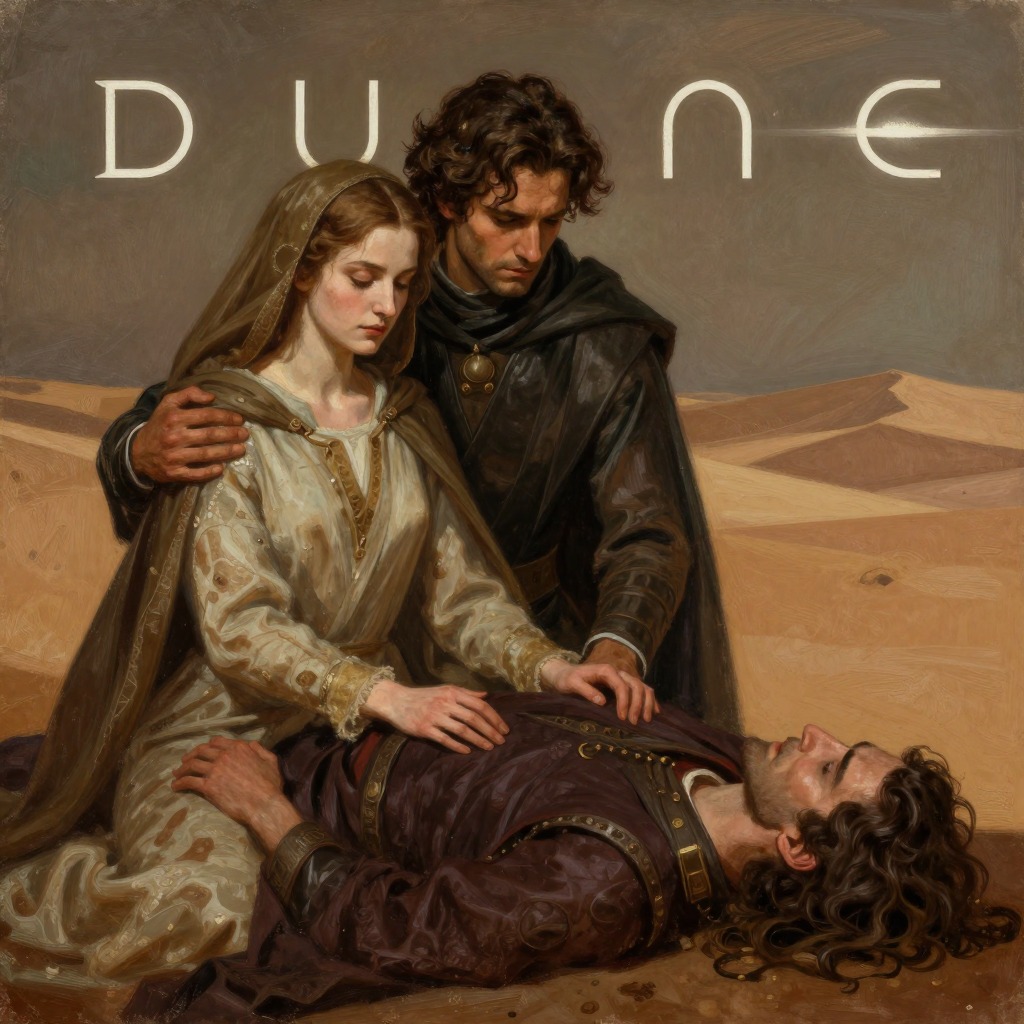
The Old Duke
The Old Duke, formally Leto Atreides I, is a foundational figure in the history of House Atreides, a man whose life and death cast a long shadow over his descendants. Though he is dead before the events of the novel begin, his presence is felt throughout, shaping the identity, values, and destiny of his son, Duke Leto Atreides, and his grandson, Paul Atreides. He is remembered as a man of immense bravura, a quality that even the Reverend Mother Gaius Helen Mohiam, who knew him, recalls with a certain respect, noting that he "appreciated the power of bravura – even in death." His legacy is one of honor, strength, and a dramatic, almost theatrical, approach to life and death that becomes a defining characteristic of the Atreides line.
Identity and Legacy
The Old Duke is defined by his role as the patriarch of House Atreides, a man whose reputation for courage and boldness precedes him. He is the father of Duke Leto Atreides, and his physical and personality traits are seen as having been passed down through the generations. When the Reverend Mother Gaius Helen Mohiam studies the young Paul Atreides, she notes the "shape of directly staring green eyes: like the old Duke, the paternal grandfather who is dead." This observation highlights how the Old Duke's genetic and spiritual inheritance is perceived as a living force within his grandson. His legacy is also one of a certain kind of leadership; Thufir Hawat, the Master of Assassins, reflects on his service to "three generations of them now," a testament to the Old Duke's reign and the continuity of the House he helped shape. The Old Duke's memory is so potent that it serves as a benchmark for his descendants, with Paul being told he is "more like your grandfather's" in manner and look, a comparison that carries both pride and the weight of expectation.
The Bull's Head and the Portrait
The most tangible symbols of the Old Duke's legacy are the two objects that Lady Jessica unpacks first upon arriving at the Arrakeen Residency: a painting and a bull's head. The painting, created by the famed artist Albe during the Old Duke's middle years, depicts him in matador costume with a magenta cape, his face young and bearing the same hawk features and gray stare as his son. This portrait is a powerful emblem of his identity, a man who embraced the spectacle and danger of the bullring. The bull's head, mounted on a polished board, is an even more potent symbol. Its horns are not clean; they are caked with what Jessica reveals to be "the blood of our Duke's father," sprayed with a transparent fixative within hours of the beast killing him. This gruesome trophy is a constant, visceral reminder of the Old Duke's death, transforming his demise into a symbol of Atreides defiance and the acceptance of fate. The Duke Leto's insistence on hanging these two items in the dining hall, over Jessica's objections, underscores their importance as family talismans, meant to be displayed and contemplated, reinforcing the values of courage and honor in the face of mortality.
The Old Duke's Death and Its Symbolism
The Old Duke's death, killed by a bull, is a defining event that resonates throughout the narrative. It is not a death in battle or by treachery, but a death in the arena, a spectacle of bravery and a confrontation with raw, untamed power. This manner of death is seen as fitting for a man of his character, a final act of bravura. The bull's head, with its blood-stained horns, becomes a permanent monument to this event, a reminder that even the strongest can be brought down, but that the manner of one's fall can be as important as the manner of one's life. The Old Duke's death also serves as a point of contrast and reflection for his descendants. Duke Leto, contemplating his own mortality and the dangers of Arrakis, is haunted by the memory of his father's fate. The bull's head and the portrait are not just decorations; they are a constant challenge to live up to the Old Duke's example of fearless confrontation with destiny, a theme that Paul Atreides will ultimately embody in his own journey.
Influence on Duke Leto and Paul Atreides
The Old Duke's influence is most clearly seen in the character of his son, Duke Leto Atreides. Leto is described as having the same hawk features and gray stare as his father, and he carries the weight of his father's legacy. He is a man of honor and strength, but also one who is shaped by the "cold, callous, demanding, selfish" aspects of his father's personality, as Jessica observes. She laments, "That's the man shaped by the father," and even wishes, "If only that old man had died when my Duke was born!" This reveals a complex inheritance: the Old Duke's strength and courage are passed down, but so too are his harsher qualities. The Old Duke's legacy also extends to Paul, who is seen as carrying his grandfather's eyes and, later, his manner. When Gurney Halleck first sees Paul as a man, he is struck by the resemblance, noting "a hardness in the expression that reminded Gurney of the Old Duke, Paul's grandfather." This connection suggests that Paul, in his own rise to power, is not just the son of Leto, but also the inheritor of a deeper, more primal Atreides spirit, one that is willing to embrace the harsh necessities of power and destiny.
Narrative Role and Thematic Significance
The Old Duke functions as a narrative anchor, a figure from the past whose presence is felt in the present. He represents the idealized, and sometimes problematic, virtues of the Atreides: courage, honor, and a certain theatrical bravura. His death by the bull is a powerful symbol of the family's relationship with fate – they do not shy away from danger but confront it head-on, even when it leads to their demise. The objects associated with him, the portrait and the bull's head, serve as constant reminders of this ethos, displayed prominently in the family's homes. Thematically, the Old Duke's legacy raises questions about inheritance, both genetic and cultural. His traits are seen as being passed down, for better or worse, to his son and grandson. His story also foreshadows the tragic fates that befall the Atreides, suggesting that the family's courage and pride, while admirable, can also lead to their downfall. In this way, the Old Duke is more than just a memory; he is a force that shapes the destiny of his descendants, a ghost that haunts the halls of House Atreides and guides their actions in the face of overwhelming odds.