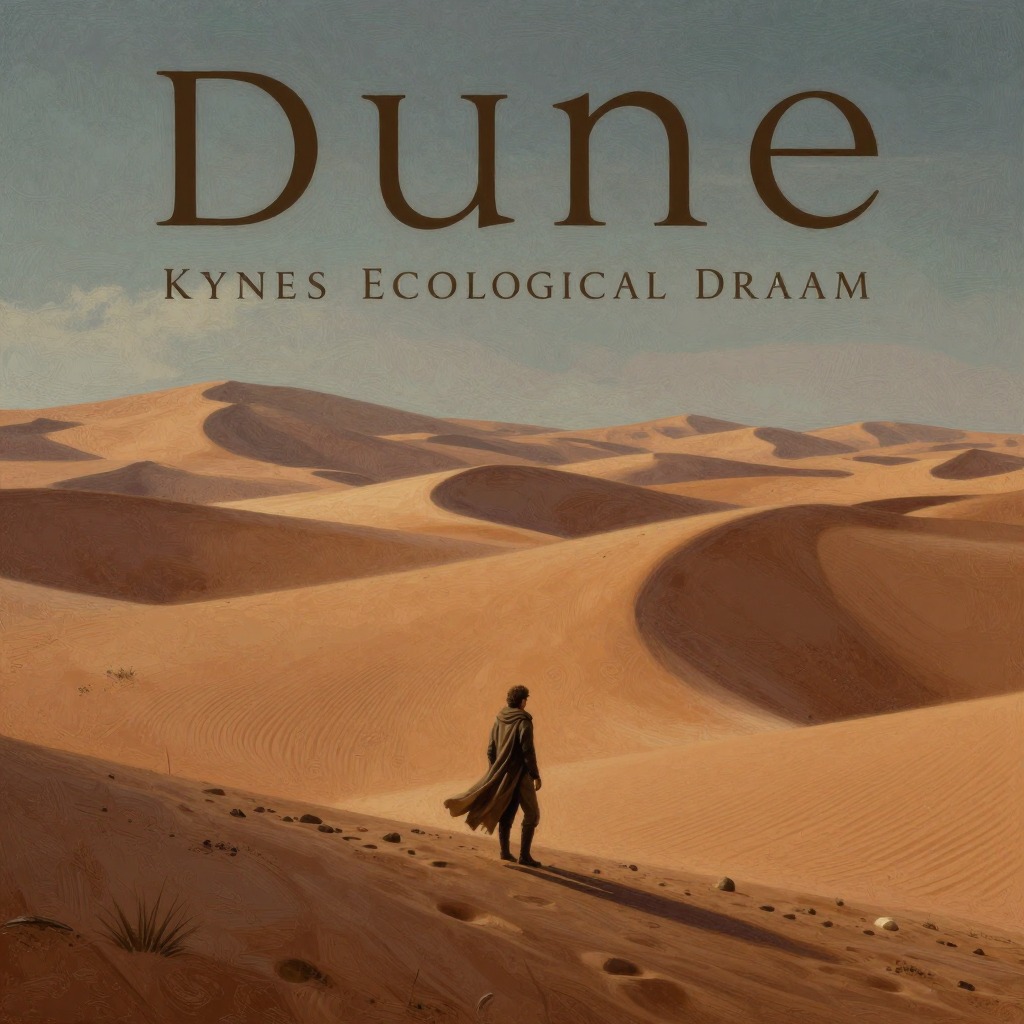
Pardot Kynes
Pardot Kynes, the First Planetologist of Arrakis, is the visionary scientist whose ecological dream of transforming the desert planet into a paradise reshaped the Fremen into an ecological and geological force of almost unlimited potential. His single-mindedness, his marriage into the Fremen, and his revolutionary teachings laid the foundation for the Arrakis terraforming project that would ultimately become the ideological core of Paul-Muad'Dib's power. Kynes's legacy, carried on by his son Liet-Kynes, transformed the Fremen from a scattered, oppressed people into a united force with a sacred goal, making him a pivotal figure whose ideas outlived him and directly enabled the events of the novel.
Identity and Background
Pardot Kynes was the Imperial Planetologist on Arrakis, a scientist who saw the planet not as a barren wasteland but as "merely an expression of energy, a machine being driven by its sun." His mind went directly to the free-moving human population, the Fremen, seeing them as a tool of almost unlimited potential. He was a direct and simple man in many ways, one who "merely permitted himself no distractions." His approach to the planet was revolutionary: he believed that what it needed was reshaping to fit it to man's needs. He was a man of enormous single-mindedness and innocence, approaching any problem with a focus that allowed no deviation. His first encounter with the Fremen came when he stumbled upon a deplorably common scene: six Harkonnen bravos, shielded and fully armed, had trapped three Fremen youths in the open behind the Shield Wall near the village of Windsack. To Kynes, it was a ding-dong battle, more slapstick than real, until he focused on the fact that the Harkonnens intended to kill the Fremen. He wasn't brave; he merely had that single-mindedness and caution. The Harkonnens were killing Fremen, and they were destroying the tools with which he intended to remake a planet.
The Ecological Mission and the Fremen
Kynes's mission was to transform Arrakis into a habitable world, a goal he pursued with a religious fervor that eventually infected the Fremen. He married a Fremen woman, and when she gave him a Fremen son, Liet-Kynes, he began with him and the other children, teaching them ecological literacy, creating a new language with symbols that arm the mind to manipulate an entire landscape, its climate, seasonal limits, and finally to break through all ideas of force into the dazzling awareness of order. He lectured to sietch warren classes, expounding his philosophy: "There's an internally recognized beauty of motion and balance on any man-healthy planet," he said. "You see in this beauty a dynamic stabilizing effect essential to all life. Its aim is simple; to maintain and produce coordinated patterns of greater and greater diversity. Life improves the closed system's capacity to sustain life. Life – all life – is in the service of life. Necessary nutrients are made available to life by life in greater and greater richness as the diversity of life increases. The entire landscape comes alive, filled with relationships and relationships within relationships." His ideas were so powerful that when a would-be executioner was sent to kill him, the man, Uliet, walked three paces and deliberately fell on his own knife, thus "removing" himself. From that instant, Kynes had but to point, saying "Go there," and entire Fremen tribes went. Men died, women died, children died, but they went.
The Transformation of Arrakis
Kynes returned to his Imperial chores, directing the Biological Testing Stations, and Fremen began to appear among the Station personnel, infiltrating the "system." Station tools, especially cutterays, began finding their way into the sietch warrens, used to dig underground catchbasins and hidden windtraps. Water began collecting in the basins. It became apparent to the Fremen that Kynes was not a madman totally, just mad enough to be holy. He was one of the umma, the brotherhood of prophets. Kynes knew that highly organized research is guaranteed to produce nothing new, so he set up small-unit experiments with regular interchange of data for a swift Tansley effect, letting each group find its own path. He organized only isolated and rough run-through tests to put their difficulties into perspective. Core samplings were made throughout the bled, and charts were developed on the long drifts of weather that are called climate. He found that in the wide belt contained by the 70-degree lines, north and south, temperatures for thousands of years hadn't gone outside the 254-332 degrees (absolute) range, and that this belt had long growing seasons where temperatures ranged from 284 to 302 degrees absolute: the "bonanza" range for terraform life, once they solved the water problem. When the Fremen asked when they would see Arrakis as a paradise, Kynes told them, "From three hundred to five hundred years." A lesser folk might have howled in dismay, but the Fremen had learned patience from men with whips. It was a bit longer than they had anticipated, but they all could see that the blessed day was coming. They tightened their sashes and went back to work. Somehow, the disappointment made the prospect of paradise more real.
The Scientific Breakthroughs
Kynes's scientific work was marked by a series of breakthroughs that turned his dream into a practical plan. He saw the salt pan, a giant oval depression some three hundred kilometers on the long axis, and tasted its storm-cleaned surface. Salt. Now, he was certain there'd been open water on Arrakis – once. He began reexamining the evidence of the dry wells where trickles of water had appeared and vanished, never to return. He set his newly trained Fremen limnologists to work, and they discovered the sandtrout, a sandswimmer that blocked off water into fertile pockets within the porous lower strata. This "water-stealer" died by the millions in each spice-blow, and the few survivors entered a semidormant cyst-hibernation to emerge in six years as small sandworms. Now they had the circular relationship: little maker to pre-spice mass; little maker to shai-hulud; shai-hulud to scatter the spice upon which fed microscopic creatures called sand plankton; the sand plankton, food for shai-hulud, growing, burrowing, becoming little makers. Kynes and his people turned their attention from these great relationships and focused now on micro-ecology. They planted mutated poverty grasses on the downwind faces of dunes, creating giant sifs of more than 1,500 meters height. When barrier dunes reached sufficient height, they came in with deeper plantings – ephemerals, scotch broom, low lupine, vine eucalyptus, dwarf tamarisk, shore pine – then the true desert growths: candelilla, saguaro, and bis-naga, the barrel cactus. They turned then to the necessary animal life – burrowing creatures to open the soil and aerate it: kit fox, kangaroo mouse, desert hare, sand terrapin, and the predators to keep them in check: desert hawk, dwarf owl, eagle and desert owl. Now came the crucial test: date palms, cotton, melons, coffee, medicinals – more than 200 selected food plant types to test and adapt. A report came up from the palmaries that the sand plankton was being poisoned through interaction with the new forms of life, creating a barren zone. Kynes went down to the palmaries himself, tested the barren zone, and came up with a bonus: the addition of sulfur and fixed nitrogen converted the barren zone to a rich plant bed for terraform life. The plantings could be advanced at will.
The Legacy and Death
From the charts emerged a figure: three per cent. If they could get three per cent of the green plant element on Arrakis involved in forming carbon compounds, they'd have their self-sustaining cycle. When the Fremen demanded to know how long, Kynes reported, "Oh, that: about three hundred and fifty years." So it was true as this umma had said in the beginning: the thing would not come in the lifetime of any man now living, nor in the lifetime of their grandchildren eight times removed, but it would come. The work continued: building, planting, digging, training the children. Then Kynes-the-Umma was killed in the cave-in at Plaster Basin. By this time his son, Liet-Kynes, was nineteen, a full Fremen and sandrider who had killed more than a hundred Harkonnens. The Imperial appointment for which the elder Kynes already had applied in the name of his son was delivered as a matter of course. The course had been set by this time, the Ecological-Fremen were aimed along their way. Liet-Kynes had only to watch and nudge and spy upon the Harkonnens, until the day his planet was afflicted by a Hero. Pardot Kynes's death did not end his mission; it was carried forward by his son and by the Fremen he had transformed, becoming the very dream that would unite them under Paul-Muad'Dib and drive the events of the novel to their climax.