Mrs. Kintner
Mrs. Kintner is the mother of six-year-old Alexander Kintner, the second victim of the great white shark off Amity. Her anguished confrontation with Police Chief Martin Brody in his office transforms her from a grieving parent into the town's most devastating accuser, crystallizing the moral weight of the suppressed shark attacks and forcing Brody to confront his own complicity in the deaths.
Identity and Background
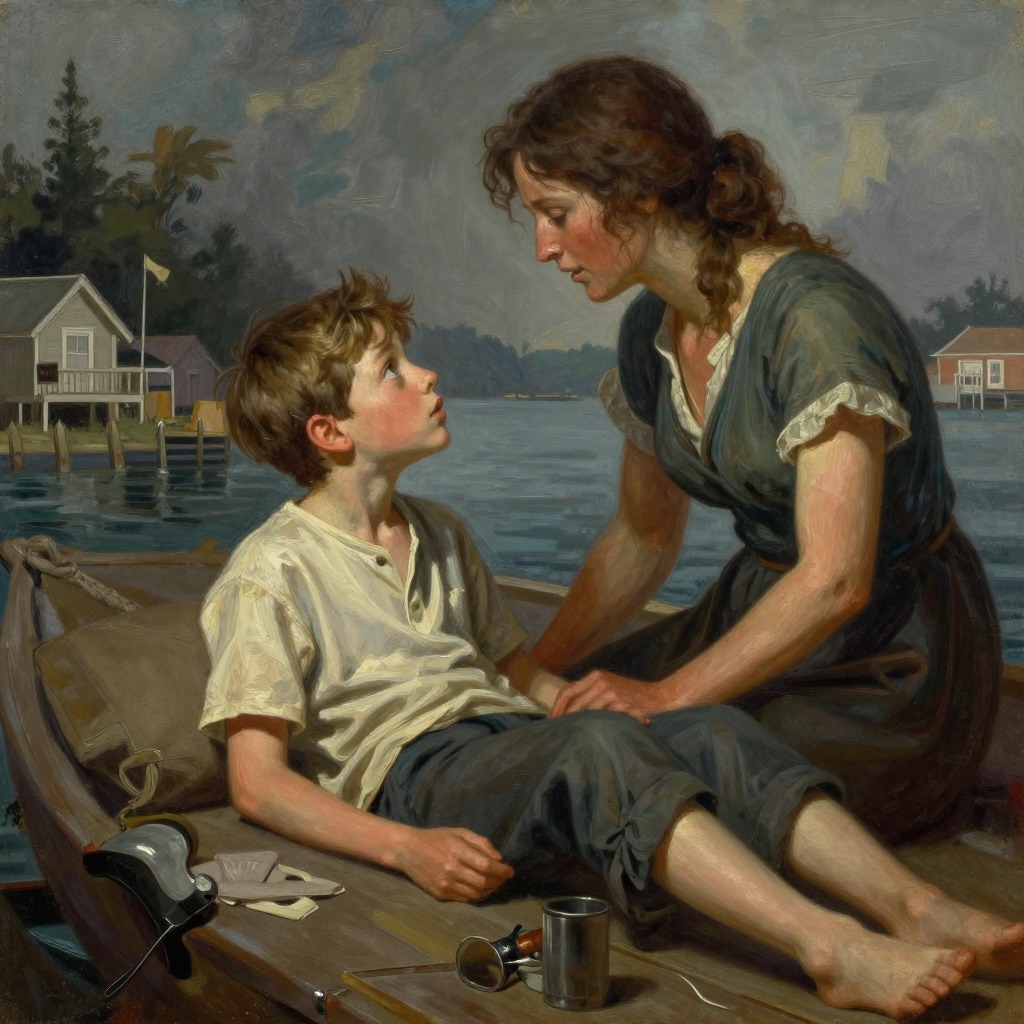
Mrs. Kintner is a summer visitor to Amity, staying with her son Alexander in the Goose Neck Lane house owned by Mr. and Mrs. Richard Packer. She is first seen on the beach on Sunday, June 20, lying on a towel, dozing in the sun while her son complains of boredom. She initially refuses his request to go swimming, citing the cold water, but eventually relents and allows him to take his rubber raft out, warning him not to go too far. She does not witness the attack; she sees only pieces of his raft afterward. When Brody interviews her at the police station, she is wearing a short robe over her bathing suit, her feet bare, clutching a handkerchief. Her eyes are masked by large, round sunglasses, and her voice is weak but steady as she describes seeing nothing of the attack itself.
Confrontation with Brody
The morning after the attacks, Mrs. Kintner bursts into Brody's office, clutching a copy of the Amity Leader that reveals the suppressed news of Christine Watkins's death. She slaps the newspaper across Brody's face, the sharp report ringing deep into his left ear. She screams, "You killed Alex!" and accuses him of knowing the danger and keeping it secret. Her fists are clenched at her sides, and her head snaps forward as she screams, as if trying to inject the words into Brody. She asks if he made money from her son's blood, if someone paid him not to tell what he knew. Brody, horrified, denies it. When he explains that they did not think it could happen again, she repeats the words to herself, says "Oh," then "Jesus," and slumps into a chair, weeping in gasping, choking sobs. A doctor is called, gives her a shot of Librium, and leads her to the hospital.
Thematic Significance
Mrs. Kintner's role is to embody the human cost of the town's economic and political compromises. Her accusation that Brody "killed" her son is the direct, unanswerable charge that the novel's moral structure demands. She is a flat character in the sense that she appears only in this scene, but her function is round: she forces the reader to weigh the abstract arguments about public safety and economic survival against the concrete, visceral reality of a child's death. Her grief is not sentimentalized; it is raw, accusatory, and unassimilable into the town's narrative of a freak accident. She is the voice of the victim that the town's "understanding" tried to silence, and her appearance marks the point at which Brody's guilt becomes inescapable.