Godland
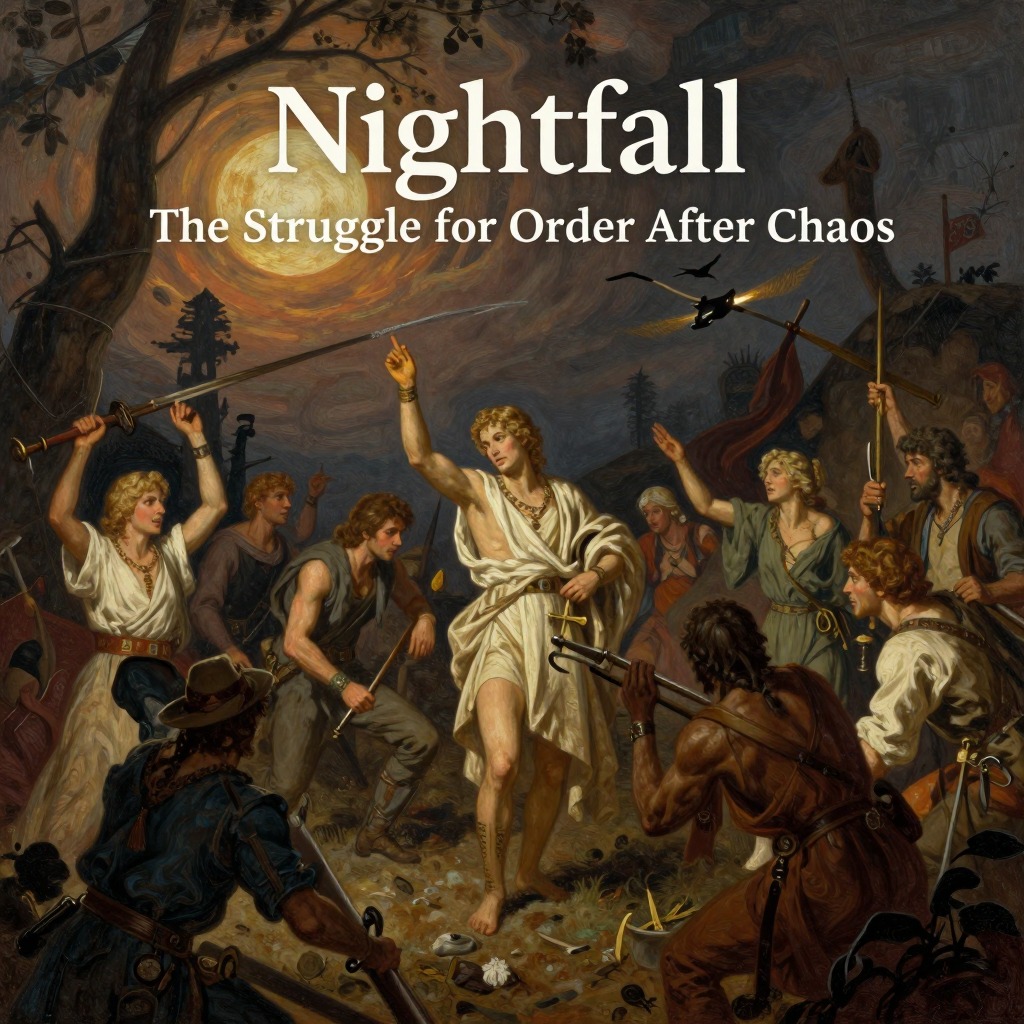
Godland was one of the many small, makeshift provinces that crystallized along the Great Southern Highway in the weeks following the Nightfall eclipse, as the collapse of the Federal Republic of Saro left a power vacuum that local strongmen rushed to fill. Like its neighbors Restoration Province, Six Suns Province, and Daylight, Godland was a narrow strip of territory, perhaps a few miles wide, that clung to the highway and extended a short distance on either side. Its existence was a symptom of the fragmentation of the old order: where there had once been a single nation, there were now dozens of petty jurisdictions, each with its own border guards, its own rules, and its own paranoid obsessions.
The Search and the Fear of Fire
The defining feature of Godland, as of the other highway provinces, was the institution known as the Search. In the wake of the worldwide conflagration that had destroyed Saro City and countless other settlements, the surviving population had developed a pathological fear of fire. The Search was a formalized ritual of inspection at every provincial border: travelers were stopped, their belongings were examined, and any device capable of starting a fire—matches, lighters, needle-guns—was confiscated. The penalty for attempting to bring fire-making equipment across a border was severe, and the suspicion was universal. When Theremon 762 and Siferra 89 crossed from Six Suns Province into Godland, they faced a border patrol that looked like a gang of cutthroats. The head guard, a cold-eyed man, demanded to see their passport and questioned their right to carry needle-guns, which were themselves classified as fire-making equipment. Only Siferra's impassioned claim that they were on an urgent mission to warn the provisional government at Amgando about the approaching Army of Holiness, combined with the authority of the passport signed by Beenay 25, persuaded the guards to let them pass.
A Province of Fragile Order
Godland, like its neighbors, was a place of fragile and provisional order. The highway itself was being cleared of the wreckage of the Nightfall disaster, and the dead were being buried. But the landscape beyond the road was scarred by burned-out towns and dotted with refugee camps where the stunned and bewildered survivors of the catastrophe moved slowly and purposelessly. The new provinces were essentially strings of such camps linked by the highway, each under the control of a local strongman who had managed to assemble a little realm. The borders between them were porous and ill-defined, and the names of the provinces changed frequently as people wandered on to other places. Godland was a place where the old certainties had been replaced by a new, desperate calculus of survival, where the fear of fire was the only law that everyone could agree on.
Narrative Significance
Godland serves as a representative example of the political fragmentation that followed the Nightfall eclipse. It illustrates the central paradox of the post-catastrophe world: the very fear of fire that had driven the population to destroy their own cities now became the organizing principle of the new, primitive societies that replaced them. The Search, with its ritualized suspicion and its monopoly on the means of producing light, was a direct response to the trauma of the eclipse, but it also created a system of petty tyrannies that would have to be overcome if civilization was ever to be rebuilt. Godland, like the other highway provinces, was a place where the future was uncertain, but where the first, halting steps toward order were being taken.