Monsieur Papon
Monsieur Papon is the executioner of Grasse, a man whose professional identity is defined by the iron rod he wields. In a town that has not seen an execution by breaking for years, Papon is the designated agent of the state's ultimate violence, the craftsman of judicial death. Yet when he confronts Jean-Baptiste Grenouille on the scaffold, his entire being is unmade by a power he cannot comprehend, transforming him from an instrument of punishment into a trembling supplicant.
Preparation and Professionalism
Papon prepares for the execution of Grenouille with the meticulous care of a master of his grim trade. He has a heavy, squared iron rod forged specifically for the occasion and goes to the slaughterhouse to practice his blows on carcasses, honing the precise technique required to crush all twelve major joints—arms, legs, hips, and shoulders—without damaging vital organs like the chest or head. The sentence demands that Grenouille be bound to a wooden cross, his face turned toward heaven, and dealt twelve blows while still alive, after which he is to be left hanging until death, with the customary mercy of strangulation expressly forbidden. Papon knows that this is a difficult business demanding fine touch and good timing, and he treats it with the seriousness of a professional whose reputation rests on the clean execution of a brutal task.
Collapse Before the Scaffold
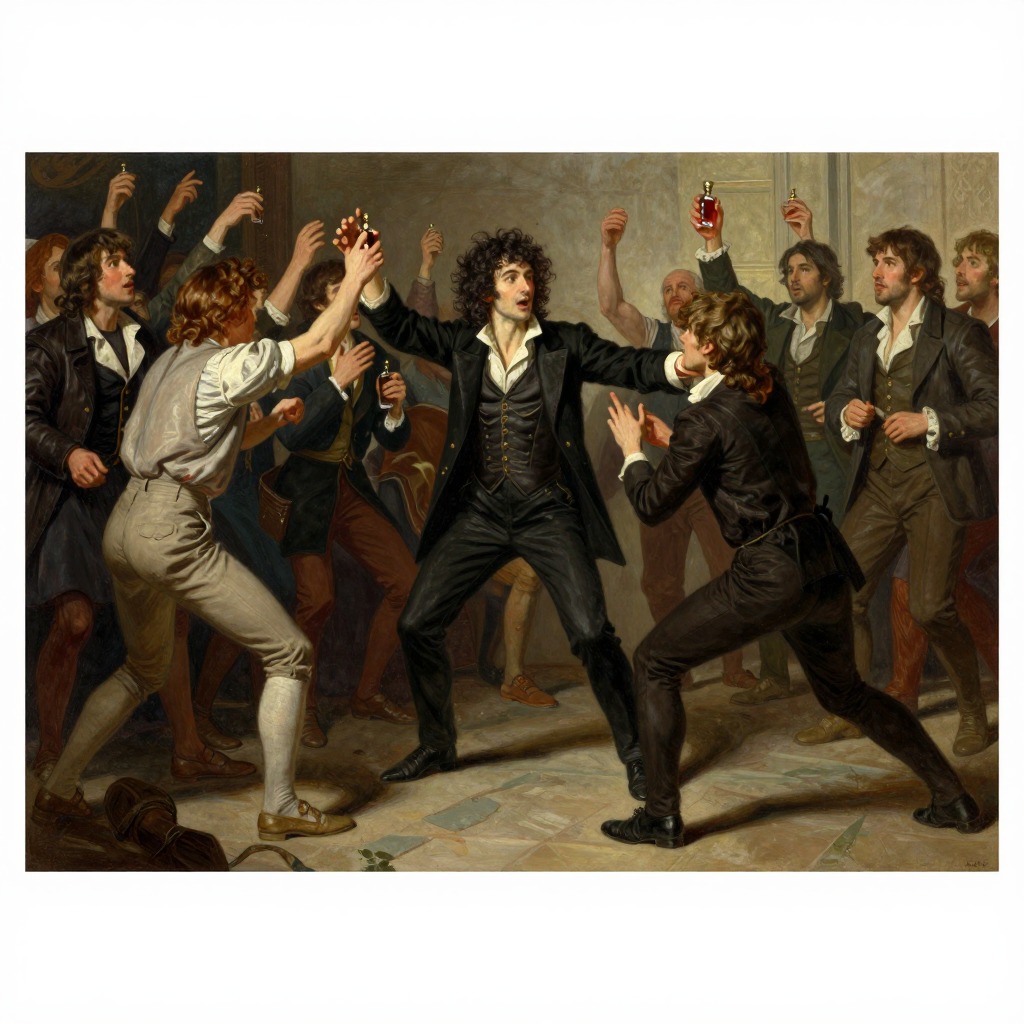
When Grenouille steps from the carriage wearing his blue frock coat and radiating the perfume of twenty-five murdered virgins, Papon is the first to feel the full force of the scent's power. His great hands, still clutching the iron rod, begin to tremble. All at once his strong arms become as weak, his knees as wobbly, his heart as anxious as a child's. He knows in a flash that he cannot lift that rod, that he will never in his life have the strength to lift it against this little, innocent man. He dreads the moment when they will lead Grenouille forward, and he totters, forced to prop himself up with his death-dealing rod to keep from sinking feebly to his knees. The great, the mighty Papon is reduced to a state of helpless adoration, his professional will dissolved by an olfactory magic he cannot resist.
Narrative Role and Thematic Significance
Papon's collapse is the most concentrated demonstration of the perfume's power over the machinery of justice. He is not a corrupt or weak-willed man; he is a skilled executioner who has prepared himself for the task. Yet his trained body and iron will are rendered utterly useless in an instant. His failure signals that no human institution—not the court, not the church, not the state—can withstand the force of Grenouille's scent. The executioner becomes the executed in spirit, his authority stripped away, and the scaffold, meant to be the site of justice, becomes the stage for a miracle that overturns the verdict of the entire legal system. Papon's trembling hands and buckling knees are the physical proof that Grenouille has achieved what he set out to do: to rule the hearts of men through the invisible tyranny of scent.