Father Terrier
Father Terrier, a bald monk of about fifty with a faint odour of vinegar about him, served as the administrator of charities at the Cloister of Saint-Merri in Paris. His duties included distributing alms to the poor and needy, a task he performed with an expectation of gratitude and a strong aversion to being bothered further. He despised technical details, because details meant difficulties, and difficulties meant ruffling his composure, which he simply would not tolerate. An educated man who had studied theology and read the philosophers, dabbling in botany and alchemy on the side, he held a rather high opinion of his own critical faculties. He most vigorously combated the superstitious notions of the simple folk, such as witches, fortune-telling cards, amulets, and the evil eye, considering them heathenish customs that should have been uprooted a thousand years after the firm establishment of the Christian religion. He was, however, careful not to go so far as to question the miracles or the truth of Holy Scripture, preferring not to meddle with problems that were too discomfiting and would land him in agonizing insecurity and disquiet.
Encounter with the Odorless Infant
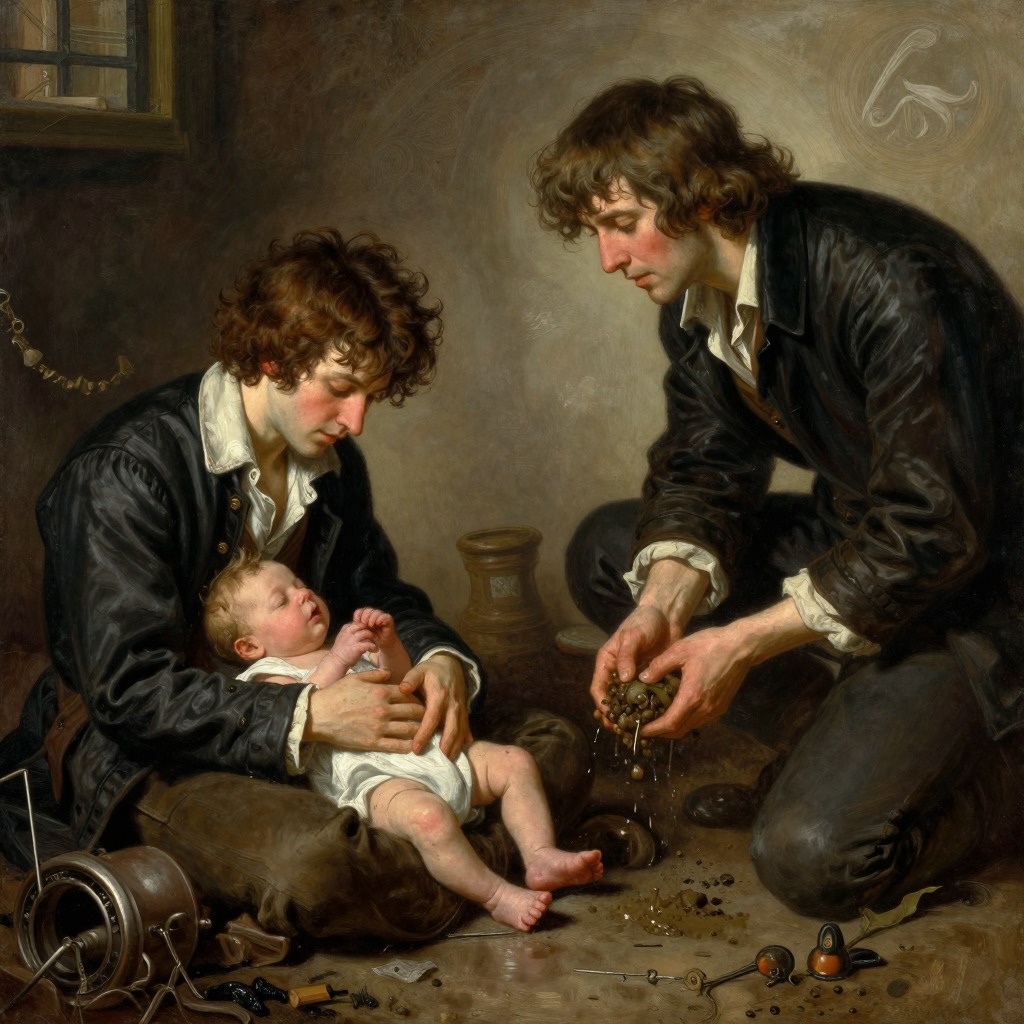
When the wet nurse Jeanne Bussie brought the infant Grenouille to the cloister gate, Terrier initially treated the matter with his characteristic desire to avoid trouble. He bent over the basket, sniffing at it in the hope it contained something edible, and upon seeing the sleeping child, declared it looked "rosy pink and well nourished." The wet nurse, however, insisted the baby was "possessed by the devil" because he did not smell. Terrier dismissed this as superstition, arguing that an infant was not yet a fully developed human being and therefore of no interest to the devil. He reasoned that if the child were possessed, he would have to stink. To soothe the woman and test his own courage, he lifted the basket and held it up to his nose, smelling "absolutely nothing out of the ordinary." When the wet nurse persisted, describing how babies should smell like fresh butter, milk-soaked pancakes, and caramel at the back of the head, Terrier grew impatient and discharged her, taking the child himself.
The Unsettling Awakening
Alone with the infant, Terrier attempted to maintain his composure. He rocked the basket on his knees, stroking the child's head and repeating the soothing nonsense word "poohpeedooh." He tried to rationalize the baby's lack of smell, convincing himself that an infant, if kept clean, simply did not have an odour, just as it did not speak or walk. He even recalled Horace to support his theory. But when the child awoke, its nose moved first, sniffing the air. Terrier had the very odd feeling that the child saw him with its nostrils, scrutinizing him more piercingly than eyes could ever do, as if it were using its nose to devour something that came from him. He felt naked and ugly, as if the child were smelling right through his skin into his innards, exposing his most tender emotions and filthiest thoughts. Gone was the sentimental idyll of father and son; a strange, cold creature lay on his knees, a hostile animal. Overcome with nausea, Terrier wrenched himself to his feet and set the basket on the table, wanting to get rid of the thing as quickly as possible.
Abandonment and Flight
When the infant began to wail with a repulsively shrill screech that made the blood in Terrier's veins congeal, the monk's fear turned to action. He hitched up his cassock, grabbed the bellowing basket, and ran through the tangle of alleys to the rue du Faubourg Saint-Antoine, far out to the rue de Charonne. There, at an address near the cloister Madeleine de Trenelle, he knew a certain Madame Gaillard who took children to board no matter of what age or sort. He handed over the still-screaming child, paid a year in advance, and fled back into the city. Once at the cloister, he cast his clothes from him as if they were foully soiled, washed himself from head to foot, and crept into bed in his cell, crossing himself repeatedly, praying long, and finally with some relief falling asleep.
Legacy and Later Role
Terrier's brief encounter with Grenouille established a pattern of rejection that would define the child's early life. Years later, when the murders of young girls terrorized Grasse, the town council, in their distress, wrote an abject petition begging the bishop to curse the monster. The bishop, following the precedent set in 1708 against locusts, excommunicated the murderer from all the pulpits of the city. The murders ceased, and the people celebrated a mass of thanksgiving. During the execution scene, the bishop himself was overcome by Grenouille's perfume, slumping forward and banging his forehead against his knees, experiencing religious rapture for the first time in his life, believing a miracle had occurred. This final episode echoes Terrier's own failure of faith and reason: where Terrier fled in terror from the odorless infant, the bishop, decades later, was utterly deceived by the same man's manufactured scent, mistaking a murderer for an angel.