Jeanne Bussie
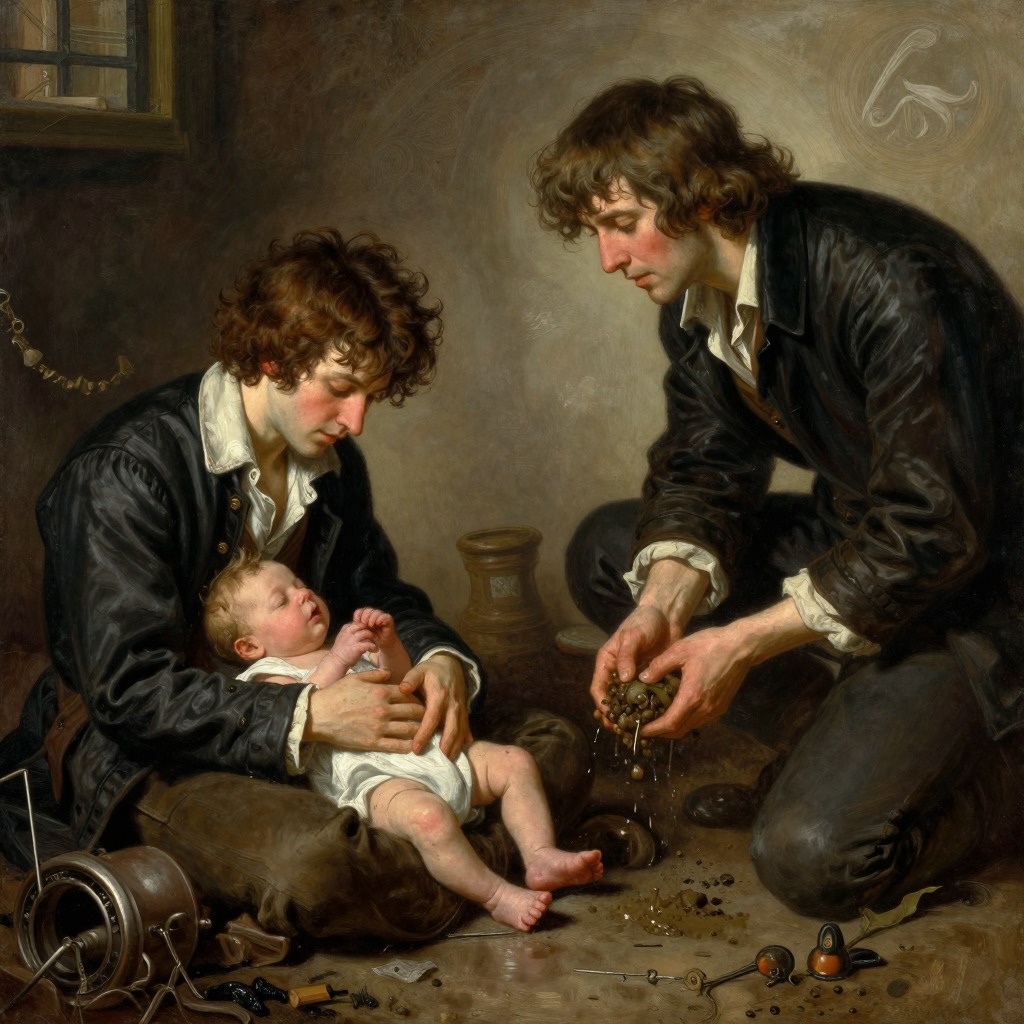
Jeanne Bussie is the wet nurse who first takes in the newborn Jean-Baptiste Grenouille after his baptism at the cloister of Saint-Merri, but she soon becomes the first person to recoil from his most fundamental abnormality: he has no smell of his own. Her refusal to keep him sets in motion the chain of rejections that defines Grenouille's early life, and her testimony provides the earliest articulation of the horror that his odorlessness inspires in others.
Identity and Role
Jeanne Bussie lives in the rue Saint-Denis and is hired by the cloister of Saint-Merri to nurse Grenouille, receiving three francs per week for her trouble. She is a practical, hard-headed woman who has raised many children and knows intimately how a baby ought to smell. When she appears at the cloister gate with her market basket, she is determined to be rid of the child, complaining that he has "pumped me dry down to the bones" and that she has lost ten pounds from feeding him. She declares that he will "gobble up anything"—goat's milk, pap, beet juice—but she will not keep him.
The Confrontation with Father Terrier
When Father Terrier opens the gate, Jeanne Bussie sets down her basket and announces the child as "the bastard of that woman from the rue aux Fers who killed her babies!" Terrier, an easy-going administrator who dislikes complications, initially tries to persuade her to continue nursing Grenouille, offering raises from three to four to five francs per week. But Jeanne Bussie refuses all money. Her reason is not financial but supernatural: "He's possessed by the devil." When Terrier challenges her, asking whether the child twitches, jerks, or emits an evil stench, she gives the devastating reply: "He doesn't smell at all." For Jeanne Bussie, this absence is more terrifying than any foul odor could be. She explains that a normal baby smells like fresh butter on its feet, like a pancake soaked in milk on its body, and—most tellingly—like caramel on the crown of its head, where the hair makes a cowlick. She has smelled that sweetness on dozens of children and knows it is the scent that makes one love them, whether they are one's own or another's. Grenouille has no such scent, not even as much as cold air. This lack, she insists, makes her flesh creep.
Theological and Sensory Dismissal
Father Terrier, an educated man who prides himself on his rational skepticism, dismisses Jeanne Bussie's testimony as primitive superstition. He argues that an infant is a pre-human being without a fully developed soul and therefore of no interest to the devil. He mocks her reliance on the sense of smell, calling it "the basest of the senses" and linking it to pagan beliefs in werewolves and cannibal giants. Yet even as he lectures her, he cannot help sniffing his own fingers after touching the baby's head, finding only the odor of the choucroute he ate for lunch. Jeanne Bussie, though unable to match his theological arguments, holds her ground with the unshakeable certainty of her lived experience. She retracts the word "devil" when cornered, but she does not retract her fear. She crosses her arms beneath her bosom and declares that she will not take "that thing" back.
Aftermath and Significance
Father Terrier formally discharges Jeanne Bussie from her duties, but her rejection has already done its work. He is left alone with the infant, and when Grenouille awakens and begins to smell at him with his tiny, quivering nose, Terrier himself is overcome with revulsion and rushes the child to Madame Gaillard's establishment, paying a year in advance to be rid of him. Jeanne Bussie's visceral reaction—her inability to articulate why the lack of scent is so disturbing, yet her absolute refusal to ignore it—establishes the pattern that will follow Grenouille throughout his life. She is the first to sense that his odorlessness is not a neutral absence but a kind of negative presence, a void that others instinctively fear. Her testimony also introduces the novel's central theme: that scent is the invisible medium of human connection, and that to lack it is to be excluded from the human community itself.