Thomas Rogers is the butler and manservant on Indian Island, whose quiet professionalism masks a deep complicity in the death of his former employer, Jennifer Brady, and whose own murder by the judge completes the seventh stanza of the nursery rhyme.
The disappearance of Dr. Edward George Armstrong is a pivotal event in the plot of *And Then There Were None*, marking the moment when the remaining survivors realize their number has been reduced to three and that the murderer is not among the living. It is a carefully staged illusion orchestrated by the true killer, Lawrence John Wargrave, who uses Armstrong's trust to lure him to his death by drowning, then manipulates the crime scene to suggest the doctor has vanished, thereby deepening the mystery and paranoia among the remaining guests.
The brand of Cain is a biblical symbol invoked by Lawrence John Wargrave in his confession to describe the mark on his forehead from his own suicide, representing his self-identification as a murderer and his belief that his crime—though executed as a form of justice—marks him with the same divine stigma as the first biblical killer.
France serves as a crucial geographical and psychological backdrop in Agatha Christie's *And Then There Were None*, functioning as the setting for several characters' past crimes and as a symbol of escape, memory, and the inescapable reach of justice.
Devon is the English county where Indian Island is located and where the novel's central events unfold, serving as the geographical anchor for the entire narrative. The county's coastal landscape, with its red earth, steep hills, and treacherous seas, provides the setting for the isolated island and shapes the characters' journey and fate.
Lawrence John Wargrave's eyeglasses are the final, self-destroying instrument of his meticulously planned mass murder on Indian Island, transformed from a judge's accessory into the trigger mechanism of his own suicide, completing the nursery rhyme's last verse and sealing the mystery.
George Milton shoots Lennie Small in the back of the head beside the Salinas River, ending his friend's life to spare him from a lynch mob while reciting their shared dream of a farm one last time.
Aunt Clara is the deceased aunt who raised Lennie Small, appearing only as a hallucination in Lennie's mind at the Salinas River pool, where she voices Lennie's guilt and self-reproach over his dependence on George Milton.
The bird is a minor but recurring element in the natural setting of the Salinas River pool, appearing as a small bird whose movements trigger Lennie Small's cautious reactions and later as a symbol of the freedom and loneliness that George Milton imagines he could have without Lennie.
Carlson's Luger is the pistol George Milton uses to kill Lennie Small at the Salinas River pool, transforming from a mundane ranch object into the instrument of a mercy killing that ends the dream of the little farm.
George and Carlson's relationship is a brief, functional interaction defined by the aftermath of Lennie's death, where Carlson's practical questions and George's exhausted, fabricated answers reveal the social performance required to conceal the truth of the killing.
The relationship between George Milton and Slim is defined by a single, decisive act of understanding and solidarity. In the aftermath of George's mercy killing of Lennie Small, Slim is the only man who immediately grasps the necessity of the act, offering George not judgment but companionship and absolution. Their bond, forged in the story's final moments, stands in stark contrast to the suspicion and cruelty of the other ranch hands, providing the novel's only glimpse of genuine, unspoken human connection in a world defined by isolation.
Lennie Small's relationship with Aunt Clara, his deceased aunt, is defined by guilt, memory, and the internalized voice of moral judgment. In the novel's climactic scene, Lennie hallucinates Aunt Clara, who scolds him for failing to protect George and for his uncontrollable behavior, revealing the deep psychological burden he carries and the foundation of his desperate need for George's approval.
Min' George is the central ethical command that Lennie Small has internalized from his caretaker George Milton, a rule that demands obedience and good behavior to avoid causing trouble. It appears in Lennie's hallucination of Aunt Clara, who scolds him for failing to follow this rule, and it shapes Lennie's guilt and fear of abandonment throughout the novel's climactic scene.
The rule "Nobody gonna hurt nobody nor steal from 'em" is the moral and emotional core of George and Lennie's shared dream, a promise of a peaceful, self-sufficient life on their own farm that stands in stark contrast to the violence and exploitation of the itinerant worker's world. It is the final, consoling vision George offers Lennie before killing him, transforming the dream into a mercy that fulfills its own terms even as it is destroyed.
We got each other is the central affirmation of the bond between George Milton and Lennie Small, a phrase that encapsulates their shared dream and mutual dependence in a world of itinerant loneliness. It is the emotional and thematic core of their relationship, recited as a ritual of hope and comfort, and its final utterance marks the tragic climax of the novel.
Cardinal Richelieu is the master strategist and de facto ruler of France in The Three Musketeers, whose political machinations, personal vendettas, and manipulation of King Louis XIII drive the novel's central conflicts. As the archrival of both Queen Anne of Austria and the Duke of Buckingham, he orchestrates a web of espionage, assassination plots, and military campaigns—including the siege of La Rochelle—while simultaneously attempting to neutralize the four friends whose loyalty to the queen repeatedly thwarts his designs. His character embodies the tension between absolute power and the unpredictable forces of honor, love, and friendship that resist it.
Comte de Cramail is a minor courtier who appears in the retinue of King Louis XIII during the ball at the Hôtel de Ville, one of the many nobles accompanying the king and thereby forming part of the backdrop against which the central drama of the diamond studs unfolds.
John Felton is a Puritan naval lieutenant who becomes the unwitting instrument of Milady's vengeance, assassinating the Duke of Buckingham before being captured and executed.
The Bastille, the formidable state prison of seventeenth-century Paris, functions in Alexandre Dumas's *The Three Musketeers* as the cardinal's primary instrument of political repression, a place where the threat of arbitrary imprisonment hangs over characters from the king's Musketeers to humble mercers, and where the novel's central conflict between royal authority and ministerial power is made concrete.
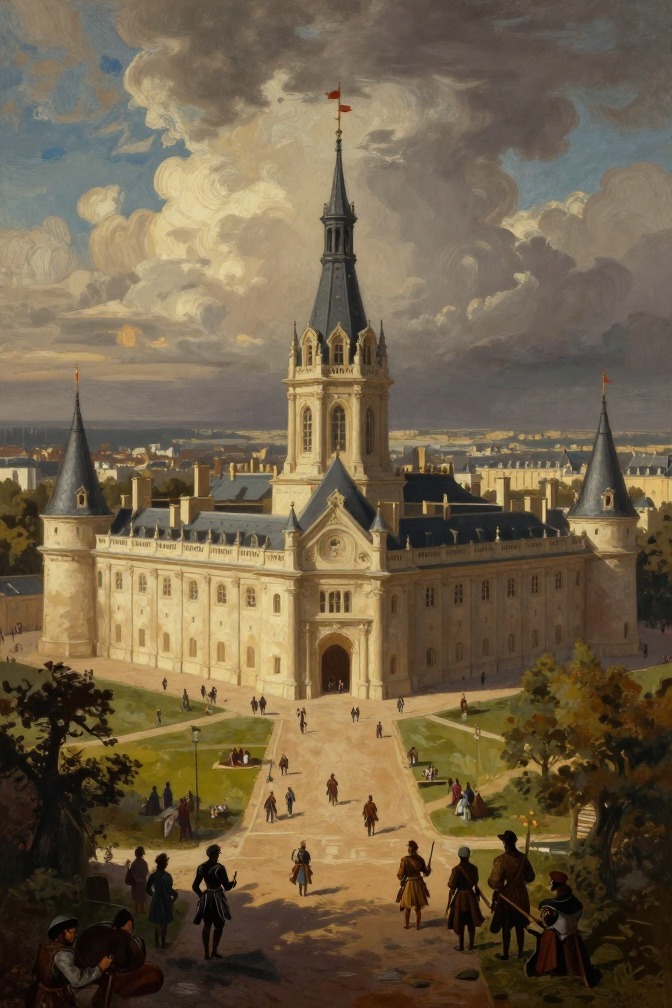
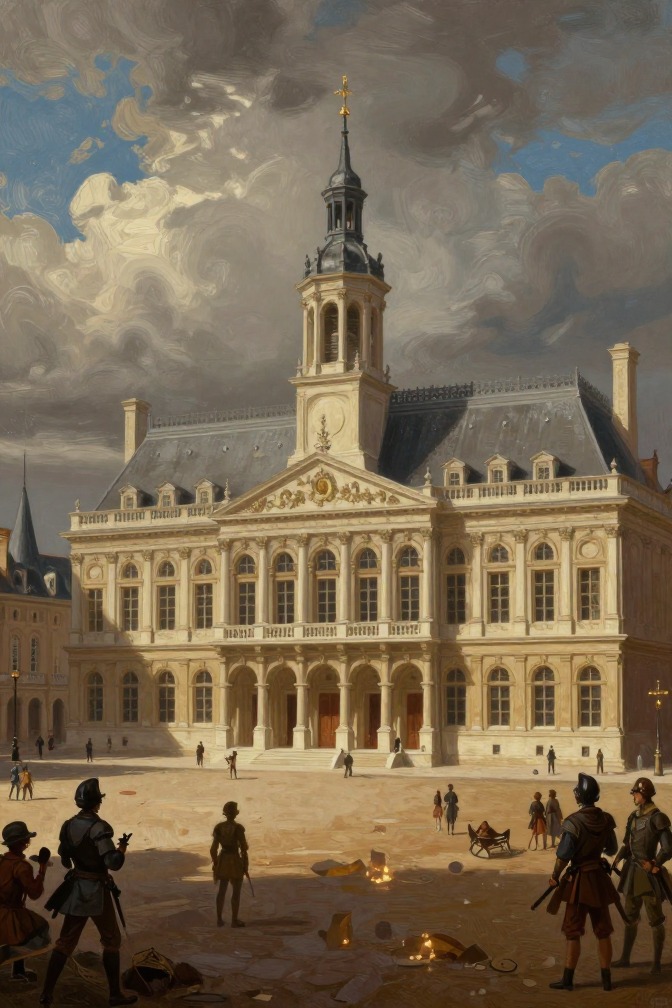
The Hotel de Ville (City Hall) of Paris serves as the magnificent setting for the climactic ball of the novel, where the fate of Queen Anne of Austria and the Duke of Buckingham is decided through the display of the diamond studs. It is also the site of a dramatic confrontation between King Louis XIII and the queen, orchestrated by Cardinal Richelieu, and the scene of d'Artagnan's ultimate triumph and reward.
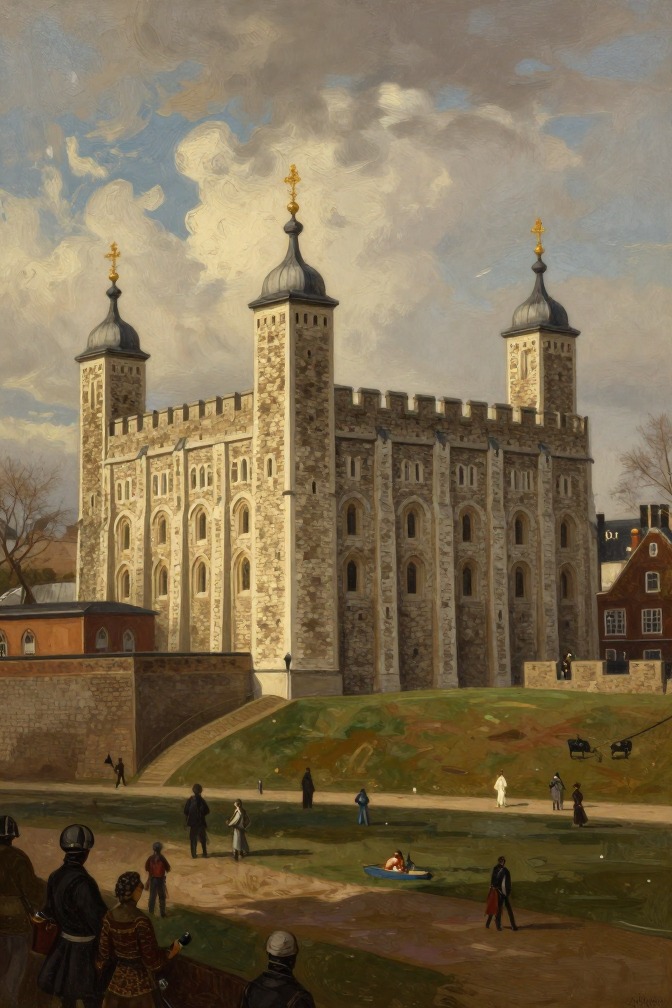
The Tower of London appears in *The Three Musketeers* as a landmark of English royal authority and a point of reference during d'Artagnan's journey to London, where he seeks the Duke of Buckingham to recover the queen's diamond studs.
The Minimes was the quarter where the Guards of Monsieur Dessessart, including d'Artagnan, were encamped during the Siege of La Rochelle, serving as the base from which he ventured into the dangerous no-man's-land and where the poisoned wine plot nearly killed him.
Finisterre is the northwestern cape of France, a rocky promontory on the Atlantic coast that appears in the novel as the first land Milady sees after nine days of stormy sailing from the Charente, marking her return to France after the assassination of the Duke of Buckingham.
Barriere St. Denis is the northern gate of Paris through which d'Artagnan and his three companions depart at two o'clock in the morning on their journey to London, marking the beginning of the perilous expedition that will test their loyalty and courage.
Rue de Seine is a Parisian street that serves as a key thoroughfare in the early adventures of d'Artagnan, connecting the Luxembourg quarter to the Seine and marking the path of his first, frustrated pursuit of the Man of Meung.
Nantes is a city in western France that serves as a secondary but significant location in the novel, primarily as the site of Constance Bonacieux's imprisonment in a state prison, from which she is transferred to a convent by order of the queen.
Fort de La Pree is a small fortification on the Isle of Re, whose defense by the Comte de Toiras and a hundred men against the Duke of Buckingham's invading English army in 1627 became a pivotal military event that shaped the siege of La Rochelle and the broader war between France and England.
Chaillot is a road on the outskirts of Paris that serves as the setting for a crucial, fleeting encounter between d'Artagnan and the imprisoned Constance Bonacieux, and later as the site where d'Artagnan confirms her fate, marking a pivotal turn in the novel's romantic and political intrigues.
Piedmont is a region in northwestern Italy that serves as the final posting for Planchet, d'Artagnan's loyal lackey, after the events of the novel. Rochefort secures Planchet a sergeant's rank in the Piedmont regiment, marking the culmination of Planchet's journey from a timid servant to a rewarded soldier.