Alcinous, the king of the Phaeacians, is the gracious host who receives Odysseus after his shipwreck and provides him with the ships and treasure that finally return him to Ithaca, acting as the crucial agent of the hero's homecoming.
Amphiaraus is a seer and warrior from Argos, a figure from the generation before the Trojan War, whose story is told within the Odyssey as part of the lineage of the prophet Theoclymenus and as a tragic example of a man undone by a woman's greed.
Amphion is a son of Zeus and Antiope, who together with his twin brother Zethus founded the city of Thebes and built its famous seven-gated wall. His story is briefly recounted by Odysseus during his visit to the underworld, where he appears among the ghosts of famous women.
Amphitrite is the goddess of the sea, wife of Poseidon, and a figure who appears in the Odyssey primarily through epithets and indirect references that underscore the power and danger of the ocean.
Ariadne, daughter of King Minos of Crete, appears in Odysseus's account of the heroines he encountered in the Underworld, where her story is compressed into a brief but telling episode that highlights the themes of betrayal, divine punishment, and the tragic fate of women in heroic myth.
Arybas is a wealthy Sidonian father mentioned in Eumaeus's backstory, whose daughter was kidnapped by Taphian pirates and sold into slavery in Ithaca, where she became the nurse of Eumaeus and later orchestrated his abduction by Phoenician traders.
Cretheus is a minor but structurally significant figure in the Odyssey, appearing only in Odysseus's catalogue of heroines during his visit to the underworld, where he is identified as the mortal husband of Tyro and the father of Aeson, Pheres, and Amythaon, thereby linking the epic's genealogical web to the foundational myths of Iolcus and Pylos.
Ctimene is the younger sister of Odysseus, mentioned only in passing by the swineherd Eumaeus, who reveals that she was raised alongside him as a foster-sibling before being married off to a man on Same with a splendid dowry.
Elpenor is a minor member of Odysseus's crew who dies in an undignified accident on Circe's island and whose unburied ghost compels Odysseus to return and perform proper funeral rites, making him a figure who underscores the epic's themes of mortality, the obligations of the living toward the dead, and the contrast between heroic glory and ordinary human frailty.
The Erinyes, the chthonic goddesses of vengeance in Greek mythology, appear in the Odyssey as a potent threat invoked by characters to enforce oaths, punish familial crimes, and uphold cosmic justice, though they never physically manifest in the narrative.
Eurypylus, son of Telephus, is a minor but vividly drawn hero in Odysseus's account of the Trojan War, remembered as the handsomest man Odysseus ever saw except Memnon, whose death at the hands of Neoptolemus is recounted in the underworld to Achilles.
Eurytion is a centaur whose drunken violence at the wedding of Peirithous and Hippodamia triggered a war between the Lapiths and the centaurs, and whose story is invoked by Antinous in the Odyssey as a cautionary example of how wine leads to ruin.
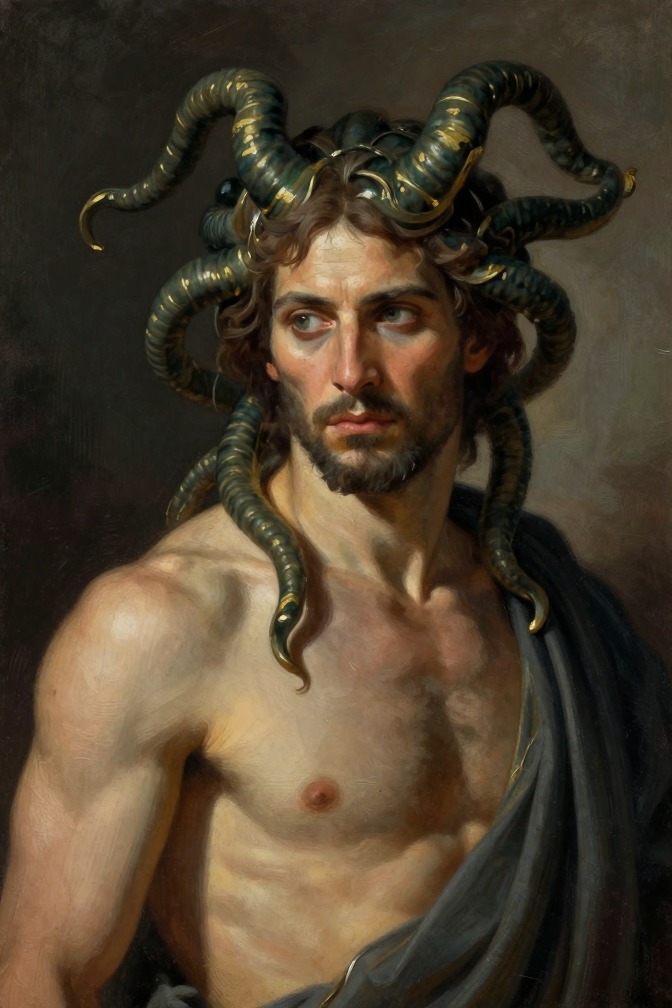
The Gorgon appears in the Odyssey as a terrifying mythological monster whose head is feared even in the underworld, serving as a boundary marker for Odysseus's journey into the realm of the dead and as a symbol of the ultimate horror that threatens to overwhelm the hero.
Idomeneus, the Cretan king and hero of the Trojan War, appears in the Odyssey as a figure whose safe return to Crete contrasts with Odysseus's prolonged absence, and whose household is drawn into the false identity Odysseus constructs to test Penelope.
Melaneus is a minor figure in the Odyssey, mentioned only as the father of Amphimedon, one of the suitors of Penelope. His sole appearance in the poem is through the ghost of his son, who recounts the suitors' fate to the shade of Agamemnon in the underworld. Despite his scant presence, Melaneus serves as a genealogical marker that ties Amphimedon to the Ithacan nobility and underscores the theme of familial loss that pervades the aftermath of the suitors' slaughter.
Minos, the son of Zeus and king of Crete, appears in the Odyssey as the supreme judge of the dead in Hades, a role that underscores the poem's concern with justice, authority, and the ordering of the afterlife.
Neaera is a minor but structurally significant figure in the Odyssey, identified as the mother of Phaethusa and Lampetie, the nymphs who tend the Sun-god Helios's immortal cattle and sheep on the Thrinacian island. Her sole appearance in the poem occurs within Circe's warning to Odysseus, where she is named as the mortal or goddess who bore these daughters to Helios and then sent them to the distant island to guard the herds. Though Neaera never appears as an active character, her role as the mother of the herds' guardians places her at the origin of the most fateful prohibition in Odysseus's journey: the command not to harm the Sun's cattle, whose violation brings destruction upon his crew and seals his final, solitary return.
Neritus is a mountain on Ithaca, mentioned in the Odyssey as a landmark that defines the island's rugged terrain and serves as a reference point for navigation and identity.
Oenops is the father of Leiodes, the sacrificial priest among the suitors in Homer's Odyssey. Though he never appears in the poem, his son's role and fate define his significance: Leiodes is the only suitor who disapproves of their behavior, yet he is killed by Odysseus for having prayed for the suitors' success.
Phaethusa is a minor goddess in Homer's Odyssey, one of the two daughters of the sun-god Helios (Hyperion) by Neaera, who together with her sister Lampetie tends the immortal herds of cattle and flocks of sheep on the Thrinacian island. Her role is structurally decisive: the prohibition against harming these herds, which she and her sister guard, becomes the fatal temptation that destroys Odysseus's crew and triggers the final phase of his solitary wanderings.
Pisistratus, the youngest unmarried son of Nestor, serves as Telemachus's host, guide, and companion during the prince's journey to Pylos and Sparta, embodying the ideals of aristocratic hospitality and youthful friendship that structure the Telemachy.
Polyctor is a minor but recurring figure in the Odyssey, mentioned as a father of two suitors and as a co-founder of Ithaca's fountain, whose name appears in contexts of gift-giving, craftsmanship, and the island's civic geography.
Scylla is a six-headed, twelve-footed marine monster who dwells in a high cave on a sheer rock face in the Strait of Messina, and who snatches and devours six of Odysseus's crew in a single, horrifying moment as his ship passes her lair.
Tantalus is a figure glimpsed by Odysseus during his visit to the Underworld, whose eternal punishment—standing in a receding pool of water beneath fruit trees whose branches the wind forever tosses out of reach—embodies the Homeric conception of insatiable desire and divine retribution for transgressions against the gods.
Tityus is a giant son of Gaia whose eternal punishment in Tartarus—two vultures devouring his liver for attempting to rape Leto—serves as one of the Odyssey's most vivid warnings against violating the gods' inviolable boundaries.
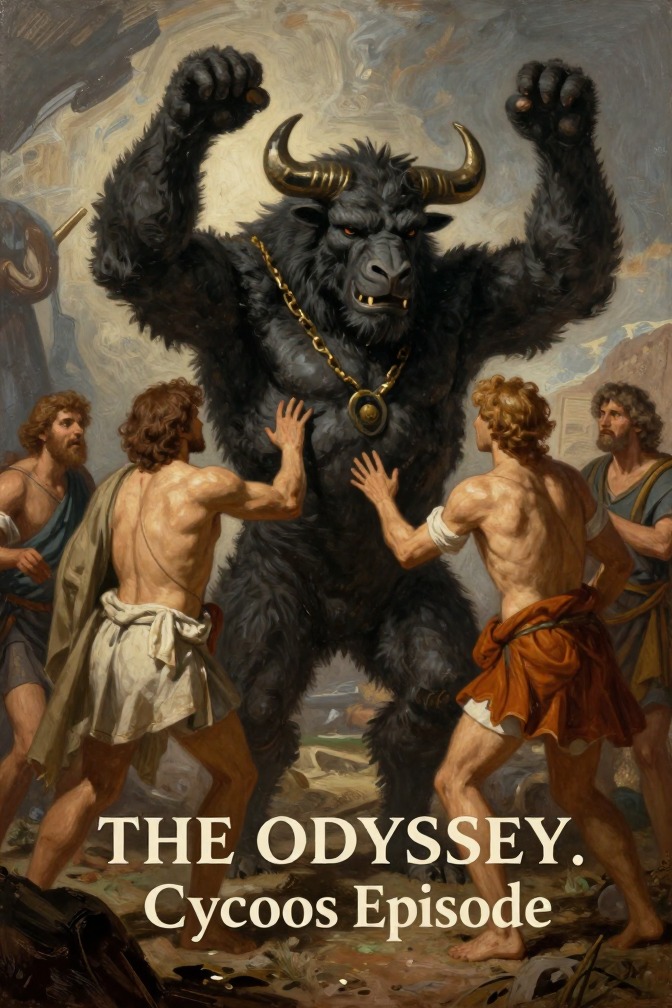
The Cyclops Episode is the first and most iconic of Odysseus's adventures after leaving Troy, a harrowing encounter with the man-eating giant Polyphemus that showcases Odysseus's cunning, his fatal pride, and the enduring curse that prolongs his homecoming.
The formulaic epithet "rosy-fingered Dawn" (Eos) is the most frequently repeated time-marking phrase in the Odyssey, appearing at every major transition from night to day and serving as a structural and thematic anchor that links the poem's oral-formulaic composition to its narrative rhythm of suffering, endurance, and renewal.
The Sirens' song is a deadly enchantment in Homer's Odyssey that lures sailors to their doom on a green island littered with rotting bones; Odysseus, forewarned by Circe, stops his crew's ears with wax and has himself bound to the mast so he can hear the song without perishing, making the episode a defining test of heroic curiosity and self-restraint.
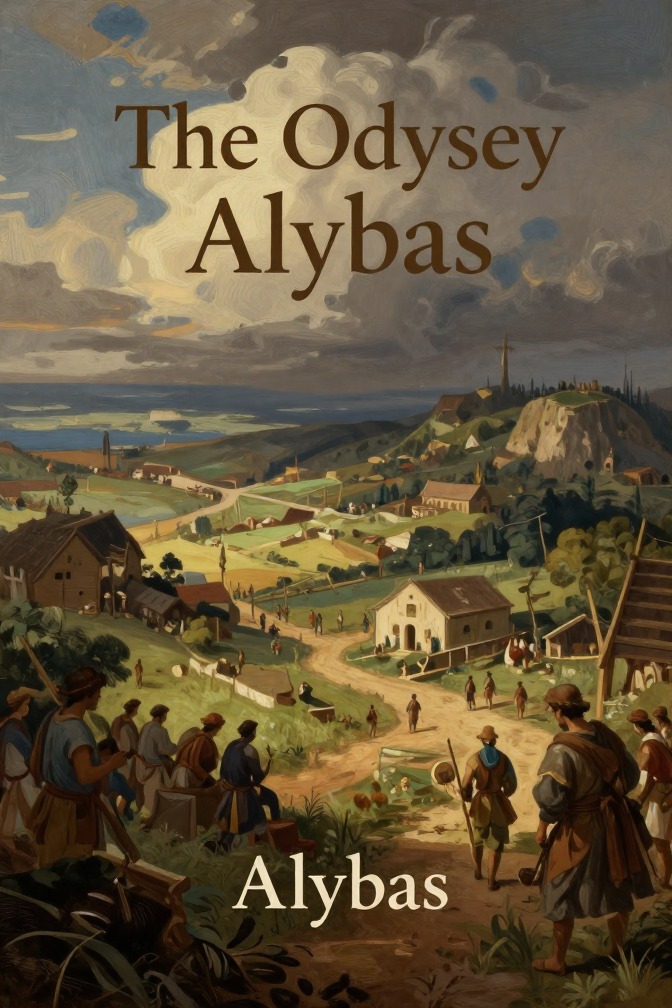
Alybas is a fictional city mentioned only once in the Odyssey, during Odysseus's lying tale to his father Laertes, where he claims to be Eperitus, son of Apheidas, king of Alybas. The name appears to be a deliberate invention, serving as a geographical placeholder within a fabricated identity that Odysseus constructs to test his father's recognition and loyalty.
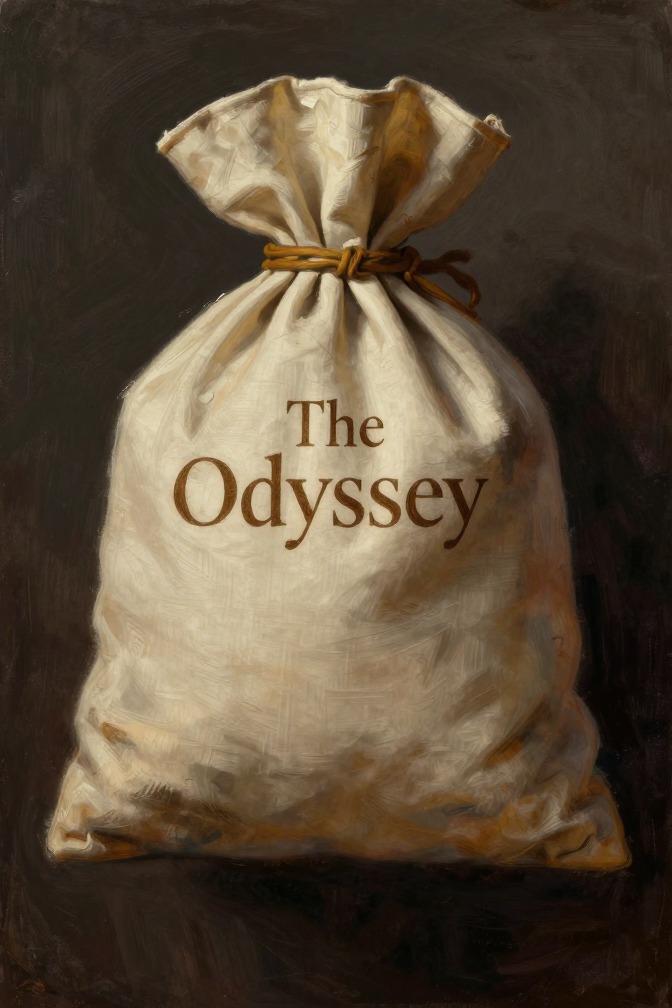
Aeolus' bag is a magical object given to Odysseus by the wind god Aeolus, containing all the winds of the world except the favorable West wind. Its premature opening by Odysseus' crew, who believed it held treasure, unleashes a storm that blows the fleet back to the Aeolian island and destroys their chance of reaching Ithaca, making it a pivotal symbol of human folly and the fragility of homecoming.