Sophie Mauriac is the daughter of Vianne and Antoine Mauriac, whose childhood is shattered by World War II. Forced to grow up far too quickly, she witnesses the deportation of her best friend, Sarah, and the death of her friend's mother, Rachel. She becomes a protector of her younger brother, Daniel (Ari), and a silent witness to her mother's suffering under the Nazi occupation, ultimately embodying the war's profound and lasting impact on the next generation.
The expression "Asking yourself a question, that's how resistance begins" serves as the epigraph to Part Five of the novel, encapsulating the novel's central theme that moral and political resistance originates in an individual's internal act of questioning. It frames the entire second half of the story, particularly Isabelle's journey from impulsive rebellion to deliberate, organized defiance, and marks the moment when passive endurance transforms into active, conscious choice.
The expression "Patriotism is not enough" is a quotation from the British nurse Edith Cavell, executed by the Germans in 1915, and it becomes a touchstone for Isabelle Rossignol's evolving understanding of resistance, sacrifice, and love in Kristin Hannah's The Nightingale. For Isabelle, the phrase first represents a call to action beyond national loyalty, but as the war deepens, she learns that patriotism alone cannot sustain the personal costs of her work as a passeur, and that love—for her sister, for Gaëtan, for the men she saves—must be the deeper foundation of her courage.
The Champs Élysées is a major Parisian boulevard that serves as a symbol of French national pride and cultural identity, whose occupation by German forces during World War II becomes a central image of the nation's subjugation and loss.
Normandy is the region in northern France where the Allied invasion (D-Day) took place in June 1944, a pivotal event that reshaped the war's final year and directly impacted the lives of the characters in Carriveau. For Vianne, the invasion brought hope of liberation but also intensified Nazi reprisals, while for Isabelle, the coded message signaling the invasion sent Gaëtan into immediate action.
San Sebastián is the Spanish coastal city that served as the terminus of the Nightingale escape route, where Isabelle Rossignol (code name the Nightingale) delivered downed Allied airmen to the British consulate after leading them across the Pyrenees. It was the only safe destination in the entire network, the place where the phrase "The Nightingale has sung" signaled success, and the site where Isabelle secured the funding that kept the route operational.
Vianne Mauriac and Daniel/Ari de Champlain (adoptive mother and son) is a relationship forged in the crucible of the Nazi occupation of France, defined by Vianne's desperate promise to her deported best friend, Rachel, and her subsequent transformation from a cautious, rule-following woman into a courageous protector who risks her life to hide a Jewish child. The bond is built on a necessary lie—that Ari is her adopted son, Daniel—and is tested by the constant threat of discovery, the trauma of Vianne's rape by the SS officer billeted in her home, and the ultimate, heartbreaking separation when Ari is reclaimed by his surviving relatives after the war. This relationship is the central axis of Vianne's moral awakening and her most profound experience of love, loss, and the cost of survival.
Vianne Mauriac and her son Julien Mauriac share a relationship defined by love, protection, and a fundamental lack of knowledge. In the present-day frame of the novel, Julien is a caring, controlling surgeon who manages his elderly, dying mother's life, believing he knows her. Vianne, however, has spent a lifetime hiding the traumatic truths of her wartime past—the rape, the murder, the secret heroism—to protect the incomplete version of herself that her son loves. Their relationship is the narrative engine for the book's frame story, forcing Vianne to finally confront her past and decide whether to be known before she dies.
The curfew imposed by the Nazi occupation of Carriveau was a foundational instrument of control, enforced from the first day of occupation and carrying the threat of immediate violence or death for violators. It transformed the daily rhythms of the town, criminalizing movement after dusk and forcing the entire population into a state of constant, fearful compliance. The rule was announced by Sturmbannführer Weldt of the Gestapo during the initial assembly in the town hall, where he declared a nine P.M. curfew instantly in effect, along with the requirement that no lights be on after dusk. This decree was not a suggestion but a lethal boundary: any act of sabotage, espionage, or resistance would be punished by death, and the curfew itself became the most intimate and inescapable expression of that threat. For characters like Isabelle Rossignol, the curfew was a direct challenge to her defiance, a line she repeatedly crossed in her work for the Resistance, while for Vianne Mauriac, it was a cage that defined the limits of her world and the safety of her daughter.
The Punishment for hiding Jews was a Nazi decree in occupied France that made sheltering Jewish people a capital offense, punishable by death or deportation to concentration camps. It transformed ordinary acts of compassion into life-threatening crimes, forcing French citizens to choose between moral duty and survival.
The Prohibition of Aiding Allied Pilots was a Nazi decree issued during the occupation of France, which declared that any person who assisted downed Allied airmen would face immediate execution (for men) or deportation to a concentration camp (for women). This rule was part of a broader system of repressive laws designed to isolate and destroy the French Resistance, and it created a climate of extreme danger for anyone who chose to help the enemy.
The Jewish deportation order was a Nazi policy enacted in occupied France that mandated the systematic arrest, assembly, and transport of Jewish residents—first foreign-born, then all Jews—to concentration and extermination camps in Germany, enforced by French police and German forces with lethal consequences for those who resisted or aided the targeted.
The STO decree (Service du Travail Obligatoire) was a compulsory labor service imposed by the Vichy government under Nazi pressure, requiring French men between eighteen and fifty to work in German factories. It drove thousands of young men into hiding, swelling the ranks of the Maquis guerrilla resistance, and became a defining mechanism of coercion and collaboration in occupied France.
The Battle of the Somme (1916) is a World War I battle that functions in the novel as a traumatic historical antecedent, shaping the post-war lives of the Rossignol family and serving as a recurring point of reference for the characters' understanding of war, loss, and the long-term psychological damage inflicted on survivors.
Christmas in The Nightingale is a marker of time and a symbol of lost innocence, appearing in the pre-war idyll of 1939 and the desperate winter of 1940, where it underscores the contrast between the family's former happiness and the brutal realities of occupation.
Halloween is a minor holiday mentioned in the attic inventory of Vianne Mauriac's steamer trunk, where a box marked 'Halloween' sits among other seasonal decorations, symbolizing the ordinary domestic life she is leaving behind as she prepares to move into a retirement home.
The winter of 1940 was the coldest anyone could remember, a season of extreme deprivation and suffering that tested the limits of human endurance for the people of Carriveau and all of Occupied France. It was a time when the war's abstract horrors became a tangible, daily reality of freezing cold, starvation, and the constant threat of Nazi violence, forcing characters like Vianne and Isabelle into desperate acts of survival and resistance.
World War I, referred to in the novel as the Great War, is a foundational trauma that shapes the lives of the Rossignol family and the entire generation of French characters in The Nightingale. Its aftermath—broken men, shattered families, and a deep-seated fear of conflict—directly informs the choices made during World War II, creating a cycle of loss, silence, and the desperate need to protect what remains.
Willy Loman is the sixty-three-year-old traveling salesman at the center of Arthur Miller's Death of a Salesman, a man whose desperate faith in the American dream of being "well liked" and materially successful drives him to psychological collapse and, ultimately, suicide. His life is a battleground between the promise of a transformed tomorrow and the humiliating reality of a career in ruins, a fractured family, and a mind that can no longer distinguish between past glory and present failure.
The West is a recurring geographical and symbolic concept in Arthur Miller's Death of a Salesman, representing an alternative to the urban, commercial world of New York and embodying Biff Loman's desire for a life of physical labor, open space, and personal authenticity.
The Boston discovery is the pivotal scene in which Biff Loman, having traveled to Boston to seek his father's help after flunking math, inadvertently discovers Willy Loman's extramarital affair with The Woman, shattering Biff's idealized image of his father and precipitating the collapse of the Loman family's shared dream.
The woods are burning is a recurring expression used by Willy Loman to convey a sense of imminent crisis, desperation, and the collapse of his carefully maintained illusions, particularly when he feels trapped by his failures and the pressures of his life.
Ebbets Field, the former home of the Brooklyn Dodgers, serves in Arthur Miller's Death of a Salesman as the symbolic stage for Biff Loman's greatest triumph and the moment his life's trajectory decisively turns. It is the site of the All-Scholastic Championship football game, where Biff, as team captain, promises his father a touchdown, and it becomes the fixed point in Willy Loman's memory against which all subsequent failure is measured. The stadium represents the peak of the Loman family's hopes and the beginning of their unraveling.
Bill Oliver's fountain pen is the object Biff Loman impulsively steals from his former employer's office during a failed attempt to secure a loan, an act that crystallizes his lifelong pattern of theft and self-sabotage and forces the final confrontation between Biff and his father, Willy Loman.
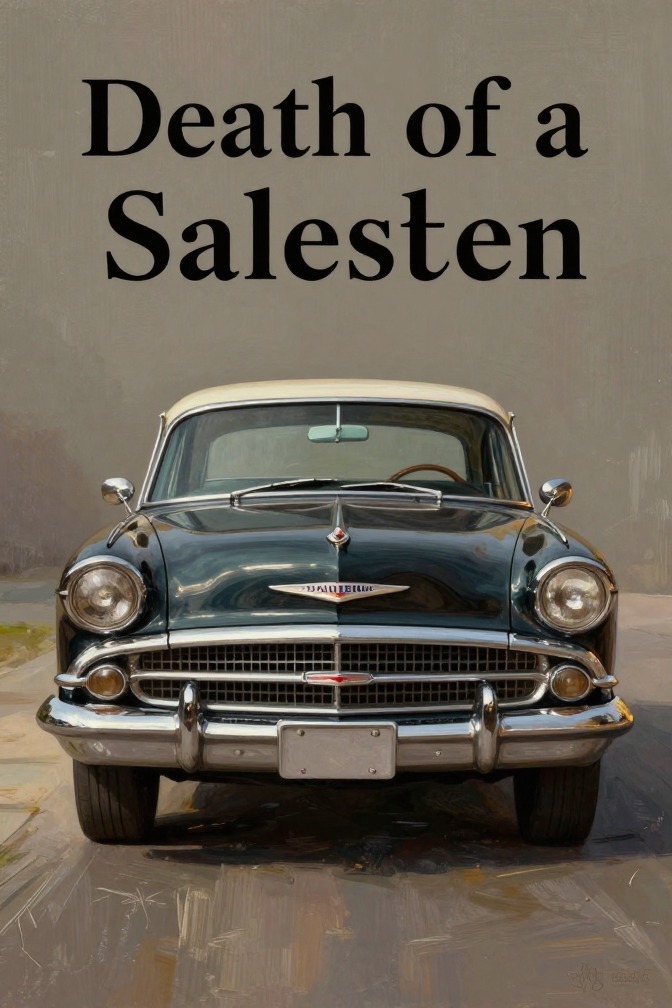
The car in Death of a Salesman is both a practical object and a powerful symbol of Willy Loman's deteriorating life, his failed dreams, and his suicidal intentions. It appears in multiple forms—a 1928 red Chevrolet associated with past glory, a failing Studebaker in the present, and the vehicle of his final, fatal act.
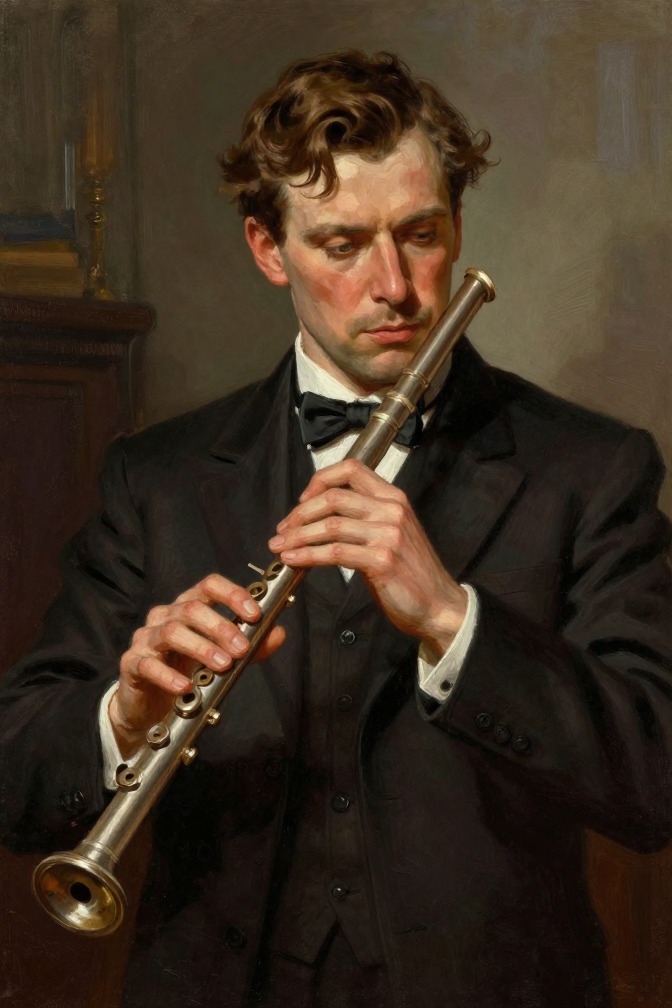
The flute is a recurring musical motif in Arthur Miller's Death of a Salesman, serving as a sonic emblem of Willy Loman's lost past, his father's abandonment, and the unattainable promise of the American frontier. It opens and closes the play, weaving through memory and reality to mark the gap between the natural world Willy yearns for and the urban confinement that crushes him.
The relationship between Biff Loman and Bill Oliver is a central, disillusioning thread in Arthur Miller's Death of a Salesman, representing the collapse of Biff's inherited dream of success through personal charm and the painful revelation of his own self-deception. Oliver, a wealthy sporting-goods magnate for whom Biff once worked as a shipping clerk, becomes the object of Willy Loman's desperate hope that his son can secure a loan to buy a ranch. Biff's attempt to rekindle this connection ends in humiliation, theft, and a final, shattering confrontation with the truth about his past and his father's illusions.
Biff Loman and Happy Loman are the two sons of Willy and Linda Loman, whose relationship is defined by a shared past of youthful promise, a present of mutual disappointment and divergent paths, and a final rupture that leaves each brother facing a different future.
Willy Loman and Happy Loman are father and son, but their relationship is defined by Happy's role as a loyal, supportive, and often enabling presence who seeks to soothe his father's anxieties and fulfill his dreams, even as he remains trapped in the same materialistic values that destroy Willy.
Willy Loman and Linda Loman are husband and wife whose relationship is defined by Linda's unwavering devotion, her role as Willy's emotional and practical support, and her desperate attempts to shield him from the consequences of his failures, even as she becomes a victim of his delusions and his suicidal trajectory.