The VIP Section is a designated area within the Christiania guard-house for homeless individuals deemed respectable, offering a private cell and preferential treatment, but its privileges are contingent on social performance and can be revoked arbitrarily.
Bakery No Credit is a recurring informal rule in Knut Hamsun's Hunger that governs the protagonist's access to food, reflecting the broader economic and social exclusion he faces. The rule manifests in multiple interactions where the protagonist is denied credit or forced into humiliating transactions, underscoring his poverty and the rigid, unforgiving nature of the society he inhabits.
Editor Advances Payment is a recurring rule of conduct in Knut Hamsun's *Hunger*, whereby the newspaper editor known as the Commandor offers the starving protagonist an advance on future work, an act that both sustains the narrator's life and deepens his shame by transforming a professional relationship into one of charity.
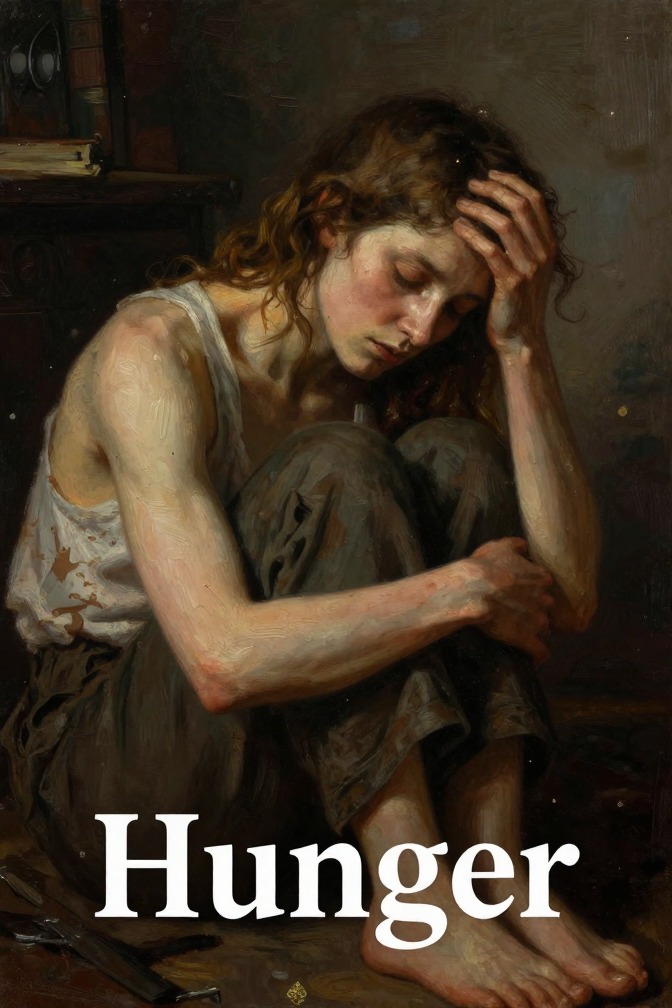
Poverty is the central, relentless condition that defines the protagonist's existence in Knut Hamsun's *Hunger*, functioning not merely as a lack of money but as a totalizing state that erodes his physical health, mental stability, social identity, and moral compass, driving the novel's episodic plot and its profound exploration of human endurance and degradation.
The night journey to save Melinda Moores is the clandestine operation in which Paul Edgecombe, Brutus Howell, Harry Terwilliger, and Dean Stanton smuggle the condemned prisoner John Coffey out of Cold Mountain Penitentiary to the home of Warden Hal Moores, where Coffey miraculously heals the warden's wife of a fatal brain tumor. This event is the moral and narrative fulcrum of the novel, transforming Coffey from a passive victim of the justice system into an active agent of grace, and forcing the guards who participate to confront the terrible irony that they are about to execute an innocent man who has just saved a life.
Beverly McCall, a Black woman condemned to death for murdering her unfaithful husband, was the only female prisoner ever held on E Block at Cold Mountain Penitentiary. Her brief stay is remembered for her request to die under her African spirit-name, Matuomi, and for the last-minute commutation that sent her to a women's prison instead of the electric chair. Decades later, Paul Edgecombe recognized her obituary as a beloved small-town librarian, a transformation that underscores the novel's meditation on the gap between a person's worst act and their full humanity.
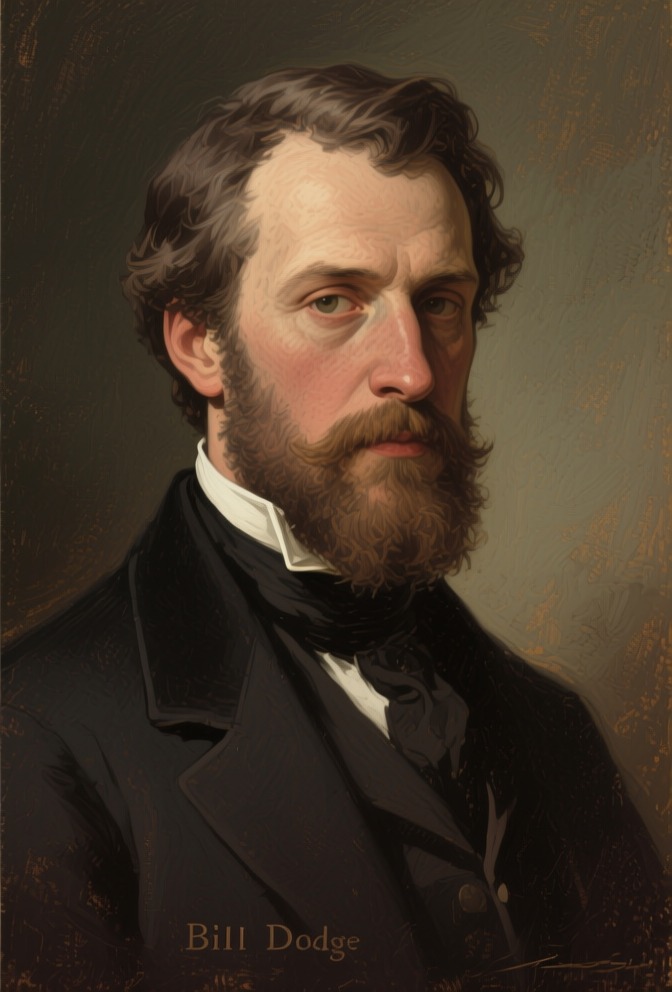
Bill Dodge is a veteran Cold Mountain guard and a frequent floater on E Block, known for his steady competence, dry humor, and a tendency to look on the bright side that sometimes grates on his colleagues. He is present at key moments of the story, from the first appearance of the mouse to the botched execution of Eduard Delacroix, and his actions and observations help define the normal routines and the mounting tensions on the Green Mile.
Hal Moores is the warden of Cold Mountain Penitentiary during the events of 1932, a fundamentally decent and competent administrator whose personal life is shattered by his wife Melinda's terminal brain tumor. His quiet integrity and political savvy shape the moral atmosphere of E Block, but his desperate love for his dying wife ultimately draws him into the most extraordinary secret of Paul Edgecombe's career.
Janice Edgecombe, the wife of Paul Edgecombe, is a steadfast, perceptive, and emotionally resilient woman whose quiet strength and moral clarity anchor her husband through the moral crises of his work on the Green Mile. She is the one who pushes Paul to confront the full implications of John Coffey's innocence and who, in the aftermath of the botched Delacroix execution, forces him to see that inaction is a form of complicity.
The botched execution of Eduard Delacroix is the most gruesome and morally catastrophic event in The Green Mile, a state-sanctioned killing that becomes a prolonged, agonizing torture because Percy Wetmore deliberately used a dry sponge, causing the electric chair to burn Delacroix alive rather than kill him instantly. The event shatters the professional composure of the guards, exposes Percy's sadistic malice, and sets in motion the desperate night journey to save Melinda Moores, as Paul Edgecombe and his men seek atonement for their complicity in this horror.
After Percy Wetmore stomps Mr. Jingles, breaking the mouse's back and leaving him dying on the Green Mile, John Coffey calls for the mouse to be given to him. Taking the broken animal in his cupped hands, Coffey inhales deeply, and when he exhales a cloud of black insects that turn white and vanish, Mr. Jingles is restored to life, whole and running again. This event is the second public demonstration of Coffey's supernatural healing power, confirming for Paul Edgecombe and the other guards that his gift is real and not limited to humans, and it deepens their moral crisis over executing an innocent man.
In the aftermath of William Wharton's violent arrival on E Block, Paul Edgecombe, suffering from a severe urinary infection, enters John Coffey's cell alone. Coffey places his hand on Paul's groin, and a jolt passes through him, instantly curing the infection. Coffey then coughs out a cloud of black insects that turn white and disappear, revealing his supernatural healing power.
Percy Wetmore, the cruel and politically connected guard, deliberately stomps on Delacroix's pet mouse Mr. Jingles, breaking its back and nearly killing it, an act of pure malice that sets off a chain of horror and miraculous healing.
The prayer 'Baby Jesus, meek and mild, pray for me, an orphan child' is a simple, childlike invocation spoken by John Coffey moments before his execution, revealing his innocence, vulnerability, and orphan-like isolation, and serving as a stark contrast to the institutional violence of the state.
Praise Jesus, The Lord Is Mighty is a recurring exclamation and doctrinal phrase that anchors the folk-Christian worldview of Paul Edgecombe's childhood in the piney-woods churches of the rural South. It appears at moments of miraculous healing, moral reckoning, and narrative reflection, serving as both a sincere expression of faith and a measure of the distance between the simple belief of Paul's youth and the terrible ambiguities he confronts on the Green Mile.
Sainte Marie, Mère de Dieu, priez pour nous, pauvres pécheurs is a Catholic prayer—the Hail Mary in Cajun French—that Eduard Delacroix recites moments before his execution, marking his final act of spiritual preparation and revealing the depth of his fear and need for mercy.
The Big Juicy is a sardonic nickname for the electric chair at Cold Mountain Penitentiary, used by inmates to defuse their terror of the state's ultimate punishment. The term appears throughout Paul Edgecombe's account of the 1932 executions, marking the gallows humor that pervades E Block and contrasting sharply with the grim reality of the chair's function.
The Mouse on the Mile is the name given by the guards of E Block to a remarkable brown mouse that appeared on death row in the summer of 1932, later adopted by condemned prisoner Eduard Delacroix and renamed Mr. Jingles. More than a pet, the mouse becomes a touchstone of humanity, a target of cruelty, a recipient of John Coffey's healing power, and a living symbol of the story's central themes of innocence, suffering, and the possibility of grace within a place of execution.
The Two Dead Girls is the title of Part One of Stephen King's serial novel The Green Mile, referring to the nine-year-old Detterick twins, Cora and Kathe, whose rape and murder by William Wharton—for which John Coffey is wrongly convicted and executed—sets the entire narrative in motion. The phrase functions as both a literal description of the crime and a thematic anchor for the novel's exploration of innocence, injustice, and the failure of the legal system.
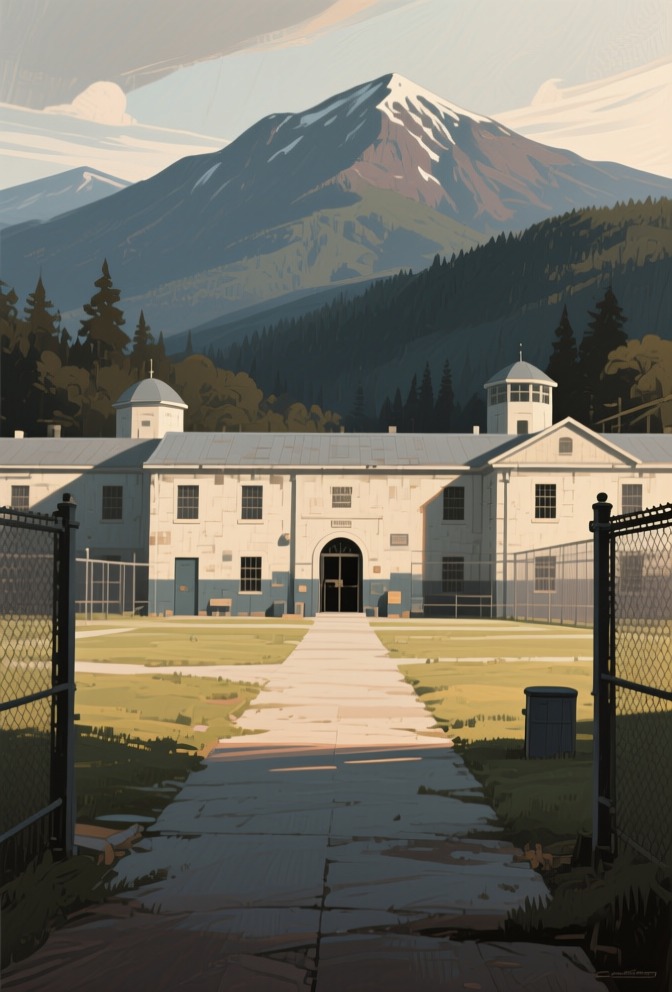
Cold Mountain Penitentiary is the Depression-era state prison in an unnamed Southern state where the novel's central events unfold, housing E Block—the death-row unit whose green-linoleum corridor gives the book its title. It is the site of all major executions, including those of John Coffey, Eduard Delacroix, and Arlen Bitterbuck, and the workplace of narrator Paul Edgecombe and his fellow guards. The prison's physical layout—the Green Mile, the restraint room, the storage shed containing the electric chair Old Sparky, and the tunnel beneath the highway—structures the narrative's geography of punishment and mercy.
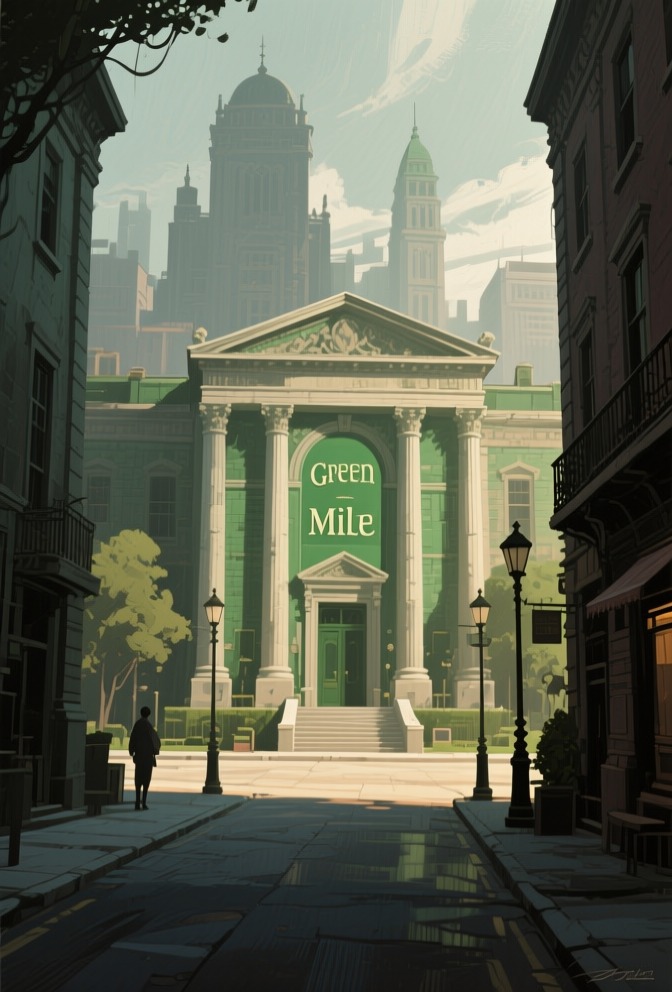
The Green Mile is the lime-colored linoleum corridor that runs the length of E Block at Cold Mountain Penitentiary, serving as the final walk for condemned men on their way to the electric chair, Old Sparky. It is the central symbolic and physical space of the novel, a place where the boundary between life and death is measured in sixty paces, and where the story's most profound encounters between guards and prisoners take place.
The administration building at Cold Mountain Penitentiary is the nerve center of the prison, housing the warden's office, the assistant warden's office, and the clerical staff. It is the site of key decisions regarding executions, prisoner transfers, and the management of E Block, and it serves as the location where Paul Edgecombe receives official orders and reports, including the death warrant for John Coffey.
The croquet course is a grassy area at the Georgia Pines retirement home, where the elderly narrator Paul Edgecombe often walks and reflects on his past. It serves as a transitional space between the main building and the woods where he keeps a secret, and is also a site of minor confrontations with the orderly Brad Dolan.
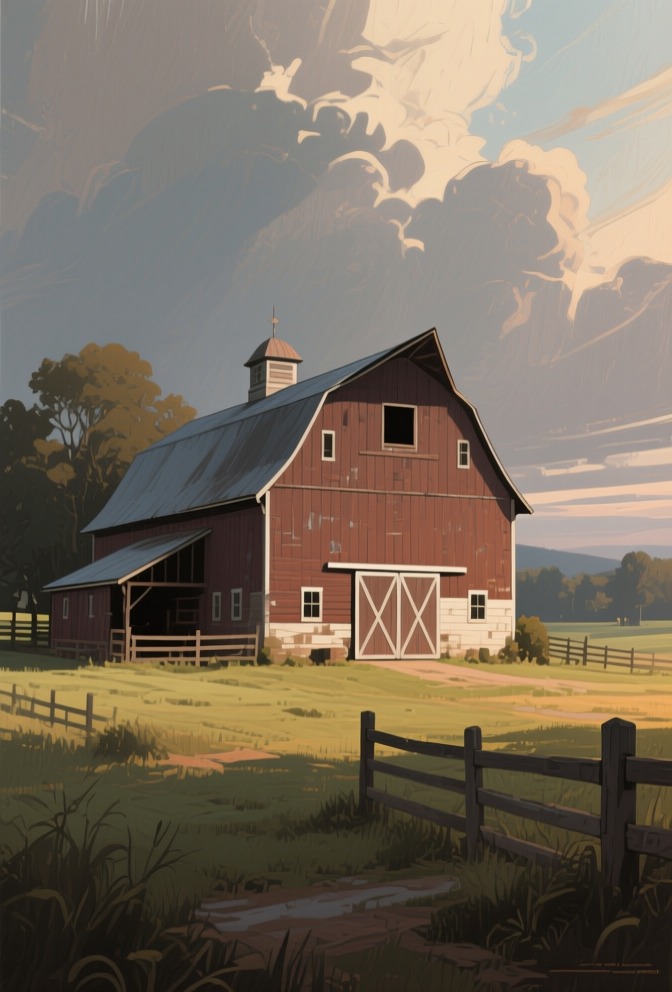
The Detterick barn is a key location in the backstory of the Detterick family, where Klaus Detterick hired a man named Will Bonney—later revealed to be the murderer William Wharton—to paint the barn in May 1932, a month before the abduction and murder of the Detterick twins. This seemingly mundane farm structure becomes a crucial piece of evidence in Paul Edgecombe's investigation, as it establishes Wharton's prior contact with the family and his opportunity to learn the girls' habits, ultimately proving John Coffey's innocence.
The Detterick porch is the screen-enclosed side porch of the Detterick farmhouse in Trapingus County, where nine-year-old twins Cora and Kathe Detterick were abducted on a warm June night in 1932, an event that sets the central crime of the novel in motion and leads to the wrongful conviction of John Coffey.
The doghouse at the Detterick farm is the site where Bowser, the family's half-breed collie, was killed by the man who abducted the Detterick twins, a murder that became a key piece of circumstantial evidence at John Coffey's trial.
The Grassy Valley Penal Facility for Women is a prison in the state of the novel, mentioned as the destination for Beverly McCall after her death sentence is commuted. It serves as a contrasting alternative to the electric chair at Cold Mountain, representing a form of life-in-prison that is still punishment but not execution.
The Heavenly Light Baptist Church is the church of Brother Schuster, the minister who provides spiritual comfort to condemned prisoners on E Block at Cold Mountain Penitentiary. He officiates at the executions of Arlen Bitterbuck and Eduard Delacroix, and his calm, efficient manner and willingness to accommodate prisoners' specific religious needs—including praying in Cajun French—make him a valued figure in the death house. The church itself is located in the community near Cold Mountain, and Brother Schuster drives down to the prison in his flivver when called upon.
The highway outside Cold Mountain Penitentiary serves as the threshold between the prison's sealed world and the outside, a boundary crossed during the clandestine night journey to save Melinda Moores and, later, the route of the fatal bus crash in Alabama that killed Janice Edgecombe.
The Pasture is the informal name for the prison exercise yard at Cold Mountain Penitentiary, where the general prison population plays flag football and baseball on fall afternoons. It is a space of relative freedom and normalcy, sharply contrasted with the death-row world of E Block, and its existence underscores the deprivation and isolation of the condemned men who can only watch from their cells.