Noah Calhoun's return to New Bern in late 1945, after fourteen years away and the end of World War II, marks the decisive turning point that anchors the novel's present-day frame. It is the moment he buys and begins restoring the 1772 plantation house he had dreamed of as a teenager, re-establishes himself in the community he left behind, and sets the stage for Allie Nelson's return—the reunion that drives the entire narrative. The return is also the event that forces Noah to confront the ghost of his lost love, the memory of Allie, which has haunted him for a decade and a half.
Noah Calhoun suffers a stroke while sitting by his window at the Creekside Extended Care Facility, an event that nearly kills him and leaves him partially paralyzed, yet he ultimately recovers enough to continue his daily ritual of reading to his wife Allie, who has Alzheimer's disease.
The Reunion is the pivotal event in which Allie Nelson, now engaged to Lon Hammond Jr., drives to New Bern and finds Noah Calhoun at his restored plantation home, setting in motion a confrontation between her past and present that will determine the course of her life.
The Storm and Making Love is the pivotal event in The Notebook where Noah Calhoun and Allie Nelson, reunited after fourteen years, consummate their rekindled love during a violent thunderstorm, marking the moment Allie realizes she has fallen in love with Noah again and setting the stage for her ultimate choice between him and her fiancé Lon Hammond Jr.
The Notebook is the handwritten manuscript that Noah Calhoun reads aloud to his wife Allie every day in their old age, serving as the central narrative device of the novel. It contains the story of their youthful summer romance, their separation, and their reunion, and it becomes Noah's primary tool for reaching Allie through the fog of Alzheimer's disease, representing the power of love and memory against the ravages of time.
Brices Creek is the tidal waterway in coastal North Carolina that anchors Noah Calhoun's restored 1772 plantation home and serves as the emotional and geographical heart of The Notebook. It is the site of Noah's daily rituals, the setting of his reunion with Allie Nelson, and the symbolic constant that links their youthful summer of 1932 to their final years together at Creekside Extended Care Facility.
Hoffman-Lane is a department store in New Bern where Allie Nelson buys art supplies during her visit, marking a pivotal moment in her reconnection with her artistic identity.
Lake Matamuskeet is a North Carolina lake that serves as the seasonal destination for migrating tundra swans and Canada geese, and in the novel it becomes the symbolic counterpart to the hidden lake where Noah Calhoun takes Allie Nelson during their reunion, representing the natural instinct for return and the possibility of finding one's true place.
The Trent River is a waterway in North Carolina that serves as a key geographical and symbolic landmark in The Notebook, marking the boundary between New Bern and the rural landscape where Noah Calhoun's restored plantation home sits, and functioning as a threshold that Allie Nelson must cross both physically and emotionally when she returns to confront her past.
Noah's Letters are the unsent correspondence Noah Calhoun wrote to Allie Nelson over two years after their summer romance, intercepted by Allie's mother Anne Nelson and hidden from her for decades. They function as a central symbol of lost time, suppressed love, and the class divide that kept the lovers apart, and their eventual return—alongside the letters Noah wrote throughout their marriage—becomes the emotional and narrative foundation of the novel's exploration of memory, devotion, and the possibility of miracles.
Love in The Notebook is the central, transformative force that defines the lives of Noah Calhoun and Allie Nelson, enduring across decades of separation, social opposition, and the devastating erosion of Alzheimer's disease. It is portrayed as an all-consuming, almost fated connection that transcends logic and common sense, shaping their identities, choices, and ultimate destiny. The novel explores love not as a static emotion but as a dynamic, resilient bond that can be lost, rediscovered, and reaffirmed through memory, sacrifice, and daily acts of devotion, culminating in a miracle that briefly reunites them even as the disease takes hold.
Loneliness is a pervasive emotional and existential state in *The Notebook*, experienced most acutely by Noah Calhoun across decades of separation from Allie Nelson, and later compounded by the isolating effects of aging, class division, and Alzheimer's disease. It shapes his daily life, his relationships, and his understanding of love and memory.
October 1946 is the pivotal month in which Noah Calhoun and Allie Nelson, separated for fourteen years, reunite in New Bern, North Carolina, and rekindle their love over the course of a few intense days, ultimately leading Allie to break her engagement to Lon Hammond Jr. and choose Noah. This month anchors the novel's central narrative, bridging the couple's summer of 1932 with their lifelong marriage and the elderly Noah's daily reading of their story to Allie, who suffers from Alzheimer's disease.
K. has his first conversation with the landlady about Frieda, a pivotal scene in which the landlady, Gardena, confronts K. about his relationship with Frieda, reveals her own past with Klamm, and warns him of the impossibility of speaking to Klamm. This conversation exposes the social hierarchy, the power of the castle, and the precariousness of K.'s position, while also deepening his resolve to seek an interview with Klamm.
K. is questioned by Momus, Klamm's village secretary, at the Castle Inn and refuses to answer, a decision that crystallizes his defiance of the castle's bureaucratic procedures and his determination to pursue his own path to Klamm.
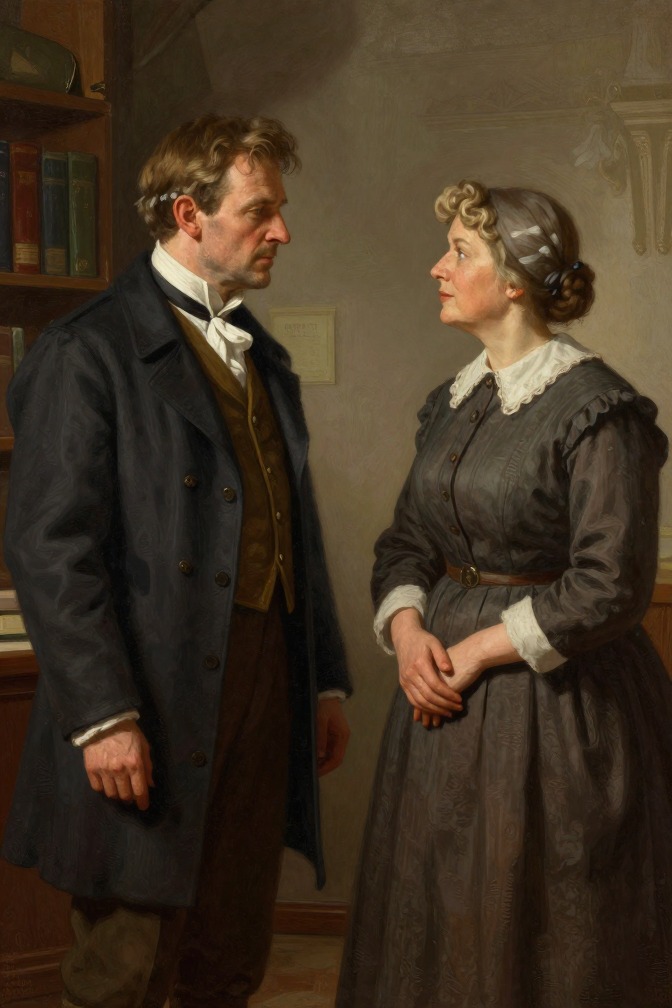
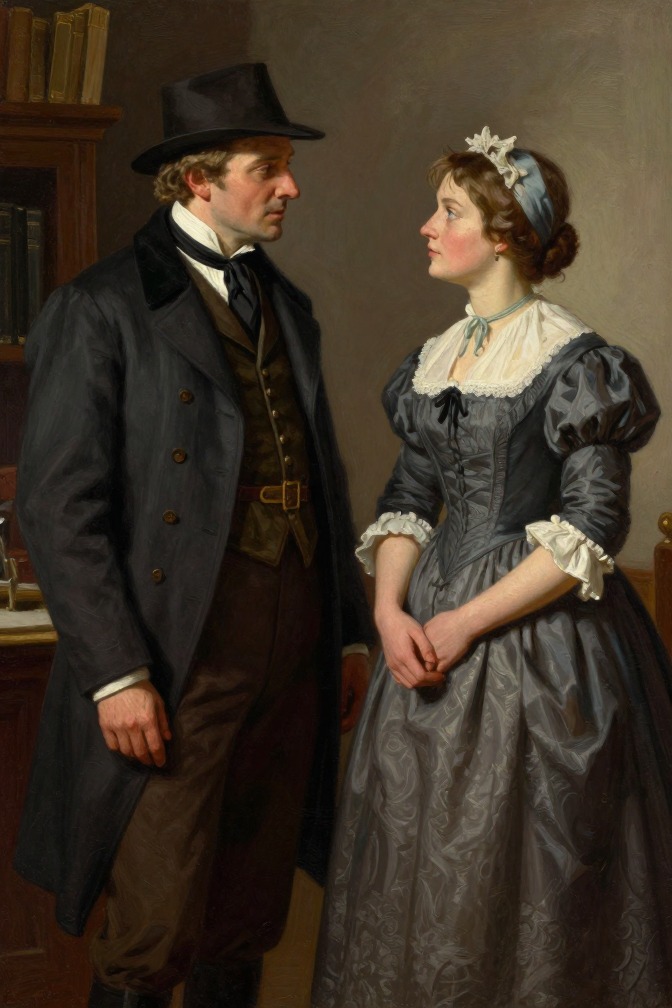
K. talks with the landlady about her dresses is a pivotal scene in which the landlady, having summoned K. to her private office, confronts him about his earlier remark on her clothing, revealing her obsession with fashion and her complex, ambiguous relationship with K. The conversation exposes the landlady's vanity, her desire for recognition, and her underlying hostility toward K., while also providing a rare glimpse into her private world and the social codes of the village. It culminates in her offering K. a new task—to fetch a new dress—and is interrupted by Gerstäcker, who seeks K.'s help with Erlanger.
Artur is one of the two assistants assigned to K., the land surveyor, by the castle authorities. He is introduced as a young man of medium height, very lean, with a dark brown complexion and a black goatee beard, nearly identical to his companion Jeremias. Artur's role is defined by his service to K., which he performs with a mixture of outward obedience and covert resistance, ultimately leaving K.'s service to complain to the castle about his treatment. His character embodies the ambiguous, almost interchangeable nature of the castle's servants and the bureaucratic absurdity that K. confronts.
Lasemann, the master tanner, is a minor but pivotal figure in Franz Kafka's The Castle, whose home becomes the site of K.'s first unsettling encounter with the village's social order and its complex relationship with the castle. His character embodies the villagers' mixture of hospitality and exclusion, and his family's connections—particularly through his brother-in-law Brunswick—link him to the bureaucratic entanglements that define K.'s struggle.
Seemann, the captain of the village fire brigade, is the official who delivers the devastating news of the family's ostracism to Amalia's father, marking the irreversible collapse of their social standing after Amalia's rejection of Sortini's summons.
The move into the schoolhouse marks a decisive turning point in K.'s struggle, as he and Frieda, along with the assistants, exchange the relative comfort of the Bridge Inn for a cold, ill-equipped classroom, triggering a series of humiliations, conflicts with the teacher and Miss Gisa, and the first serious cracks in K.'s relationship with Frieda.
The second letter from Klamm, delivered by Barnabas on a stormy night, is a pivotal event in K.'s struggle with the castle. It praises K.'s non-existent surveying work and his assistants, revealing the castle's misinformed and mocking view of his situation. This letter deepens K.'s despair and prompts him to craft a desperate, formal request for a personal interview with Klamm, marking a turning point in his strategy from passive acceptance to active, direct confrontation.
Erlanger's summons is the pivotal event in which K., after a night of failed waiting and accidental encounters, is finally called before one of Klamm's principal secretaries, only to receive a command that reveals the castle's indifference to his personal struggles and the futility of his efforts.
The First letter from Klamm is the first direct communication K. receives from the castle, delivered by the messenger Barnabas. It formally accepts K. into the count's service, names the village mayor as his immediate superior, and introduces Barnabas as a recurring intermediary. The letter's contradictory tone—alternately recognizing K.'s autonomy and reducing him to a laborer—forces K. to choose his strategy: to work as a village worker to gain access to the castle. This event marks a turning point in K.'s quest, establishing the bureaucratic ambiguity that defines his struggle.
K. meets Frieda, the barmaid at the Castle Inn, and through a series of charged encounters—including her revelation that she is Klamm's lover, his bold declaration of intent, and a night spent together under the bar—they become lovers, an event that radically alters K.'s position in the village and his relationship with the castle.
Gisa's cat is a minor but symbolically charged presence in Franz Kafka's The Castle, appearing in the schoolhouse scenes where K. and Frieda have taken up residence as janitor and his wife. The cat, a large, fat, and nearly immobile animal belonging to the assistant teacher Miss Gisa, becomes the catalyst for a series of humiliations and conflicts that expose the precariousness of K.'s position and the hostility of the village's institutional figures. Its injury, inflicted during a night-time disturbance, leads to Miss Gisa's accusation against K., a physical scratch that draws blood, and a chain of events that culminates in the teacher's attempt to dismiss K. from his post. The cat thus functions as a narrative device that crystallizes the themes of intrusion, blame, and the arbitrary exercise of authority that pervade the novel.
The Letters from Klamm are the only direct written communications K. receives from the castle, and they are central to his struggle for recognition and access. They are paradoxical documents: they seem to confirm his appointment and offer praise, yet they are private, ambiguous, and ultimately reveal the castle's inaccessibility and the futility of K.'s efforts. The letters function as a narrative device that both propels K.'s hopes and exposes the bureaucratic absurdity of the castle's authority.
Messages from Barnabas are the only direct, tangible communications K. receives from the castle, yet they are deeply ambiguous: they arrive through a messenger whose own status is uncertain, contain contradictory signals about K.'s position, and ultimately prove to be old, possibly random documents that reveal more about the castle's inscrutable bureaucracy than about any genuine interest in K. These messages shape K.'s hopes and strategies, but they also expose the fundamental unreliability of all communication with the castle.
The eagle and the slow-worm is a recurring metaphor in Franz Kafka's The Castle, first voiced by the landlady of the Bridge Inn to describe Frieda's abandonment of Klamm for K. It contrasts the majestic, powerful eagle (Klamm) with the lowly, creeping slow-worm (K.), capturing the novel's central themes of social hierarchy, the inaccessibility of the castle, and the perceived degradation of Frieda's choice. The metaphor recurs in K.'s own thoughts and in the landlady's later explanations, becoming a touchstone for the power imbalance between the castle and the village.
The flag on the wall is a childhood memory of K.'s that surfaces during his nocturnal walk with Barnabas, symbolizing a moment of personal triumph and mastery that he clings to in his adult struggles against the castle's authority.
The humming of the telephone is a recurring auditory motif in Franz Kafka's novel The Castle, first heard by K. during his initial telephone call to the castle and later explained by the village mayor as the only reliable information the telephone conveys to the village. It symbolizes the inaccessibility and ambiguity of the castle's authority, embodying the novel's themes of bureaucratic opacity and the elusive nature of official communication.