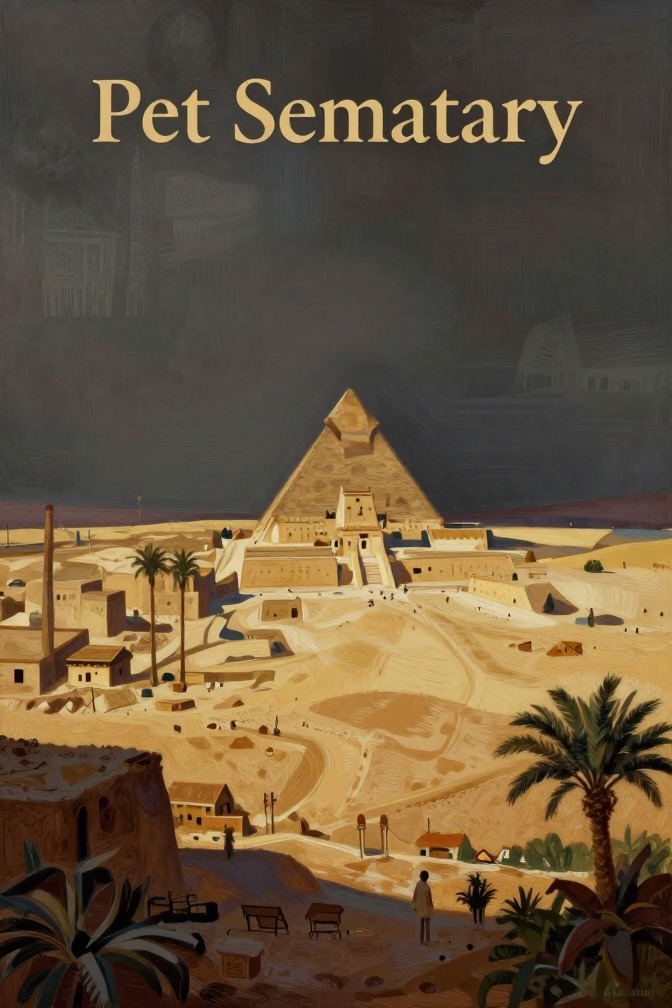
Egypt appears in Pet Sematary as a recurring historical and symbolic reference point, invoked by Louis Creed to frame the novel's central themes of death, burial, and the forbidden desire to reverse mortality. The ancient Egyptian practices of mummification, pyramid-building, and the slaughter of pets for royal tombs serve as a cultural precedent for the Micmac burying ground's power, while also underscoring the novel's argument that the human impulse to deny death is both ancient and universal.
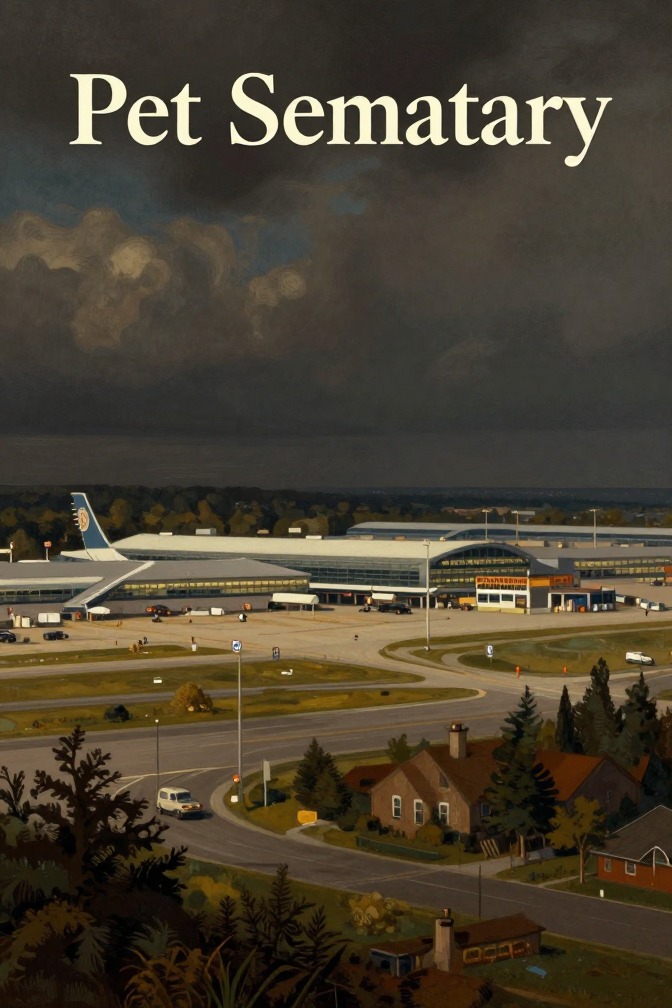
Logan Airport is the Boston airport where Rachel Creed, racing to return to Ludlow after her son Gage's funeral, misses her connecting flight to Portland, Maine, forcing her to rent a car and drive the rest of the way through the night.
Presque Isle is a remote town in Aroostook County, Maine, that serves as the northern entry point for the military coffins shipped home during World War II, including that of Timmy Baterman, and is thus a key node in the novel's geography of death and return.
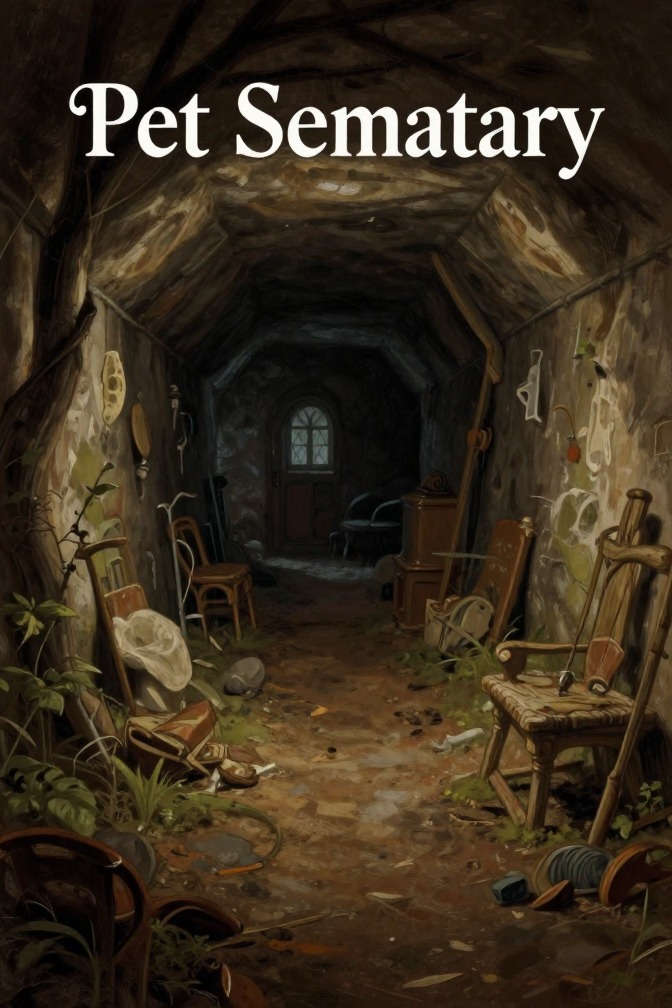
The cellar of the Creed house in Ludlow, Maine, is a dark, unfinished space that becomes a crucial threshold in the novel's supernatural geography. Initially a mundane storage area for tools and beer, it is the site where Louis Creed discovers a broken window that Church uses to re-enter the house after his resurrection, and where Louis later retrieves the beer that fuels his final, fatal decision. The cellar thus functions as a liminal space connecting the domestic world to the buried, corrupting power of the Micmac burying ground, a place where the boundary between the ordinary and the monstrous is breached.
Hampden is a town visible from Prospect Hill, the viewpoint behind the Creed house in Ludlow, Maine, and is one of the communities Louis Creed can see across the Penobscot River valley on his first walk to the Pet Sematary.
The North Ludlow Baptist Church is a landmark visible from Prospect Hill behind the Creed house, serving as a fixed point in the landscape that marks the boundary between the settled town and the wild woods leading to the Pet Sematary and the Micmac burying ground. It is also the site where Norma Crandall's funeral is held, and where Jud Crandall later organizes the funeral of Gage Creed, making it a recurring location for communal rites of passage and grief.
Portland, Maine, serves as a critical waypoint in Rachel Creed's desperate journey back to Ludlow after her son Gage's funeral, a location where her flight connection fails and where she receives Jud Crandall's advice to stop for the night, a warning she ultimately ignores.
Miami appears in Pet Sematary as a distant, almost mythical destination of escape and fantasy, a place where Louis Creed imagines fleeing his grief and his family's doom, and as a real location in a macabre anecdote about a corpse misrouted by an airline.
The North Ludlow Methodist Church is the site of Norma Crandall's funeral, a key event that deepens the novel's exploration of death, grief, and the community's relationship with mortality. It also serves as the location where Jud Crandall recounts the story of Timmy Baterman, a cautionary tale about the dangers of the Micmac burying ground.
Bucksport is a town in Maine that serves as the destination for the Orinco chemical fertilizer trucks whose constant passage along Route 15 past the Creed house forms a recurring motif of danger and death. It is also the site of the Emporium Galorium, where Jud and Norma Crandall shop, and the town where the biggest tosspot this side of Bucksport, Stanny Bouchard, once lived.
Saugus is a town in Massachusetts, mentioned in Stephen King's *Pet Sematary* as the origin of a person who, according to Jud Crandall, would be particularly likely to be harassed by moose in the Maine woods.
Purgatory, in the theological framework of Pet Sematary, is a concept that Louis Creed invokes during a conversation with his daughter Ellie about the afterlife, but the novel itself presents a world where the Catholic doctrine of purgatory is overshadowed by a far more immediate and sinister geography: the Micmac burying ground beyond the Pet Sematary, a place that functions as a literal, pagan purgatory—a liminal space where the dead can be returned to a corrupted form of life, but never to true peace.
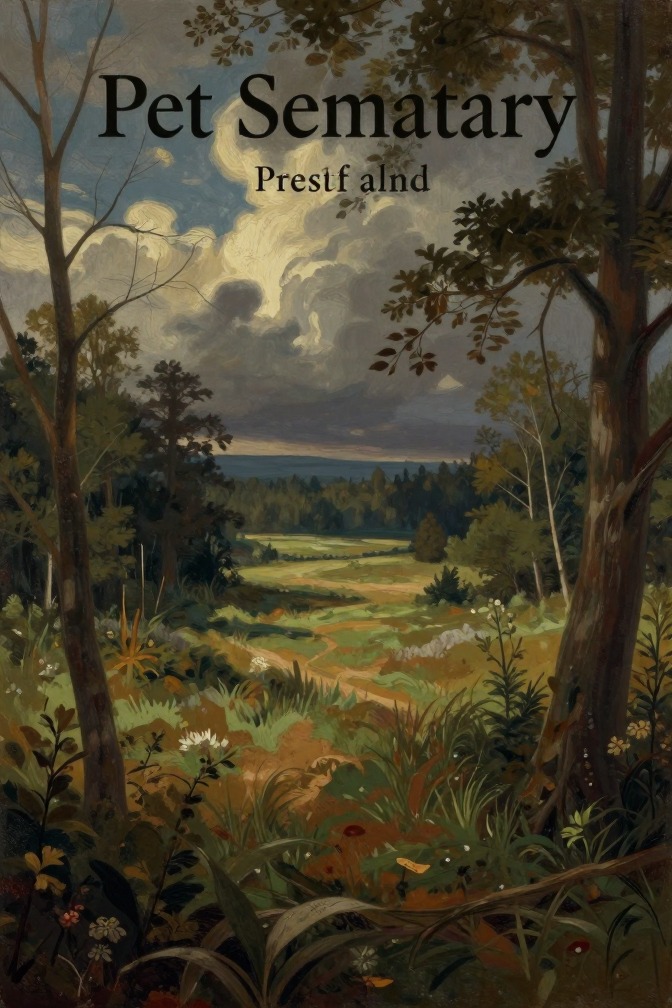
Mrs. Vinton's field is the large, open meadow adjacent to the Creed property in Ludlow, Maine, serving as the immediate threshold between the domestic safety of the Creed home and the wild, increasingly ominous woods that lead to the Pet Sematary and the Micmac burying ground. It is the site of the last genuinely happy day of Louis Creed's life—March 24, 1984—when he and his son Gage flew a Vulture kite there, a moment of pure, unshadowed joy that stands in stark contrast to the horrors that follow. The field functions as a liminal space, a pastoral buffer zone that is both a place of innocent play and the last point of civilization before the characters step into the supernatural wilderness.
The Penobscot River is a major waterway in Maine that flows past the town of Ludlow, serving as a geographical landmark visible from Prospect Hill behind the Creed house and as a boundary marker for the region's logging history and the town's location relative to Bangor and Derry.
Aroostook County is a remote, heavily forested region in northern Maine that serves as the setting for the most extreme and dangerous part of the wilderness beyond the Pet Sematary. It is the place where the Micmac burying ground's power is strongest, and it is associated with the Wendigo, a malevolent spirit of the north country. The county is mentioned in the context of a gruesome story about a corpse that was mishandled during transport, and it represents the ultimate, untamed frontier of the novel's supernatural geography.
Louis's study is the private workspace where Louis Creed retreats for model-building, professional writing, and solitary reflection, and it becomes the setting for his pivotal conversation with Ellie about death and the mortality of her cat Church.
Boston is a major city in New England that serves as a critical transit hub in the novel, where Rachel Creed's attempt to return home to Ludlow is thwarted when she misses her connecting flight, forcing her to drive through the night and setting the stage for the final tragedy.
Florida is a recurring geographical reference in Stephen King's *Pet Sematary*, serving as a symbolic destination of escape, fantasy, and failed redemption for Louis Creed. It first appears in Louis's desperate fantasy of fleeing his new life in Ludlow, Maine, to work as a medic at Disney World, and later becomes the imagined setting for a hoped-for new life with a resurrected Gage. Ultimately, Florida remains an unreachable dream, its promise of a fresh start destroyed by the inescapable consequences of the Micmac burying ground.
The Creed living room is the central domestic space of the Creed family home in Ludlow, Maine, where the family gathers for meals, conversation, and quiet evenings. It is the site of key emotional confrontations, including Louis and Rachel's argument about death and the Pet Sematary, and later becomes a space of eerie stillness and dread after Gage's death, where Louis sits alone playing solitaire, awaiting the return of his resurrected wife.
Providence, Rhode Island, is the city where Louis Creed travels in October 1984 to present a paper at the New England Conference on College and University Medicine, a professional milestone that marks his growing confidence in his new role as director of the University of Maine infirmary and his psychological distance from the traumatic death of Victor Pascow.
Houlton is a town in Aroostook County, Maine, that serves as a minor but significant waypoint in the novel's backstory, appearing as the first stop on a World War II funeral train carrying the body of Timmy Baterman back to Ludlow.
Canada is a northern country referenced in *Pet Sematary* as the ancestral homeland of the Micmac Indians, whose ancient burial ground—the source of the novel's supernatural horror—lies in the Maine woods near Ludlow. The Micmacs' migration from Canada is tied to the legend of the Wendigo, a malevolent spirit of the north country that, according to local lore, soured the ground of the burial place and gave it its dangerous, resurrective power.
New Jersey is the home state of Victor Pascow, the student whose fatal accident and dying words initiate the supernatural horror that haunts Louis Creed. It also serves as a geographical marker of the ordinary, distant world from which the story's uncanny events are separated.
Ludlow is the small Maine town where Louis Creed and his family move at the start of the novel, a place that initially seems idyllic but becomes the setting for a series of supernatural horrors centered on the Pet Sematary and the ancient Micmac burying ground beyond it.
The ambulance at the University of Maine's Student Medical Center is a critical piece of infrastructure that fails at a crucial moment, symbolizing the inadequacy of institutional systems in the face of sudden, catastrophic death and foreshadowing the novel's central theme of helplessness against mortality.
The blood-soaked carpet in the Student Medical Center waiting room is the first material trace of Victor Pascow's violent death, and its replacement becomes a bureaucratic footnote that forces Louis Creed to confront the irreducible physical reality of the catastrophe that opens the novel's supernatural plot.
Gage Creed's director's chair, a small canvas-and-wood seat with his name stenciled across the back, becomes a charged relic after his death, embodying his sister Ellie's refusal to let him recede into memory. She sits in it, though she has outgrown it, and carries it into her room as a physical anchor for her hope that he might return.
The Gerrypack is a baby carrier used by Louis Creed to carry his son Gage during the family's first hike to the Pet Sematary, a journey that introduces the Creed family to the ominous burial ground and foreshadows the physical and emotional burdens Louis will later bear.
The keys to the Creed family's new house in Ludlow, Maine, are a recurring object that marks the transition from chaos to belonging, from outsider to insider, and from the rational world to the supernatural. They first appear as a source of frustration on moving day, then as a symbol of welcome and trust when Jud Crandall offers his own set, and finally as a tool of self-destruction when Louis Creed uses them to lock his family out of their home and into a nightmare.
Louis Creed's medical bag is a black doctor's bag that serves as a crucial object throughout the novel, symbolizing his professional identity as a physician and his ultimate failure to protect his family from death. It contains the tools of his trade—syringes, morphine, and a scalpel—which he initially uses for legitimate medical purposes but later repurposes for grave-robbing, euthanasia, and self-defense. The bag's contents become instruments of both healing and destruction, reflecting Louis's descent from rational doctor to desperate father who defies the natural order.