The protagonist, starving and desperate, signs on as a crew member aboard the Russian barque Copégoro, bound for Leith and then Cadiz, in a final act of surrender to his fate and departure from Christiania.
Christy is a grocer in Groenlandsleret who briefly considers the protagonist for a bookkeeping position but rejects him due to a trivial date error on his application, embodying the indifferent, arbitrary forces that thwart the narrator's desperate attempts at survival.
The Commandor is the editor of a Christiania newspaper who serves as the protagonist's most significant professional gatekeeper and occasional benefactor, embodying both the literary establishment's standards and the possibility of unexpected mercy in Knut Hamsun's Hunger.
Scissors is the unnamed editorial assistant at the newspaper office where the narrator submits his manuscripts, a minor but recurring figure whose brusque indifference and bureaucratic routine embody the narrator's marginalization and the impersonal machinery of literary rejection.
Theft in Knut Hamsun's *Hunger* is not a simple act of criminality but a complex moral and psychological event that marks the protagonist's deepest crisis of honor and self-worth. It functions as a recurring temptation, a concrete transgression, and a catalyst for shame, confession, and a desperate attempt at moral restitution, ultimately revealing the corrosive effects of extreme poverty on the narrator's conscience.
The acceptance of the narrator's story for ten shillings marks a rare moment of triumph in his life of starvation and despair, providing temporary relief and a surge of hope that briefly lifts him from the depths of poverty.
The Tivoli is a theatre of varieties, garden, and entertainment venue in Christiania that appears in Knut Hamsun's *Hunger* as a site of sensory stimulation, social contrast, and the protagonist's fluctuating psychological states. It serves as a backdrop for moments of acute observation, erotic fantasy, and the painful collision between the narrator's destitution and the city's leisure culture.
Vaterland is the working-class district of Christiania where the narrator finds shelter during the final phase of his starvation ordeal, a lodging-house district that becomes the stage for his most acute physical and moral collapse.
The key is a recurring object in Knut Hamsun's *Hunger* that marks the protagonist's descent into homelessness and his desperate, often irrational, attempts to maintain a semblance of order and dignity. Its loss, recovery, and symbolic use chart the erosion of his domestic stability and his psychological unraveling.
The Bone is a raw, gnawed object the starving narrator obtains from a butcher by claiming it is for a dog, then desperately tries to eat in a dark alley, only to vomit repeatedly, finally hurling it away in a fury that culminates in a blasphemous curse against God.
The pencil is a seemingly trivial object that becomes a central symbol of the narrator's creative ambition, his desperate poverty, and the fragile link between his intellectual aspirations and his physical survival. Its loss, recovery, and repeated use mark the rhythm of his struggle to write, to earn money, and to maintain his sanity.
The half-sovereign is a recurring monetary object in Knut Hamsun's *Hunger* that marks the protagonist's most extreme encounters with charity, theft, and pride. It appears three times: first as the payment for his accepted story, then as an advance from the Commandor, and finally as an anonymous gift from Ylajali that he throws away in a fit of rage. Each appearance transforms the coin from a symbol of salvation into a test of honor, and its trajectory through the novel charts the narrator's progressive moral disintegration.
The Manuscript is the central object of the narrator's creative and economic life in Knut Hamsun's *Hunger*, serving as both his sole means of survival and the primary site of his psychological collapse. It is the physical embodiment of his desperate hope, the vehicle for his fleeting moments of inspiration, and the object he repeatedly destroys in fits of despair, tracing the arc of his degradation through Christiania.
The No Sleeping in Park rule is a municipal regulation in Christiania that prohibits sleeping on park benches, enforced by park-keepers and police, and it functions as a recurring mechanism of exclusion and humiliation for the starving protagonist, driving him from public space into ever more desperate shelters.
The Prepaid Rent Rule is a recurring structural constraint in Knut Hamsun's *Hunger*, representing the protagonist's precarious housing situation and the relentless pressure of poverty. It first appears as a formal demand from his landlady, Mrs. Gundersen, and later manifests in various forms throughout his homelessness, serving as a constant reminder of his social and economic vulnerability.
Homelessness is the recurring state of having no fixed shelter that defines the protagonist's existence in Knut Hamsun's *Hunger*, forcing him to sleep in parks, woods, police cells, and cheap lodgings while he struggles to write and survive in Christiania.
Madness in Knut Hamsun's *Hunger* is not a fixed clinical condition but a fluctuating, self-aware state that the protagonist experiences as a direct consequence of prolonged starvation, poverty, and social isolation. It manifests as vivid hallucinations, compulsive word invention, paranoia, and a fractured sense of self, yet the narrator consistently retains a degree of lucid observation, creating a paradoxical tension between irrationality and acute perception. This state becomes a central lens through which the novel explores the boundaries of reason, the body's influence on consciousness, and the psychological toll of extreme deprivation.
John Coffey heals Melinda Moores, the warden's wife, from a terminal brain tumor in a secret nighttime visit orchestrated by Paul Edgecombe and his fellow guards, an event that confirms Coffey's supernatural healing power and deepens the moral crisis surrounding his impending execution.
After John Coffey heals Melinda Moores, the group returns to E Block and releases Percy Wetmore from the restraint room. As Percy walks up the Green Mile, John Coffey reaches through the bars of his cell, pulls Percy to him, and transfers the brain tumor—the dark, swirling matter he had drawn from Melinda—into Percy's body. Percy immediately goes catatonic, then draws his revolver and shoots William Wharton dead, emptying all six chambers into the sleeping prisoner. The event reveals John Coffey's power to not only heal but also to transfer suffering into another person, and it seals Percy's permanent mental collapse.
Hal Moores is the warden of Cold Mountain Penitentiary during the events of 1932, a fundamentally decent and competent administrator whose personal life is shattered by his wife Melinda's terminal brain tumor. His quiet integrity and political savvy shape the moral atmosphere of E Block, but his desperate love for his dying wife ultimately draws him into the most extraordinary secret of Paul Edgecombe's career.
Jack Van Hay is the prison electrician and switch-room operator at Cold Mountain Penitentiary who controls the generator and executes the electrical current during electrocutions. Though a minor figure in the narrative, his technical role is crucial: he operates the switch marked "MABEL'S HAIR DRIER," responds to the command "Roll on two," and his knowledge of the brine-soaked sponge becomes the instrument of Percy Wetmore's sabotage during Delacroix's execution.
Janice Edgecombe, the wife of Paul Edgecombe, is a steadfast, perceptive, and emotionally resilient woman whose quiet strength and moral clarity anchor her husband through the moral crises of his work on the Green Mile. She is the one who pushes Paul to confront the full implications of John Coffey's innocence and who, in the aftermath of the botched Delacroix execution, forces him to see that inaction is a form of complicity.
John Coffey is a giant black man condemned to die in the electric chair for the rape-murder of the nine-year-old Detterick twins, but he possesses a mysterious healing power that challenges everything the death-row guards believe about guilt, innocence, and justice.
Marjorie Detterick is the mother of the nine-year-old twins Cora and Kathe Detterick, whose rape-murder by William Wharton is wrongly blamed on John Coffey. Her brief but searing appearances in the narrative—discovering the empty, blood-spattered porch on the morning of the abduction, and later screaming curses at Coffey during his execution—make her the living embodiment of a grief that has been misdirected by the legal system and by her own community's racial assumptions.
Old Toot-Toot is a long-serving trusty at Cold Mountain Penitentiary who operates a snack cart covered with hand-lettered Bible verses, selling sandwiches, pops, and novelties to guards and prisoners. He serves as the traditional stand-in for condemned men during execution rehearsals, a role he performs with macabre relish, and his presence on E Block spans decades, making him a familiar, morally ambiguous fixture of prison life.
The dog in The Green Mile is a recurring symbol of loyalty, vulnerability, and the arbitrary violence that pervades the world of Cold Mountain Penitentiary. Most prominently, Bowser, the Detterick family's half-breed collie, is killed by the real murderer to silence him during the abduction of the twins, and his broken neck becomes a key piece of circumstantial evidence wrongly used against John Coffey. Later, the reporter Burt Hammersmith uses the story of his own dog, Sir Galahad, who suddenly and without warning mauled his young son, as a parable to argue that even a gentle creature can turn violent without reason—a comparison he explicitly extends to Black men like Coffey. The dog thus functions as a dual image: an innocent victim of calculated cruelty and a rhetorical tool for racial prejudice.
The execution of Arlen Bitterbuck, the first elder of the Washita Cherokee, on July 17, 1932, was the first electrocution Paul Edgecombe oversaw after John Coffey arrived on E Block. It was a technically smooth, professionally run event that contrasted sharply with the later botched execution of Eduard Delacroix, yet it also exposed the moral strain of the job and the dangerous incompetence of Percy Wetmore, who was relegated to the switch room for this occasion.
The cry "Dead man walking!" is the ritual announcement used by guards at Cold Mountain Penitentiary to signal that a condemned prisoner is being led from his cell to the electric chair, Old Sparky. In the novel, it is first shouted by Percy Wetmore as he escorts John Coffey onto E Block, and it becomes a recurring marker of the dehumanizing machinery of capital punishment, contrasting the guards' professional duty with the moral weight of the lives they end.
The Night Journey is the central, secret event of Paul Edgecombe's memoir: the midnight expedition in which he and three fellow guards smuggled the condemned giant John Coffey out of Cold Mountain Penitentiary to the home of Warden Hal Moores, so that Coffey could use his miraculous healing power on the warden's wife, Melinda, who was dying of a brain tumor. The journey is the moral and narrative hinge of the story—the point at which the guards' professional duty collides with their private knowledge of Coffey's innocence and his gift, forcing them into an act of desperate, illegal compassion that will determine the fate of everyone involved.
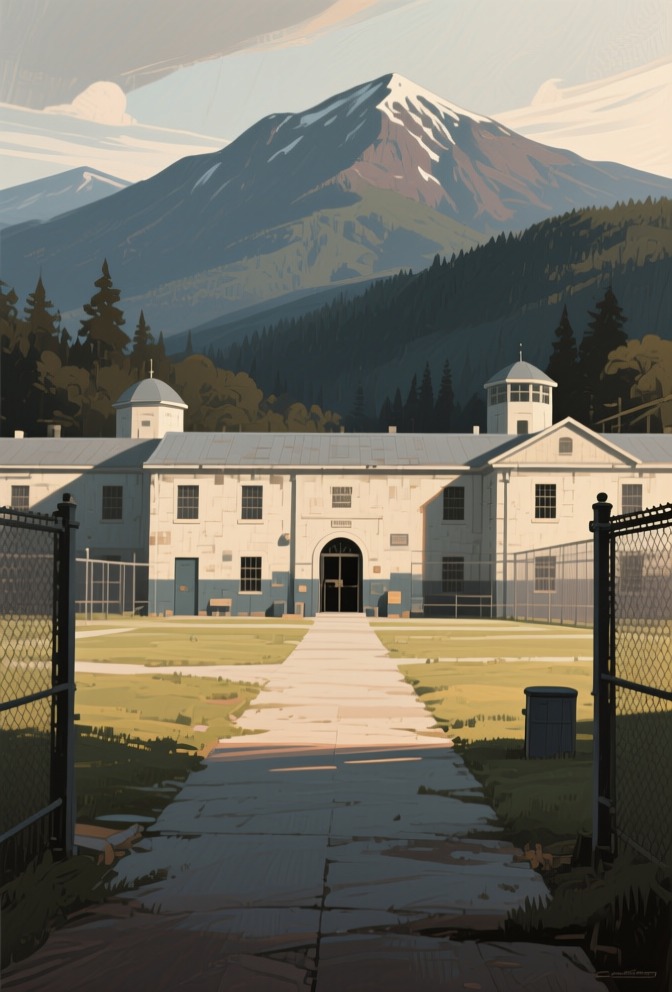
Cold Mountain Penitentiary is the Depression-era state prison in an unnamed Southern state where the novel's central events unfold, housing E Block—the death-row unit whose green-linoleum corridor gives the book its title. It is the site of all major executions, including those of John Coffey, Eduard Delacroix, and Arlen Bitterbuck, and the workplace of narrator Paul Edgecombe and his fellow guards. The prison's physical layout—the Green Mile, the restraint room, the storage shed containing the electric chair Old Sparky, and the tunnel beneath the highway—structures the narrative's geography of punishment and mercy.