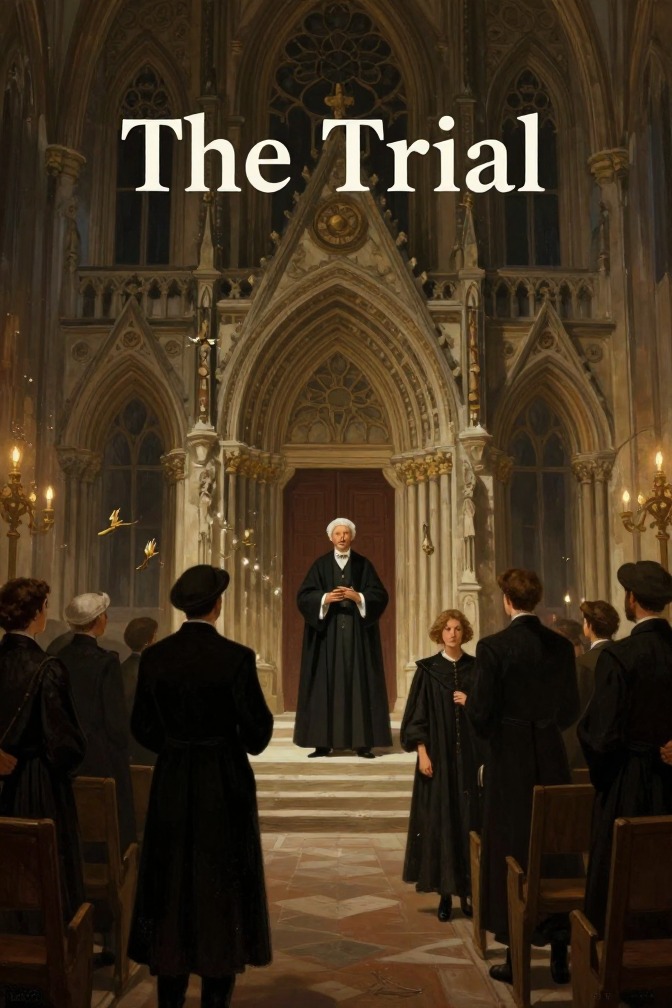
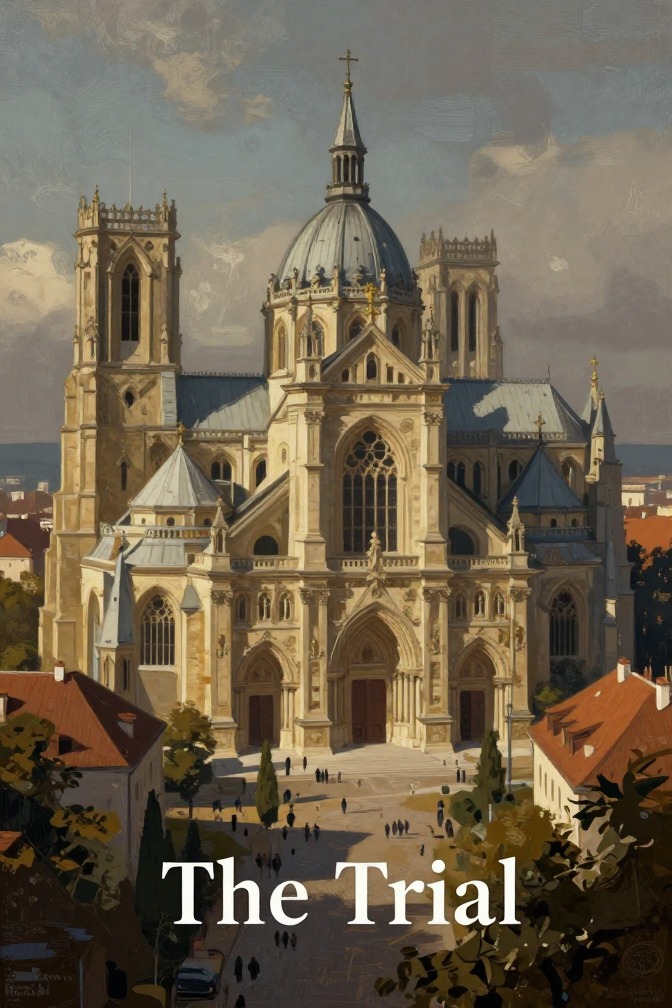
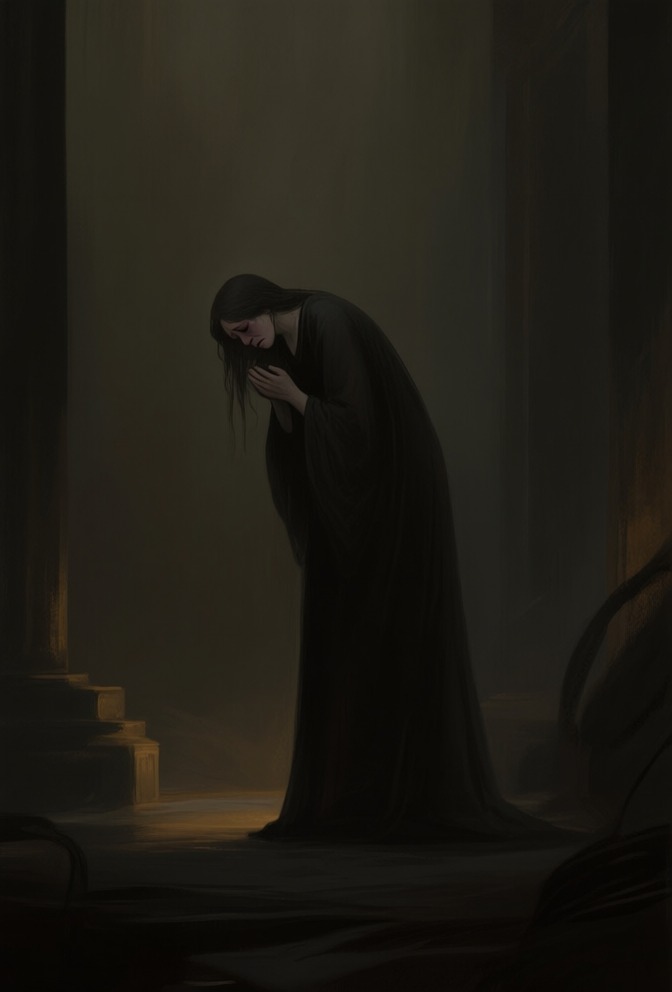
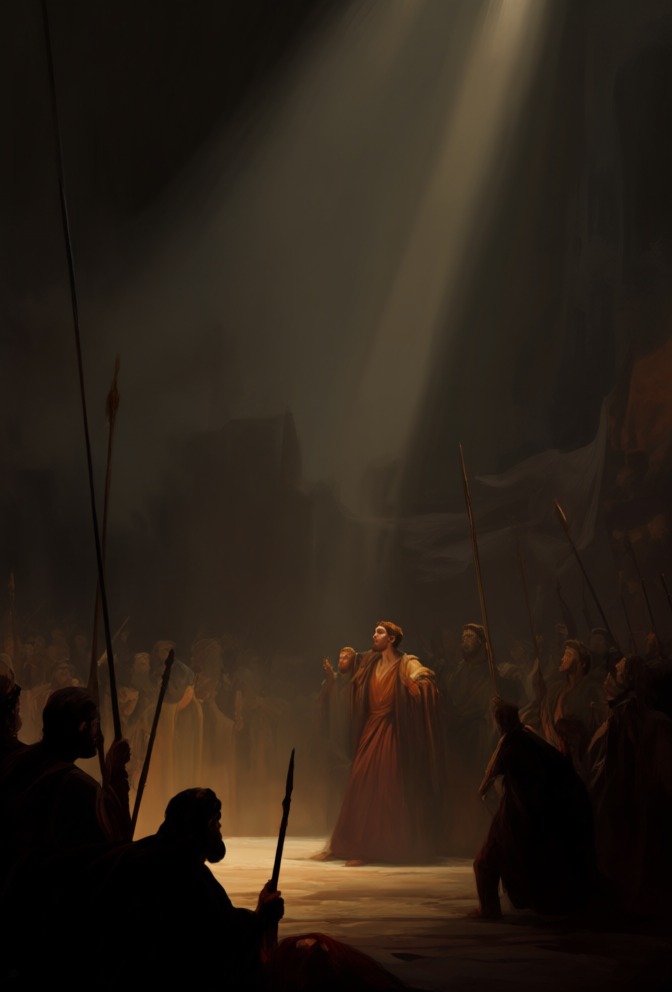
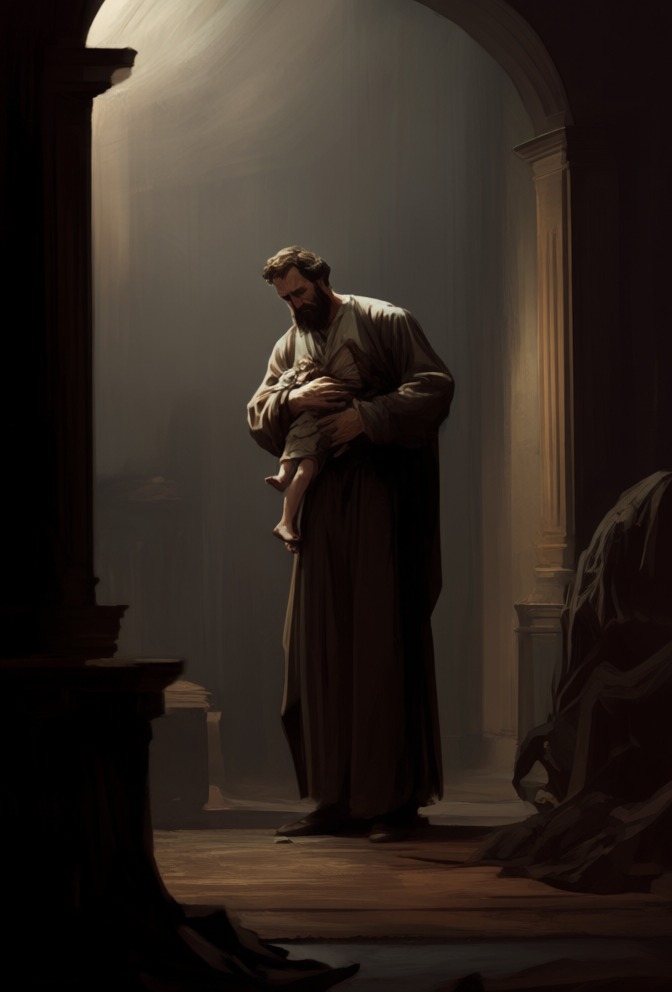
In the Cathedral is the pivotal ninth chapter of Franz Kafka's The Trial, where Josef K., awaiting a vanished Italian business contact, is summoned by name by the prison chaplain in the empty cathedral. The chaplain delivers the parable of the doorkeeper and the man from the country, a dense allegory about the law's inaccessibility and the nature of guilt, and tells K. that his case is going badly and that he is considered guilty. This encounter crystallizes K.'s isolation, his futile search for external help, and the philosophical impasse of his trial, foreshadowing his execution. The chapter is a masterful fusion of narrative and parable, marking the moment when K. confronts the court's ultimate authority and his own self-deception.
The cathedral is the site of Josef K.'s final encounter with the court before his execution, where the prison chaplain confronts him with the parable of the doorkeeper and the man from the country, a story that crystallizes the novel's themes of guilt, the inaccessibility of justice, and the necessity of accepting the law's terms.
The Court building on Juliusstrasse is the physical seat of the lower court that prosecutes Josef K., a dilapidated tenement in a poor suburb whose attic offices and interrogation room embody the squalor, secrecy, and arbitrary power of the judicial system that ensnares him.
The Court offices in Franz Kafka's *The Trial* are the bureaucratic and physical heart of the legal apparatus that ensnares Josef K. Housed in the attics of tenement buildings in poor suburbs, these offices are cramped, airless, and labyrinthine, staffed by a hierarchy of officials who operate under a system of secret proceedings and unassailable authority. Their squalid, makeshift appearance belies their immense power, and they serve as the primary setting for K.'s encounters with the court's lower functionaries, revealing the organization's paradoxical nature: simultaneously shabby and omnipotent, arbitrary and inescapable.
The whip is a central object in Franz Kafka's The Trial, appearing in the scene of the flogging of the two policemen, Franz and Willem, and later in the execution of Josef K. It embodies the arbitrary, brutal, and inescapable power of the court, serving as a tangible instrument of punishment that reveals the physical reality behind the abstract legal proceedings.
The Society for the Preservation of City Monuments is a civic organization with which Josef K. is associated, and its mention in the novel serves to highlight the bureaucratic and social networks that entangle him, as well as the ironic gap between his public reputation and his private legal predicament.
The Court in Franz Kafka's The Trial is an opaque, labyrinthine judicial authority that arrests Josef K. and prosecutes him for an unknown crime. It operates through a vast, secretive bureaucracy housed in attics and tenements, guided by inaccessible laws and staffed by corrupt, vain officials. The Court's procedures are designed to presume guilt, isolate the accused, and make genuine defense impossible, ultimately leading to K.'s execution.
The principle that the Court demands nothing from the accused is a central paradox of Josef K.'s trial, articulated by the prison chaplain in the cathedral. It encapsulates the Court's utter indifference to the individual's guilt or innocence, its refusal to engage with the defendant's efforts at defense, and its operation as an impersonal, self-sustaining system that neither seeks nor requires anything from those it ensnares.
The rule 'No progress late in proceedings' describes a structural principle of the Court in Kafka's The Trial, stating that after a certain stage in the legal process, no new developments of any importance occur, and the case becomes static, with only repetitive hearings and delays.
The rule that lawyers cannot improve the court is a fundamental principle of the Court's operation in Franz Kafka's *The Trial*, reflecting the institution's resistance to reform and its insistence on the defendant's passive submission. This rule, articulated by Dr. Huld and reinforced by the Court's physical and procedural structure, dictates that any attempt by a defendant or lawyer to alter the system is not only futile but dangerous, as it attracts the hostile attention of the officials and worsens the case.
The rule 'Doorkeeper beyond judgment' holds that the doorkeeper in the parable 'Before the Law' cannot be judged by human standards because his service to the law places him beyond the reach of human evaluation. This principle, articulated by the prison chaplain during his conversation with Josef K. in the cathedral, asserts that the doorkeeper's worth is derived from his position within the legal system, and to doubt him is to doubt the law itself. It encapsulates the court's logic of unquestionable authority and the necessity of accepting its structures without demanding their truth.
The rule that the law mandates acquittal for the innocent is a central, paradoxical tenet of the Court in Franz Kafka's The Trial. It is stated as a formal principle of the law itself, yet it is contradicted by every observable practice of the Court, creating a fundamental gap between legal theory and judicial reality that defines Josef K.'s predicament.
The rule that court offices are located in attics is a defining spatial principle of the Court in The Trial, reflecting its paradoxical nature: it is both omnipresent and squalid, hidden in the poorest parts of the city yet occupying the highest, most inaccessible spaces. This rule governs where the Court conducts its business, where defendants wait, and where officials work, and it shapes Josef K.'s understanding of the institution that has seized his life.
The Gate of Law Always Open is a foundational principle of the Court in Franz Kafka's The Trial, articulated in the parable "Before the Law" and confirmed by the novel's physical and procedural details. It asserts that the entrance to the Law is perpetually accessible, yet this openness is paradoxically paired with an impenetrable barrier—the doorkeeper—creating a system where the possibility of entry is always present but never realized. This rule governs the Court's architecture, its treatment of defendants, and the very logic of its proceedings, ultimately revealing a world where the Law's availability is a form of entrapment rather than liberation.
The rule that judges cannot acquit finally is a central principle of the Court in Franz Kafka's The Trial, establishing that no judge within the hierarchy accessible to the accused possesses the authority to grant a definitive, irreversible acquittal. This limitation transforms every apparent legal victory into a provisional reprieve, ensuring that the proceedings remain perpetually open and that the defendant can never achieve true liberation from the charge.
The rule that judges cannot be influenced is a central paradox in The Trial, where the court's official doctrine of judicial incorruptibility is contradicted by the pervasive reality of personal connections, bribery, and informal persuasion that shape the proceedings against Josef K.
The rule that the defendant must take his own life is the final, unspoken demand of the Court in Franz Kafka's *The Trial*, a command that Josef K. confronts in his last moments but ultimately fails to obey, marking the culmination of his year-long struggle and the Court's ultimate victory over his will.
Defence in The Trial is a paradoxical and largely futile activity, tolerated but not recognized by the law, operating in secrecy and dependent on personal connections rather than legal argument, and ultimately unable to alter the court's presumption of guilt.
Innocence is the central, contested concept in Franz Kafka's The Trial, functioning both as Josef K.'s unwavering personal claim and as a category the Court systematically renders irrelevant. The novel's entire drama turns on the gap between K.'s conviction that he has done nothing wrong and a legal apparatus that treats guilt as an a priori condition, making innocence not a defense but an irrelevance or even a symptom of delusion.
The Law in Kafka's The Trial is an inaccessible, self-perpetuating system that operates through secrecy, presumption of guilt, and the impossibility of genuine acquittal, shaping the entire narrative as an opaque force that Josef K. can neither understand nor escape.
Grief and loss are the central, shaping forces of Theodore Decker's life, beginning with the sudden death of his mother in a museum bombing when he is thirteen and continuing through the loss of his father, his best friend Andy Barbour, and the painting that becomes his secret talisman. The novel traces how catastrophic loss derails a life, how grief can be deferred, denied, and transformed into self-destruction, and how the process of mourning is never linear but recurs in dreams, flashbacks, and compulsive repetitions. Theo's journey from orphaned boy to drug-addicted adult is a study in the pathology of unresolved grief, yet the novel also suggests that loss, confronted rather than evaded, can open a path toward a more authentic, if permanently scarred, existence.
The canary is a minor but symbolically resonant creature in *The Goldfinch*, appearing in a single anecdote from James Hobart's childhood. Hobie's blind-in-one-eye canary, rescued from a Woolworth's store, woke him every morning of his boyhood by singing. The bird's brief presence in the narrative underscores themes of rescue, captivity, and the small, fragile beauties that persist through hardship.
Bruno the Great Dane is a beloved family pet from Audrey Decker's childhood in Kansas, appearing in silver-framed photographs in her New York apartment and symbolizing the lost pastoral world of her youth.
The Jack Russell Terrier is a small, energetic breed of dog that appears briefly in the novel as a point of contrast and connection, mentioned by Pippa Blackwell as a breed she admires for its lively and friendly temperament.
The Maltese dog, known as Popper in Las Vegas and later Popchik, is a small white lapdog who becomes a constant companion to Theo Decker during his years in Las Vegas and later in New York. Though initially belonging to Xandra Terrell, the dog is neglected and often left alone, leading Theo to take responsibility for him. The Maltese serves as a symbol of loyalty and vulnerability, accompanying Theo through his darkest moments and providing a thread of continuity across the upheavals of his life.
The Morgan horse is a breed of light horse that appears in the novel as a symbol of Audrey Decker's lost childhood and the happier, more stable life she left behind in Kansas. The horses—Paintbox, Clover, and Chalkboard—represent the warmth, freedom, and family love that were taken from her when her parents died, and their forced sale marks the beginning of her sorrows. For Theo, the stories his mother tells about these horses become a cherished link to her past and a way of understanding the depth of what she lost.
The Pekingese is an ancient breed of toy dog, historically reserved for Chinese royalty, that appears in the novel as a point of reference for Pippa Blackwell's deep knowledge of dog breeds and as a symbol of rarity and privilege.
Terriers are a recurring motif in *The Goldfinch*, appearing as loyal, scrappy, and emotionally significant companion animals that mirror the bonds and vulnerabilities of the human characters.
Audrey Decker, the mother of protagonist Theodore Decker, is killed instantly by flying debris during a terrorist bombing at the Metropolitan Museum of Art on April 10th, when Theo is thirteen years old. Her death is the central, defining trauma of Theo's life, a dividing mark between Before and After that sets him adrift into a world of orphanhood, loss, and moral chaos.
Larry Decker's abrupt abandonment of his wife Audrey and son Theo, without money or a forwarding address, is the event that shatters the family's fragile stability and sets Theo on a trajectory of loss, guilt, and rootlessness that defines the rest of his life.