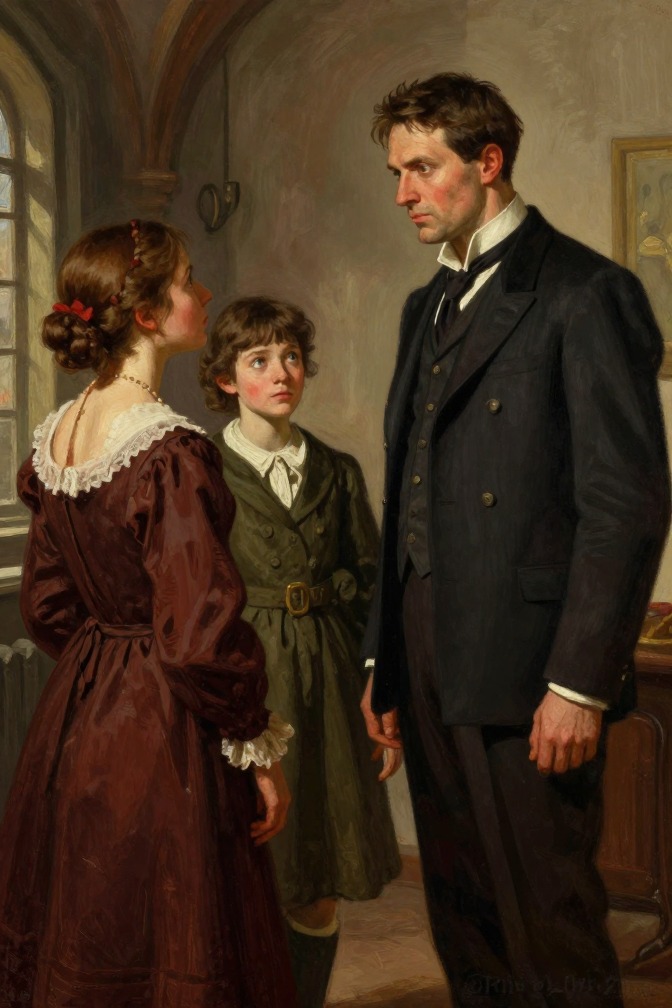
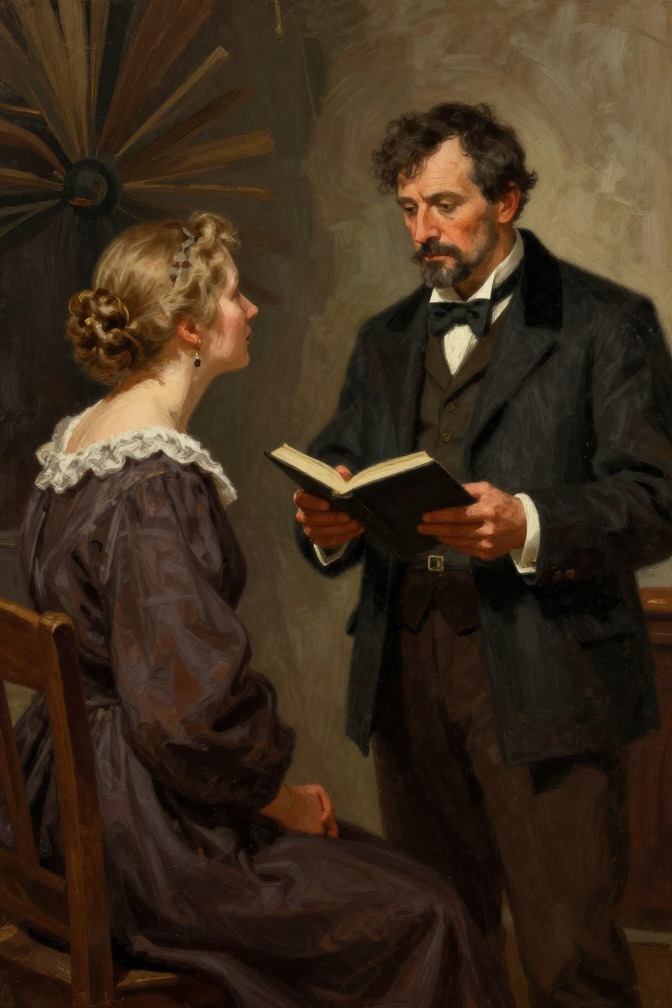
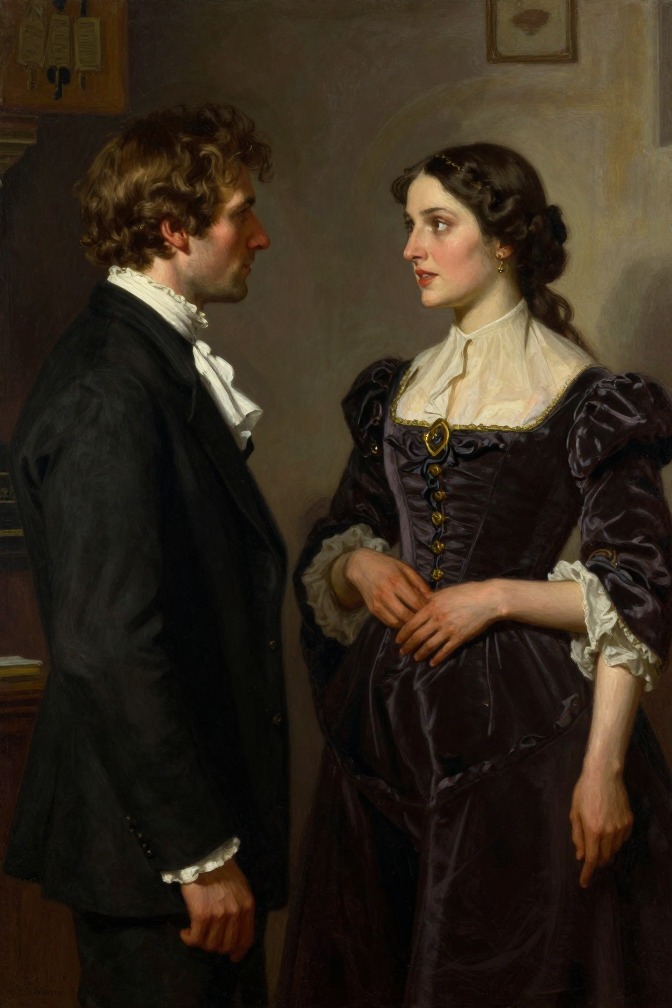
Frieda confronts K. about his visit to Barnabas's family, accusing him of betraying her trust and pursuing the sisters for his own advantage, which leads to a painful reckoning with the fragility of their relationship.
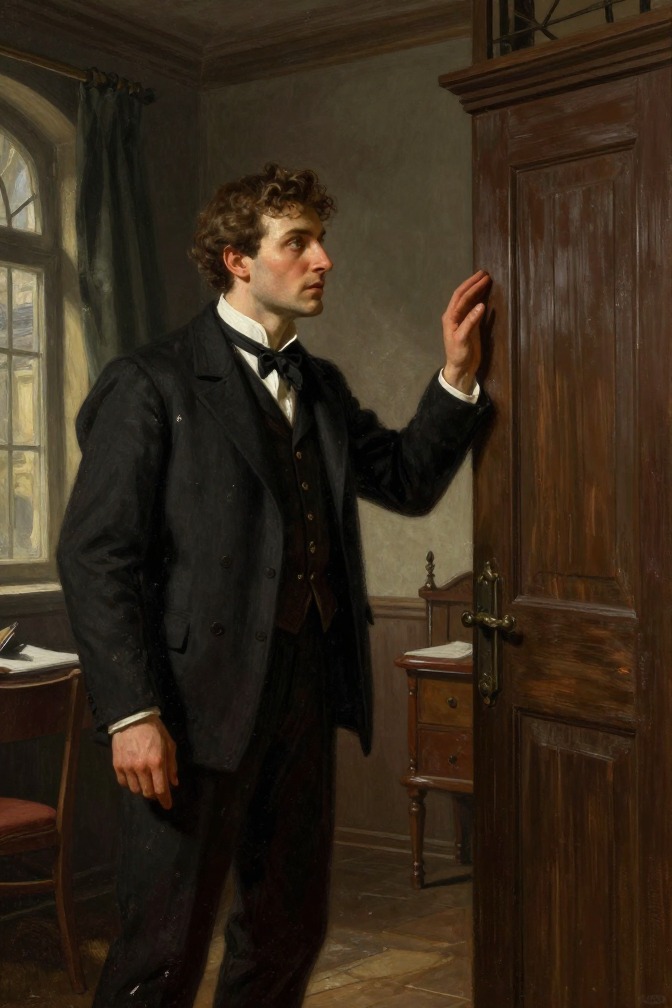
K. accidentally enters the room of Bürgel, a communications secretary, during his nocturnal search for Erlanger, and hears a lengthy discourse on the rare opportunity for a member of the public to exploit a secretary's nocturnal weakness. The encounter, marked by K.'s extreme exhaustion and Bürgel's loquacious theorizing, culminates in K. falling asleep and missing the chance Bürgel describes, only to be summoned by Erlanger immediately after.
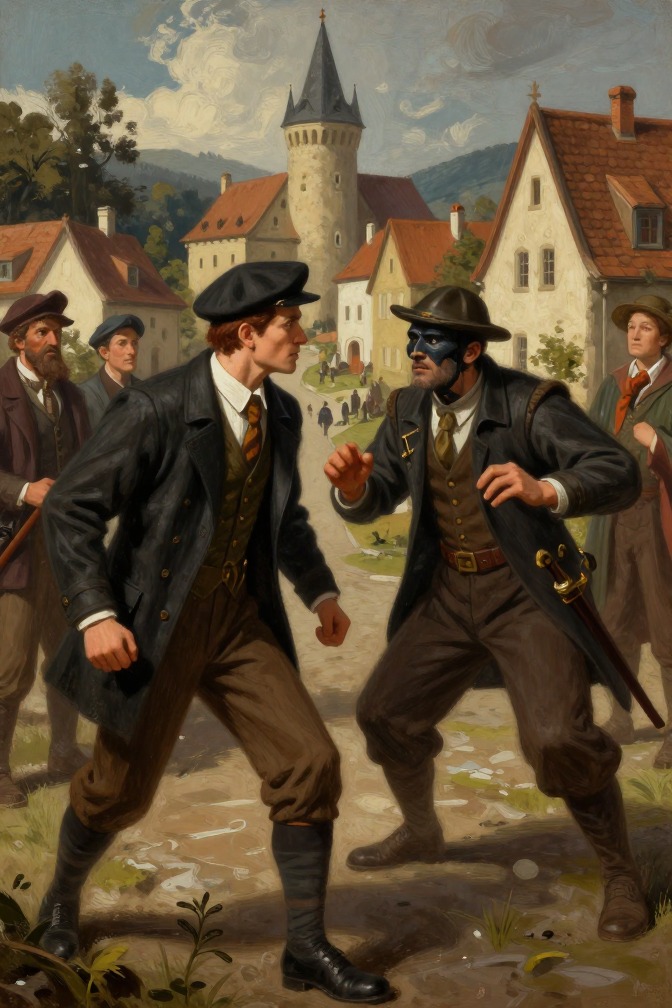
K. arrives at the village late in the evening, only to be challenged by Schwarzer, the son of a castle warden, who demands a permit to stay overnight. K. claims to be the land surveyor sent for by the count, and after a telephone call to the castle, his claim is confirmed, establishing his precarious foothold in the village and setting the stage for his struggle with the castle's authority.
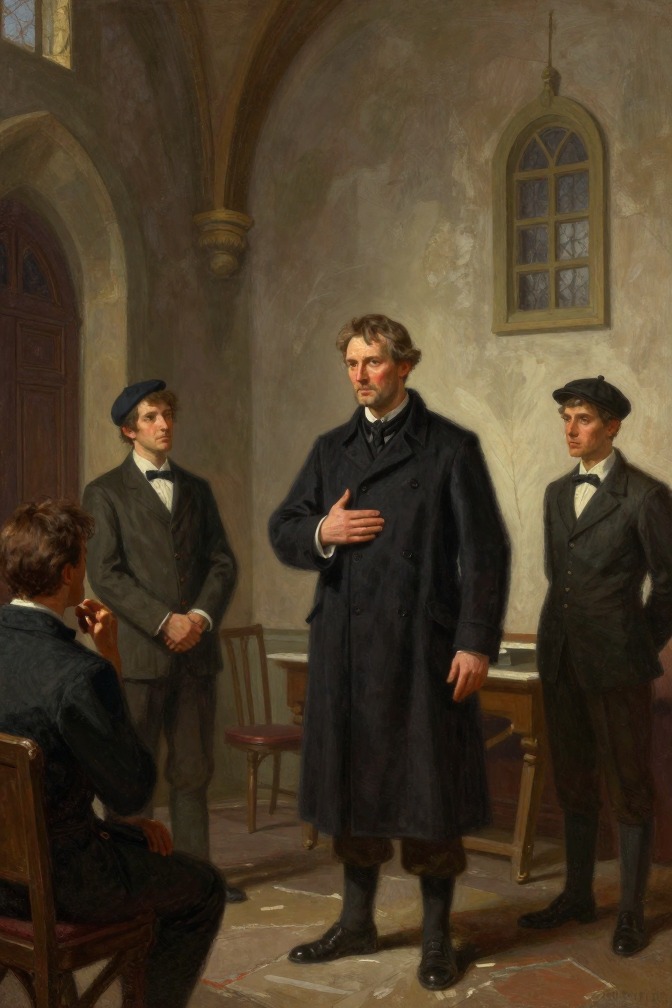
K. dismisses his two assistants, Artur and Jeremias, in a decisive act of rejection that marks a turning point in his struggle with the village and the castle. The dismissal, triggered by their intrusive behavior and suspected collusion with Frieda, leads to their expulsion from the schoolhouse and sets off a chain of consequences, including Frieda's eventual departure with Jeremias.
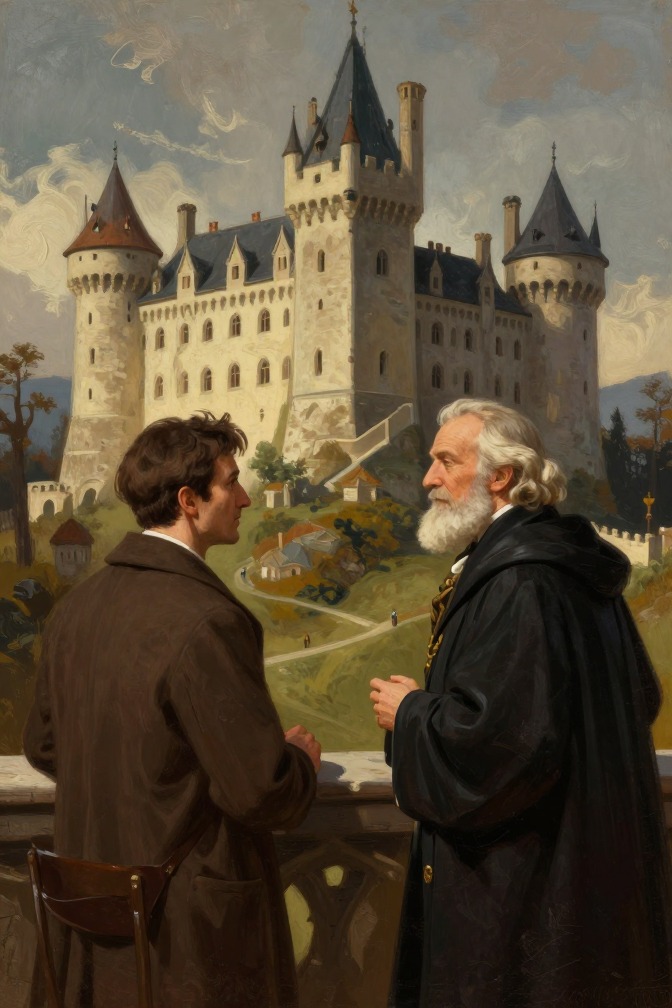
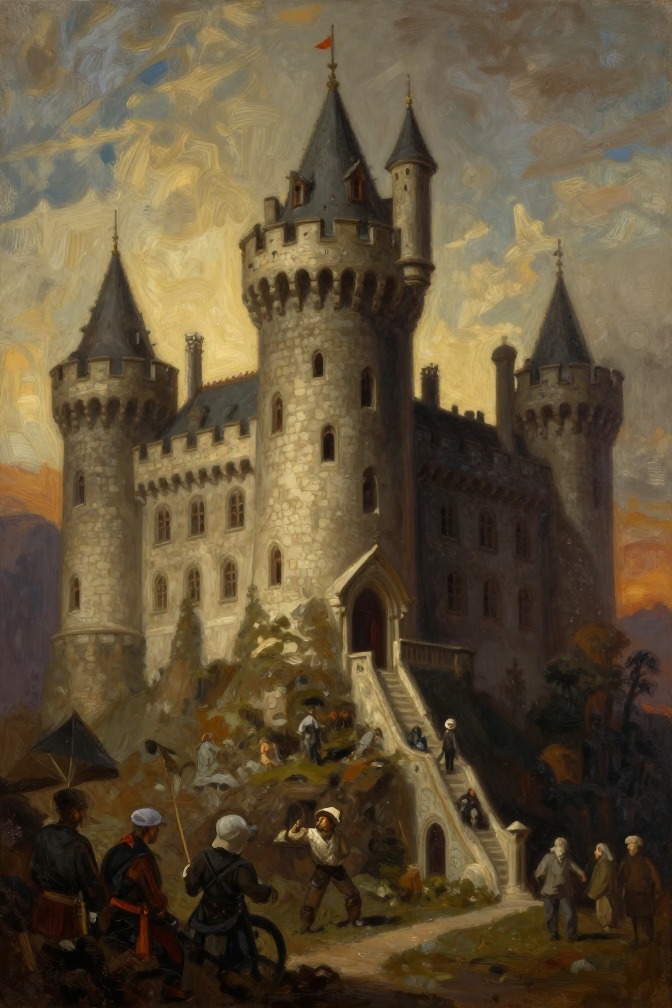
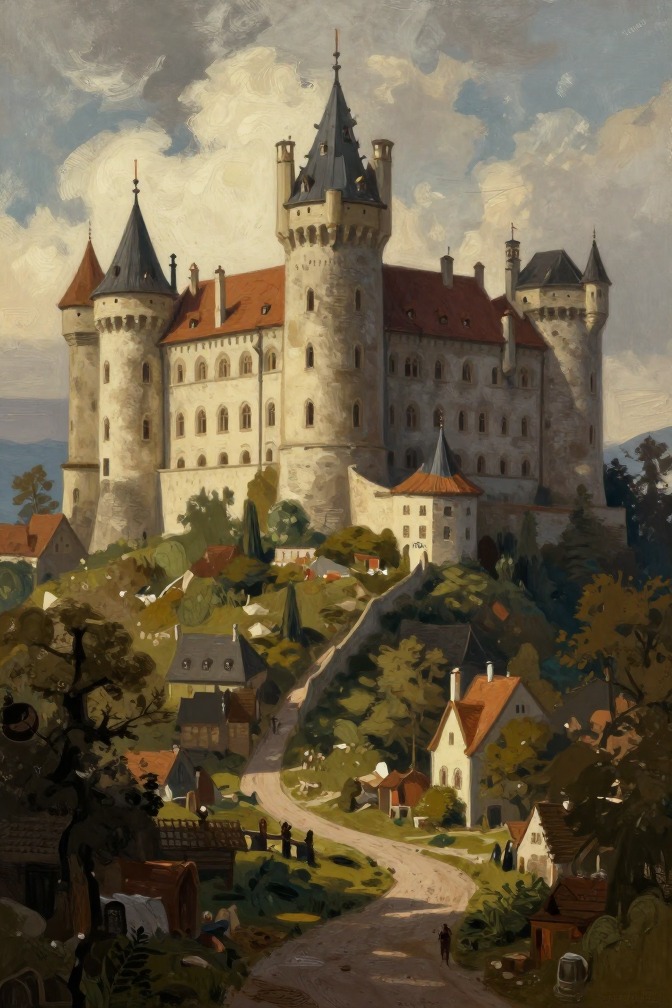
K.'s first daylight view of the castle and his encounter with the teacher mark a pivotal moment in his arrival, revealing the castle's deceptive ordinariness and the village's guarded attitude toward strangers, while also establishing K.'s initial weariness and his first tentative social contact.
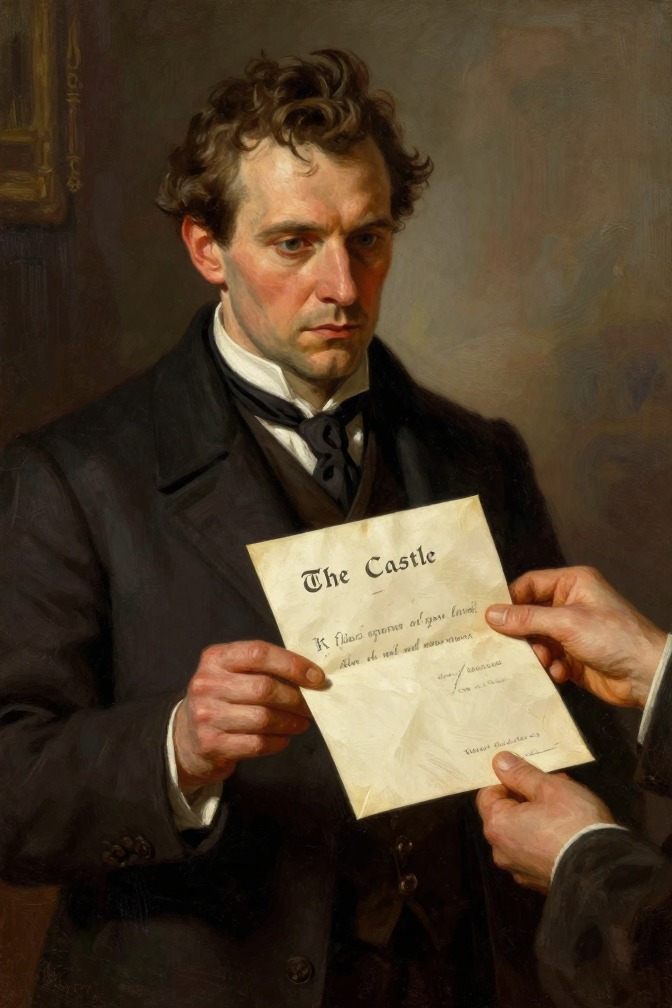
K. receives the second letter from Klamm, delivered by Barnabas on a stormy night, which praises his nonexistent surveying work and the assistants' efforts, revealing the castle's misinformed and ironic control over him. This event deepens K.'s disillusionment, exposes the unreliability of communication with the castle, and prompts him to craft a desperate oral petition for a personal interview with Klamm, marking a turning point in his struggle.
K. talks with Hans and plans to see his mother is a pivotal conversation in which the school janitor K. befriends the young Hans Brunswick, who has come to offer help after witnessing K.'s humiliation by Miss Gisa. Through this dialogue, K. learns about Hans's ailing mother, a woman from the castle, and devises a plan to visit her, hoping to gain a connection to the castle. The conversation reveals K.'s strategic thinking, his willingness to use personal relationships for his goals, and his growing desperation, while also exposing the complex dynamics within the Brunswick family and the village's social hierarchies.
Erlanger is a principal secretary of Klamm in Franz Kafka's The Castle, a minor yet pivotal official whose brief appearance near the novel's end delivers a decisive command that underscores K.'s powerlessness. He is characterized by his slight stature, a limp, and his famous memory and knowledge of human nature, recognizing Barnabas at a glance. His role is to issue orders from the castle that K. must obey, revealing the arbitrary and impersonal nature of authority.
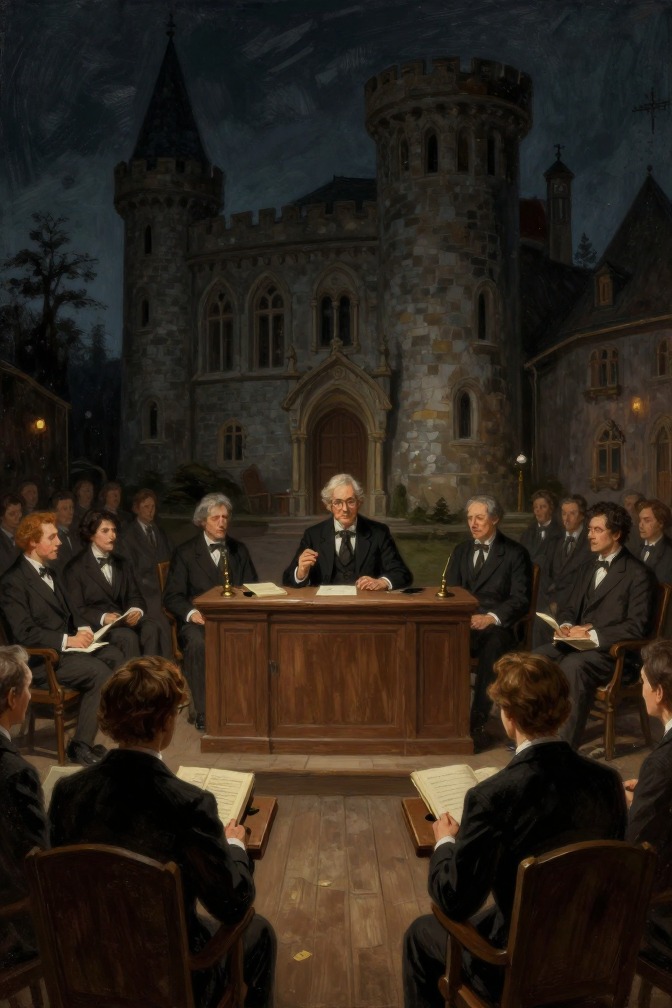
Night-time Hearings are a recurring institutional practice in Franz Kafka's The Castle, where castle secretaries conduct official interviews with villagers during the night rather than by day. This practice is explained by the secretaries' belief that the darkness and artificial light make it easier to endure the sight of the public, who are considered intolerable by day, and that the hearings allow the officials to quickly forget the unpleasantness in sleep. The novel presents these hearings as a paradoxical blend of official necessity and personal vulnerability, where the strict formalities of the day give way to a more private, human exchange that can both threaten the officials' authority and offer rare opportunities to the public.
Service to the Castle is the central, all-encompassing concept in Franz Kafka's novel The Castle, defining the relationship between the village, its inhabitants, and the inaccessible castle that governs them. It is a paradoxical and ambiguous institution: on one hand, it is a formal, bureaucratic system of employment with superiors, duties, and remuneration; on the other, it is a deeply personal, almost metaphysical bond that shapes every aspect of life in the village. K.'s entire struggle—his arrival, his attempts to gain recognition, his relationships with Frieda, Barnabas, and the authorities—revolves around his attempt to understand and secure his own service to the castle, a service that is simultaneously offered, denied, and endlessly reinterpreted by those around him.
The Assistants, Artur and Jeremias, are two identical young men assigned to K. by the castle authorities, ostensibly as his surveying assistants but actually as agents tasked with observing and unsettling him. Their presence, marked by childish behavior, constant surveillance, and ambiguous loyalty, becomes a central source of K.'s frustration and a catalyst for his conflicts with Frieda and the village hierarchy. Their role blurs the line between service and surveillance, embodying the castle's pervasive and inscrutable control over K.'s life.
The Castle Authorities are the unseen, bureaucratic power that governs the village and the castle in Franz Kafka's novel. They are characterized by their inaccessibility, their contradictory and often meaningless communications, and their immense, arbitrary influence over the lives of the villagers. The authorities operate through a complex, self-justifying bureaucracy that is both infallible and prone to error, and they maintain control through a combination of fear, ritual, and the manipulation of information.
The crow is a recurring avian motif in Franz Kafka's novel The Castle, appearing at key moments to underscore the castle's inaccessibility, the village's isolation, and the pervasive atmosphere of ambiguity and foreboding. Its presence frames K.'s arrival and his ongoing struggle against an opaque bureaucracy, symbolizing both the natural world's indifference and the elusive, almost supernatural quality of the castle itself.
K. dismisses his two assistants, Artur and Jeremias, after they repeatedly intrude on his privacy and disrupt his life with Frieda. The dismissal, which occurs in the schoolhouse, marks a turning point in K.'s struggle for control and leads to the assistants' desperate attempts to return, culminating in Jeremias's later role in Frieda's departure.
K. mistakenly enters the room of Bürgel, a communications secretary, during his nocturnal visit to the Castle Inn, where he listens to Bürgel's lengthy discourse on the rare opportunity for a member of the public to exploit a secretary's nocturnal weakness, before falling asleep and being summoned by Erlanger.
K. wakes from a twelve-hour sleep in the Castle Inn bar to find Pepi, the temporary barmaid, has been replaced by Frieda and is about to return to her old life as a chambermaid. Pepi delivers a long, bitter monologue blaming K. for her downfall, recounting her brief rise to barmaid, her four days of success, and her conviction that Frieda engineered her return through cunning and manipulation. K. responds with a measured critique of Pepi's romanticized view, defending Frieda and offering his own interpretation of events, before the landlady interrupts and K. leaves with Gerstäcker.
The village proverb 'Official decisions are as elusive as young girls' encapsulates the Kafkaesque inaccessibility of the castle's bureaucracy in Franz Kafka's novel The Castle. Spoken by Olga to K. during their conversation about her brother Barnabas's uncertain position as a messenger, the saying crystallizes the novel's central theme: official processes are unpredictable, opaque, and subject to endless delay, much like the capriciousness attributed to young women. The proverb's resonance extends across the entire narrative, from K.'s initial telephone call to the castle to the village mayor's account of bureaucratic confusion, illustrating how the villagers and K. alike struggle to interpret the elusive signals of authority.
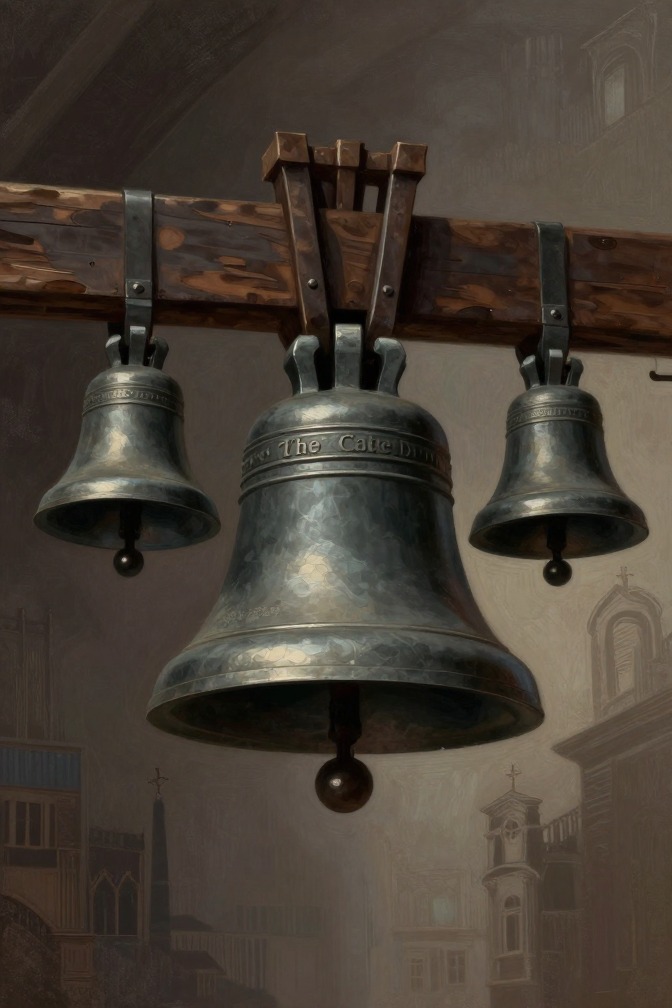
The bells in Franz Kafka's The Castle are a recurring auditory motif that marks the passage of time, signals the presence of the castle, and underscores the novel's themes of inaccessibility, bureaucratic absurdity, and the disorienting nature of authority. From the first night's telephone call to the chaotic morning of file distribution, bells ring at crucial moments, often mocking K.'s efforts and highlighting the gap between the village and the castle.
The garnet necklace is a Bohemian garnet necklace lent by the landlady of the Bridge Inn to Olga for the fire-brigade festival, which Olga then places around Amalia's neck, marking the moment when Amalia attracts the attention of the castle official Sortini and setting in motion the family's tragic downfall.
The gnarled walking-stick is a recurring object in Franz Kafka's novel The Castle, carried by the protagonist K. from his arrival in the village. It serves as a symbol of his identity, his past, and his struggle for recognition, and it appears at key moments of his journey, linking his memories of home with his present trials.
The gymnasium is the large, multi-purpose classroom in the village school that K., Frieda, and the assistants occupy as their living quarters after K. accepts the janitor post. It is a space of stark contradiction: designed for children's physical education, it becomes a cramped, cold, and exposed domestic shelter that mirrors K.'s precarious status and the village's inhospitable nature.
The lantern is a recurring object in Franz Kafka's novel The Castle, serving as a symbol of guidance, hospitality, and the elusive nature of the castle's authority. It appears at key moments, illuminating K.'s path, marking transitions, and highlighting the villagers' complex attitudes toward the outsider.
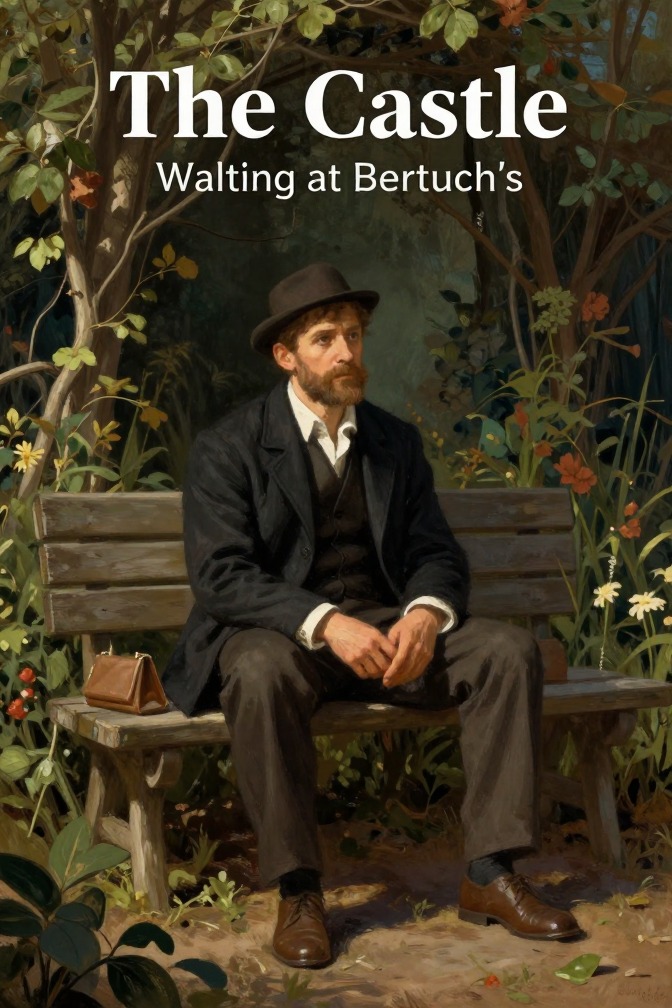
Waiting at Bertuch's garden is the father of Barnabas's family's daily vigil on the stone base of a market gardener's fence near the castle, where he hoped to present a petition for forgiveness to passing officials. This futile ritual, born of the family's ostracism after Amalia's rejection of Sortini, became a symbol of their despair and the castle's inaccessibility, ultimately breaking the father's health and mind.
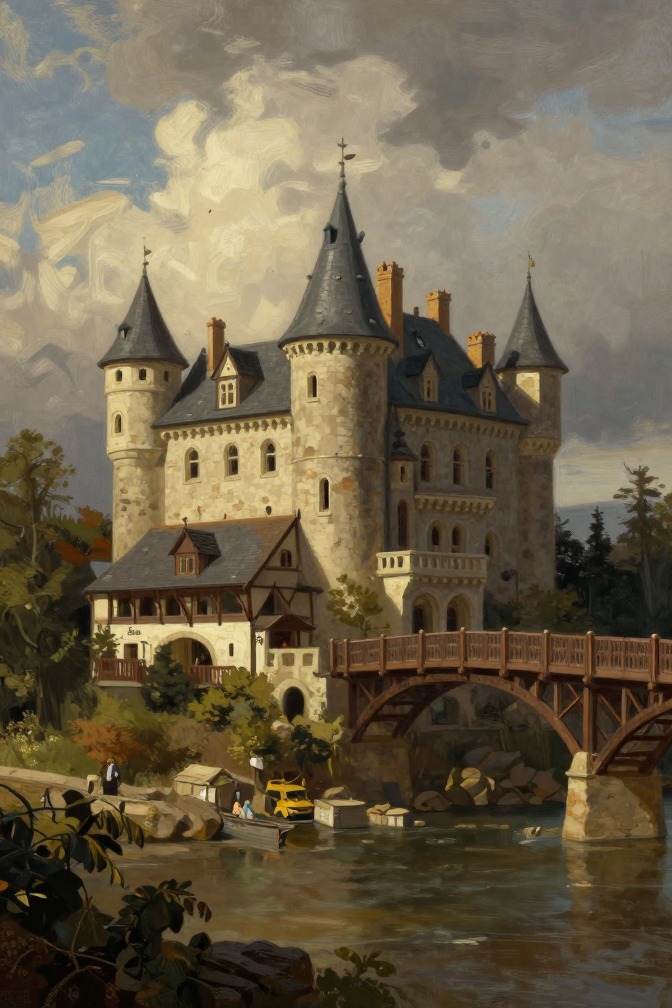
The Bridge Inn is the first and most important lodging in the village, where K. arrives late at night, is challenged by Schwarzer, and later meets Frieda, becoming her lover. It serves as the initial site of K.'s confrontation with the castle's authority and his first taste of the village's hospitality and exclusion.
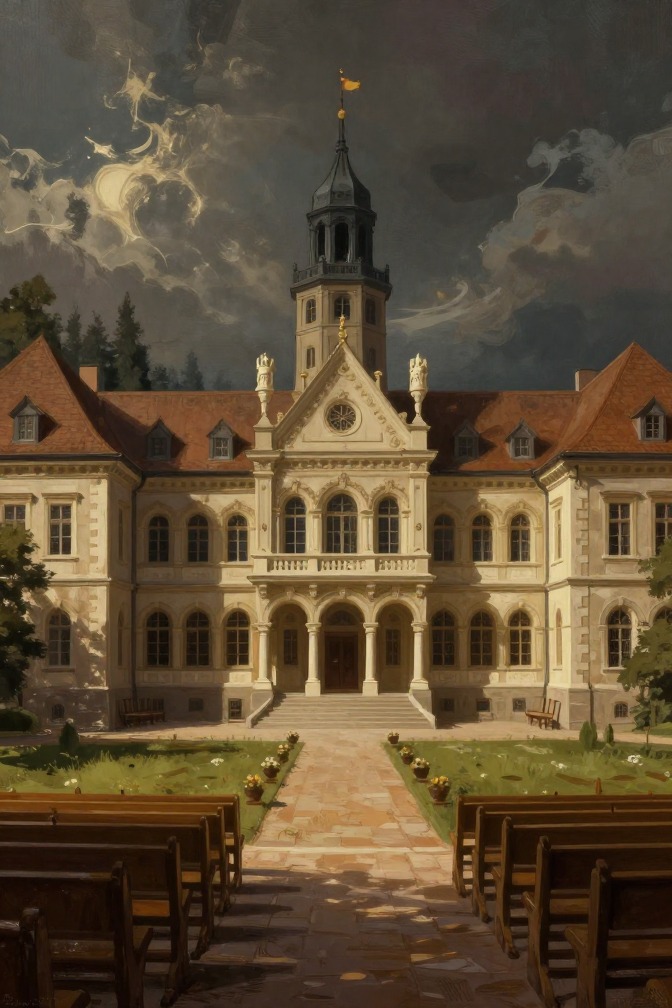
The Castle is the central, enigmatic authority in Franz Kafka's novel, a vast, inaccessible bureaucratic complex that dominates the village and governs every aspect of life through an impenetrable web of rules, officials, and communications. It represents an ultimate, distant, and often arbitrary power that K. desperately seeks to reach and understand, yet which remains perpetually out of reach, defining the novel's core conflict between the individual and an inscrutable system.
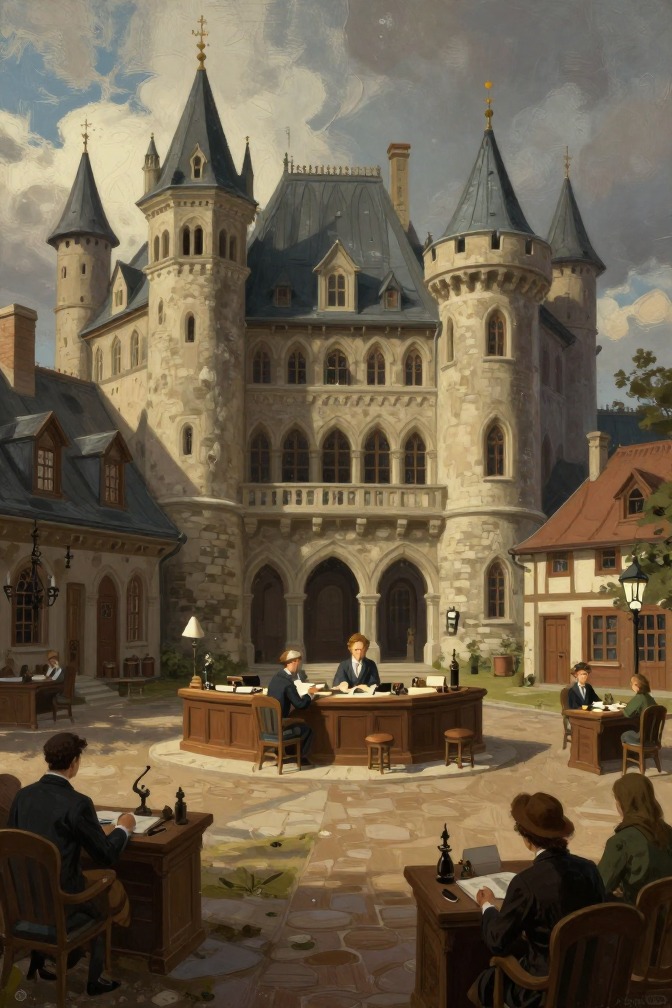
The office is the administrative heart of the castle's bureaucracy in Kafka's The Castle, a place of paradoxical power where official communications are generated, files are distributed, and officials like Klamm and his secretaries operate behind closed doors. It embodies the novel's central theme of inaccessible authority, where even the most diligent efforts to navigate its labyrinthine corridors lead to confusion, misunderstanding, and the revelation that the castle's power lies in its very inaccessibility.
The woodshed at the school is a small, locked outbuilding that becomes a flashpoint of conflict between K. and the teacher, symbolizing the petty authority and material deprivation that define K.'s life as school janitor. Its forced entry by K. and Frieda, and the subsequent confrontation, reveal the precariousness of their position and the constant struggle for basic necessities in the village.
The nightcap is a lace-trimmed head covering worn by the landlady of the Bridge Inn, one of her three treasured mementos of Klamm, the castle official. It symbolizes her lifelong fidelity to Klamm and her lost status as his former mistress, contrasting with Frieda's more recent but equally defining relationship with him.
The shawl is a key object in Franz Kafka's The Castle, serving as one of the landlady's three mementos of Klamm, alongside a photograph and a nightcap. It symbolizes her long, unrequited fidelity to Klamm and her past status as his mistress, and it becomes a point of comparison with Frieda's relationship with Klamm, highlighting themes of memory, loss, and the elusive nature of the castle's power.
Department B is a minor but pivotal administrative unit within the castle's bureaucracy in Franz Kafka's The Castle, whose accidental receipt of a misfiled decree regarding the appointment of a land surveyor triggers the entire bureaucratic confusion that ensnares K. Its role illustrates the novel's central themes of administrative chaos, the infallibility principle, and the inaccessibility of authority.