The Coena Cypriani manuscript is a medieval parody of Scripture that appears in Umberto Eco's The Name of the Rose as a key object of contention, a forbidden text whose existence and interpretation become entangled with the novel's central conflict over laughter, heresy, and the control of knowledge. It is a comic, often grotesque rewriting of biblical episodes in which every figure from Adam to Christ is made to perform absurd actions, and it serves as a dangerous precedent for the lost second book of Aristotle's Poetics, which Jorge of Burgos fears will legitimize laughter as a philosophical tool.
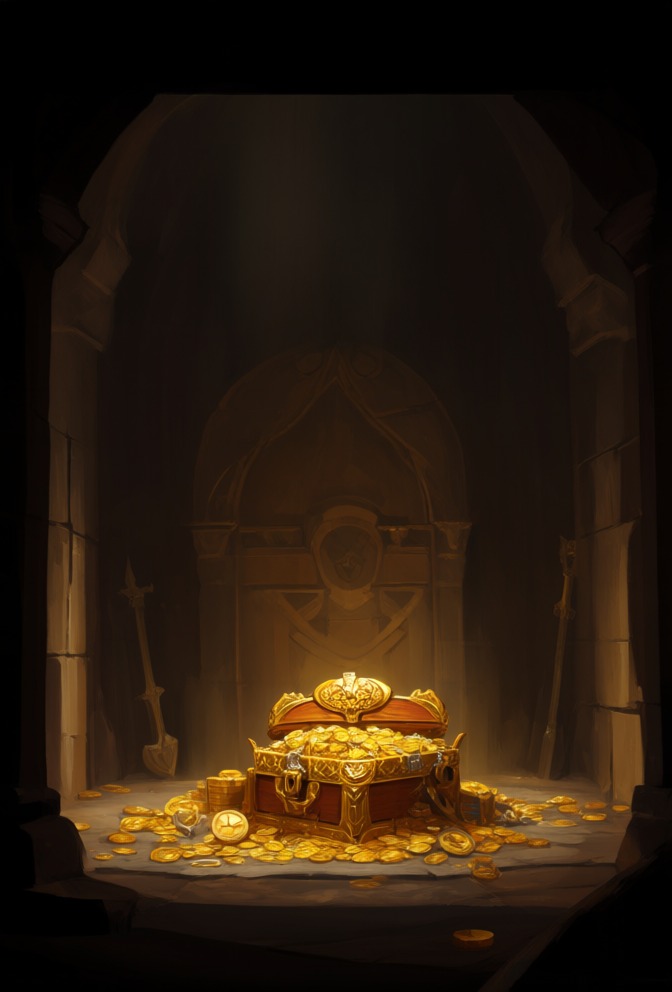
The treasure crypt of the abbey is a subterranean vault beneath the main altar of the church, housing the monastery's immense collection of relics, precious liturgical objects, and curiosities from distant lands. It embodies the abbey's temporal wealth, spiritual prestige, and the tension between evangelical poverty and institutional power that lies at the heart of the novel's theological debates.
The armillary sphere is a finely crafted astronomical instrument that becomes the murder weapon used to kill Severinus of Sankt Wendel, the herbalist, in his laboratory. Its unexpected role as a weapon—a symbol of celestial order turned instrument of violent death—underscores the novel's themes of knowledge, violence, and the collapse of rational systems.
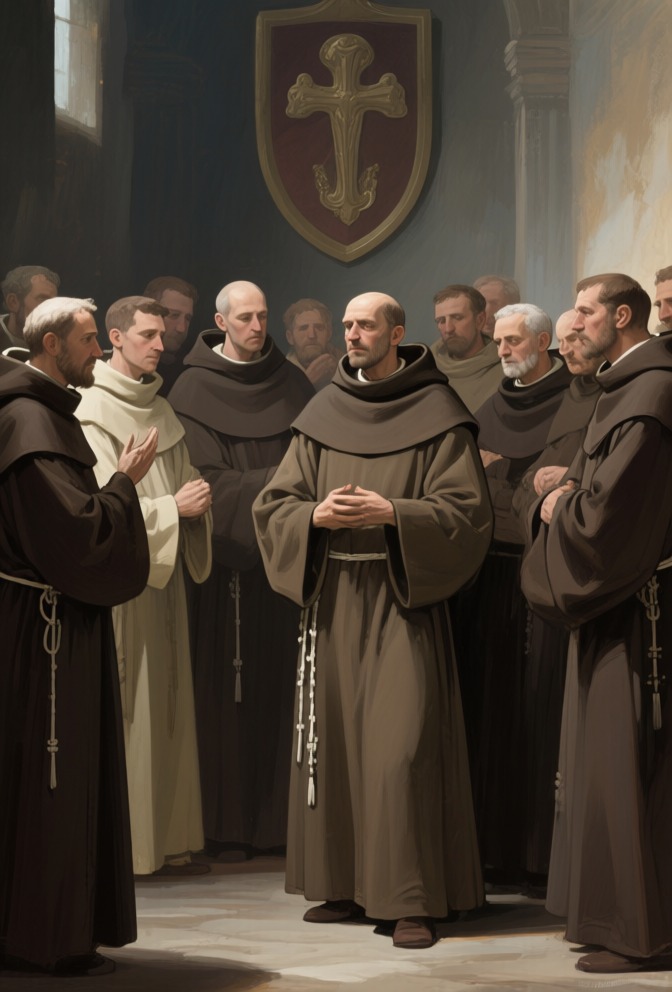
The Spiritual Franciscans, also known as the Spirituals, were a radical faction within the Franciscan Order in the late 13th and early 14th centuries. They advocated for a strict, literal interpretation of Saint Francis's Rule, emphasizing absolute poverty for both individual friars and the order as a whole, which brought them into direct conflict with the institutional Church and the papacy of John XXII.
The Franciscan Order, also known as the Order of Friars Minor, is a mendicant religious order founded by Francis of Assisi in the early 13th century. In the novel, the order is a central institution, deeply divided between the mainstream community and the Spirituals, who advocate for absolute poverty. This internal conflict, intertwined with the political struggle between Pope John XXII and Emperor Louis the Bavarian, drives the theological debates and the violent events at the abbey.
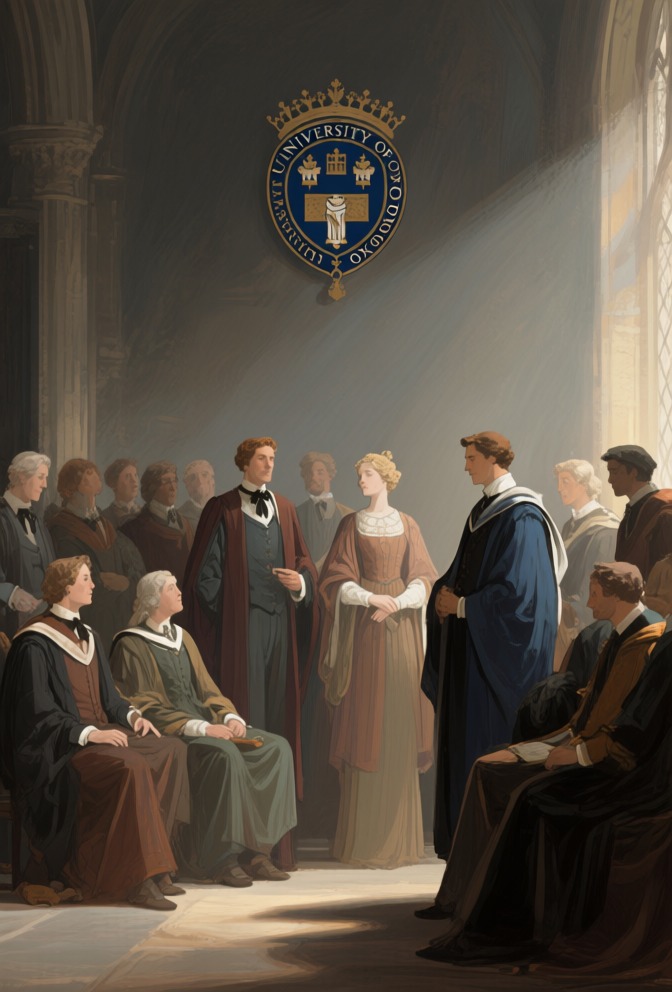
The University of Oxford, particularly its Franciscan intellectual tradition centered on Roger Bacon and William of Occam, serves as the formative intellectual background for William of Baskerville, shaping his empirical, skeptical, and rational approach to investigation, which stands in stark contrast to the dogmatic and apocalyptic worldview of Jorge of Burgos and the abbey's library.
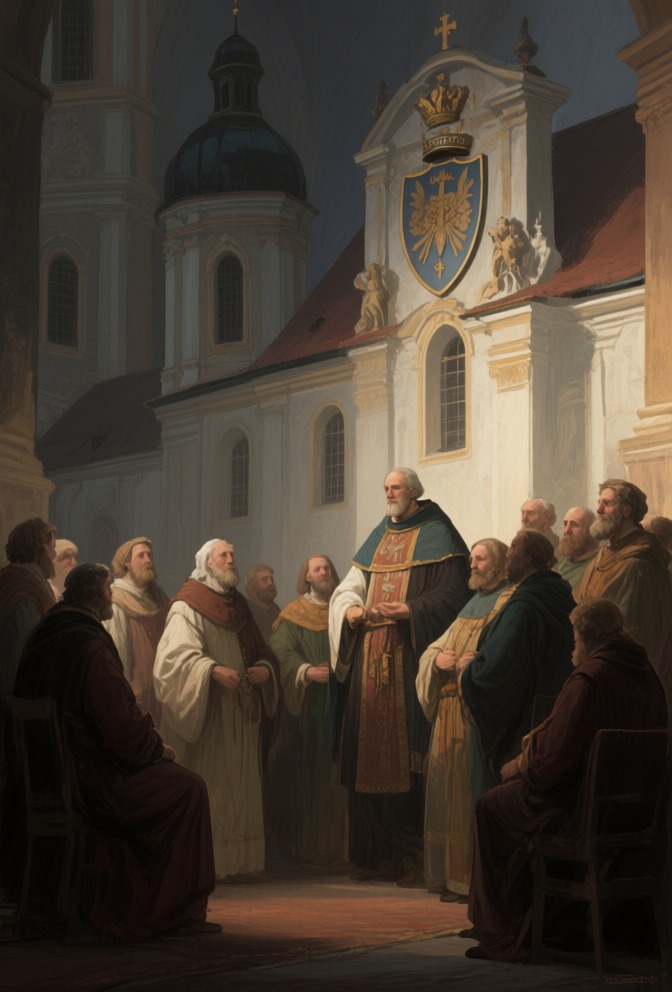
Melk Abbey is the Benedictine monastery where the elderly Adso of Melk writes his memoirs of the terrible events he witnessed in 1327, serving as the narrative frame for the entire novel and the site from which the story is told.
Jorge of Burgos and the secret of the library is the central, hidden relationship that drives the entire plot of The Name of the Rose. Jorge, the blind, ancient, and revered monk, has for decades been the true, secret master of the abbey's library. He has manipulated the succession of librarians and abbots to ensure that the library's most dangerous secret—the sole surviving copy of Aristotle's lost second book of the Poetics, a treatise on comedy and laughter—remains hidden in the inaccessible room called the finis Africae. Jorge's fanatical belief that this book would destroy Christian civilization by legitimizing laughter and doubt leads him to poison its pages, and then to commit a series of murders—orchestrating the deaths of Venantius, Berengar, Severinus, Malachi, and Abbot Abo—to prevent anyone from reading it. His final confrontation with William of Baskerville in the finis Africae reveals his motives and ends with Jorge devouring the poisoned pages and starting a fire that destroys the entire library, an act of apocalyptic self-destruction that fulfills his own grim prophecies.
Venantius of Salvemec, a translator of Greek and Arabic, was the first monk to steal the forbidden copy of Aristotle's Poetics II from the finis Africae, and his fatal curiosity about the book set off the chain of murders that devastated the abbey.
The Library catalogue rule is the system by which the abbey's vast collection of books is recorded and located, a system designed to be comprehensible only to the librarian and his assistant, thereby enforcing the library's secrecy and control over knowledge.
Doubt is a central philosophical state in The Name of the Rose, embodied most fully by William of Baskerville, who treats uncertainty not as a failure of intellect but as the necessary condition for genuine inquiry. Throughout the novel, William defends the legitimacy of doubt against the absolute certainty of Jorge of Burgos, who equates doubt with heresy and the laughter that foments it. The conflict between these two postures—doubt as an instrument of truth versus doubt as a threat to faith—structures the novel's epistemological drama and culminates in William's final, devastating admission that the order he thought he had discovered was an illusion.
Pride, in Umberto Eco's *The Name of the Rose*, is the central spiritual and intellectual sin that drives the plot and the downfall of the abbey. It manifests most destructively as intellectual pride—the arrogant conviction that one possesses the sole, absolute truth and the right to enforce it, embodied by the blind librarian Jorge of Burgos. This pride leads to a series of murders to suppress a forbidden book, and ultimately to the apocalyptic destruction of the library itself, making pride the engine of both the mystery and its tragic resolution.
The Rescue of Jean Georges Ruelle is a pivotal act of defiance in which Vianne Mauriac, during a mass roundup of Jews in Carriveau in late 1942, accepts a Jewish child from his desperate mother and, after a narrow escape from the SS officer billeted in her home, delivers him to the Abbaye de la Trinité orphanage, thereby initiating her secret work of hiding Jewish children.
The Tours refugee column bombing is a pivotal event in which German Stuka dive-bombers and machine guns attacked a column of civilian refugees fleeing the German advance near Tours, France, in June 1940. Isabelle Rossignol, traveling with Gaëtan Dubois, witnesses the massacre firsthand, an experience that transforms her from a reckless girl into a committed resister and fuels her lifelong determination to fight the Nazi occupation.
The Killing of Captain Wolfgang Beck is the pivotal, irreversible event in which Vianne Mauriac and her sister Isabelle Rossignol jointly kill the Wehrmacht captain billeted at Le Jardin, transforming Vianne from a passive survivor into a killer and forcing the sisters into a new, dangerous alliance that reshapes the rest of the war for both of them.
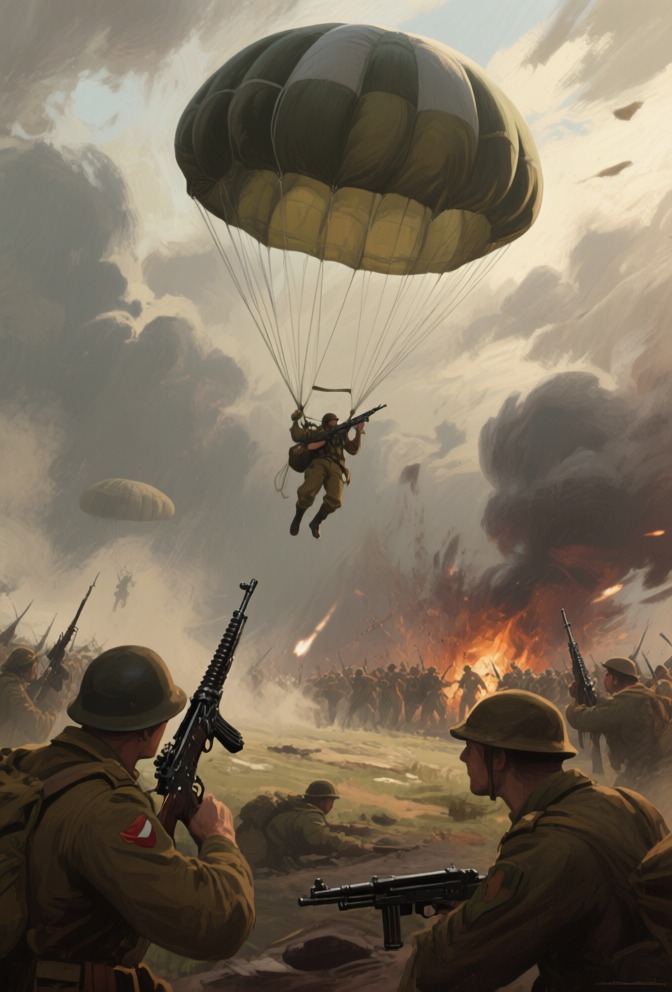
The Maquis Weapons Drop is a pivotal event in the spring of 1944, where Isabelle Rossignol, acting as a courier for the Nightingale escape route, delivers a coded BBC message to Gaëtan Dubois and his Maquisard partisans deep in the forest, signaling an imminent Allied airdrop of weapons that will fuel their guerrilla war against the German occupation.
This aphorism, stated by the elderly Vianne Mauriac in the novel's opening pages, establishes the central thematic dichotomy of The Nightingale. It posits that love reveals aspiration and ideal selfhood, while war strips away pretense to expose a person's fundamental character. The sentence functions as a philosophical frame for the entire narrative, which follows two sisters whose divergent responses to the German occupation of France—Vianne's protective, compromising endurance and Isabelle's reckless, principled resistance—test and define them in ways peacetime love could not.
This epigraph, attributed to Sir Edward Grey on the eve of World War I, appears at the opening of Chapter Two of *The Nightingale*, immediately before the narrative shifts to August 1939 in France. It establishes a tone of irrevocable loss and foreshadows the darkness that will descend on Europe and on the lives of the characters, particularly the sisters Vianne and Isabelle, whose world is about to be shattered by the coming war.
The Nightingale has sung is the coded message that signals the successful completion of an escape mission across the Pyrenees into Spain, serving as the operational signature of Isabelle Rossignol's resistance network and the formal confirmation that downed Allied airmen have reached safety.
The phrase "Wounds heal. Love lasts" is the closing affirmation of Kristin Hannah's *The Nightingale*, spoken by the elderly Vianne Mauriac as she reflects on a life shaped by war, loss, and survival. It distills the novel's central argument: that while the physical and psychological injuries of war—rape, starvation, the death of loved ones, the trauma of the concentration camps—can mend over time, it is love, in its many forms, that endures and gives life meaning. The line serves as both a personal credo and a thematic summation of the entire narrative, asserting that memory and connection outlast suffering.
The note "You are not ready" is a brief, devastating message left by Gaëtan Dubois for Isabelle Rossignol after their first kiss, which crystallizes her lifelong pattern of being deemed insufficient by those she loves and becomes a wound that shapes her subsequent actions in the Resistance.
Isabelle Rossignol's relationship with her father, Julien Rossignol, is a central emotional arc of The Nightingale, tracing a trajectory from abandonment and bitter estrangement through a painful, redemptive reconciliation that culminates in his sacrificial death. Julien, broken by World War I and his wife's death, repeatedly rejected and exiled Isabelle, leaving her with a lifelong hunger for love and approval. Their relationship is transformed during the war when Isabelle discovers that her father, whom she believed to be a collaborator, is actually a forger for the Resistance and a key member of the same network she serves. This revelation leads to a fragile, working partnership, but their full emotional reconciliation is only achieved in his final act: he falsely confesses to being the Nightingale to save her from the Gestapo, and is executed by firing squad, finally giving her the love and recognition she had always craved.
The curfew imposed by the Nazi occupation of Carriveau was a foundational instrument of control, enforced from the first day of occupation and carrying the threat of immediate violence or death for violators. It transformed the daily rhythms of the town, criminalizing movement after dusk and forcing the entire population into a state of constant, fearful compliance. The rule was announced by Sturmbannführer Weldt of the Gestapo during the initial assembly in the town hall, where he declared a nine P.M. curfew instantly in effect, along with the requirement that no lights be on after dusk. This decree was not a suggestion but a lethal boundary: any act of sabotage, espionage, or resistance would be punished by death, and the curfew itself became the most intimate and inescapable expression of that threat. For characters like Isabelle Rossignol, the curfew was a direct challenge to her defiance, a line she repeatedly crossed in her work for the Resistance, while for Vianne Mauriac, it was a cage that defined the limits of her world and the safety of her daughter.
The Punishment for hiding Jews was a Nazi decree in occupied France that made sheltering Jewish people a capital offense, punishable by death or deportation to concentration camps. It transformed ordinary acts of compassion into life-threatening crimes, forcing French citizens to choose between moral duty and survival.
The Resistance silence for two days rule was an internal protocol adopted by the French Resistance network in which captured operatives were expected to withstand interrogation for forty-eight hours without revealing names, giving their comrades time to disappear. The rule was a grim acknowledgment that torture would eventually break most prisoners, and that the only realistic goal was delay, not permanent silence.
The Mail restriction was a set of Nazi occupation policies that severely limited communication between French civilians and their loved ones, particularly prisoners of war, by banning private mail and requiring all correspondence to be conducted on official German postcards.
The Yellow star decree was a Nazi ordinance requiring all Jews in occupied France to wear a yellow cloth star marked "JUIF" on their outer clothing at all times in public, enforced by severe sanctions including immediate arrest and deportation. It transformed Jewish identity into a visible target, enabling systematic roundups and marking the escalation from discrimination to genocide.
Food control was a central mechanism of Nazi occupation in France, systematically depriving the French population of sustenance while privileging German soldiers. From the moment of occupation, the occupying authorities seized all food production and distribution, forcing civilians into endless queues for meager rations and criminalizing any attempt to grow or trade food independently. The system was not merely administrative but punitive: it was used to enforce racial laws, reward collaborators, and break civilian morale. For women like Vianne Mauriac, food control became the daily terrain of survival, moral compromise, and, ultimately, resistance.
The STO decree (Service du Travail Obligatoire) was a compulsory labor service imposed by the Vichy government under Nazi pressure, requiring French men between eighteen and fifty to work in German factories. It drove thousands of young men into hiding, swelling the ranks of the Maquis guerrilla resistance, and became a defining mechanism of coercion and collaboration in occupied France.
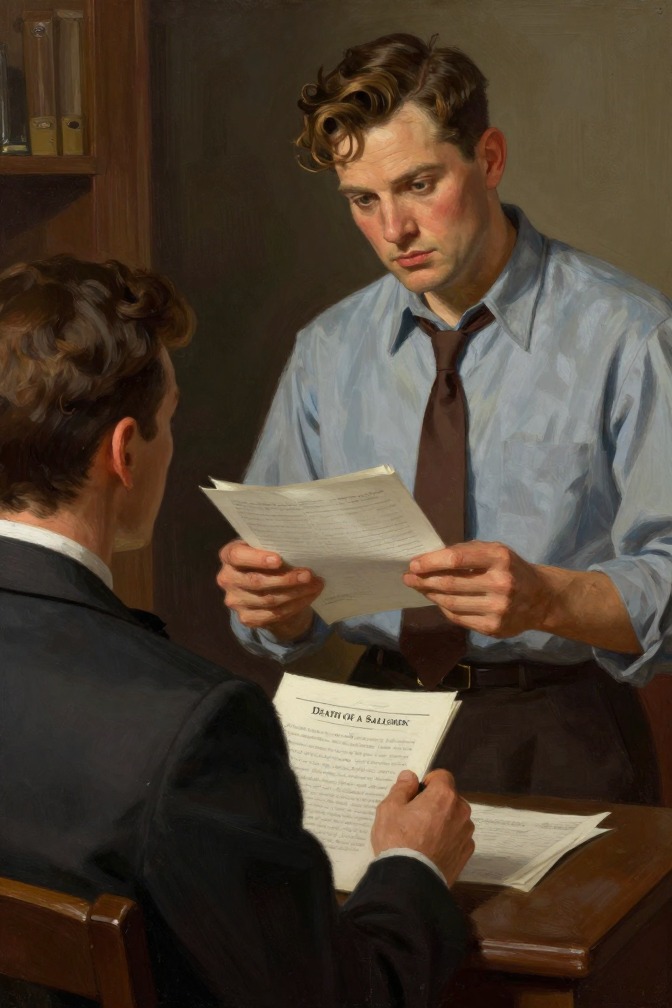
Biff Loman's attempt to secure a loan from his former employer Bill Oliver is the decisive action that shatters the family's last shared illusion and forces a final confrontation between father and son. The meeting, which Biff has built up as the means to buy a ranch and redeem himself in Willy's eyes, ends in humiliation and a compulsive theft that reveals the depth of his self-deception.