In Arthur Miller's Death of a Salesman, the state of being "phony" or a "fake" is a central accusation that defines the relationship between Biff Loman and his father, Willy Loman, and ultimately drives the play's climactic confrontation and Biff's painful self-realization.
The year 1928 represents the peak of Willy Loman's career as a salesman, a time when he earned a substantial income and felt valued by his employer, Frank Wagner. It stands in stark contrast to his present failure and serves as a benchmark of lost promise and the erosion of the American Dream.
Summer in Death of a Salesman is a season of promise and betrayal, the time when Willy Loman’s hopes for his sons reach their zenith and then shatter. It is the season of Biff’s high school football glory, of the family’s shared dreams, and of the catastrophic Boston trip that destroys Biff’s faith in his father. The season recurs as a taunting memory, a lost springtime of possibility that Willy can never recover.
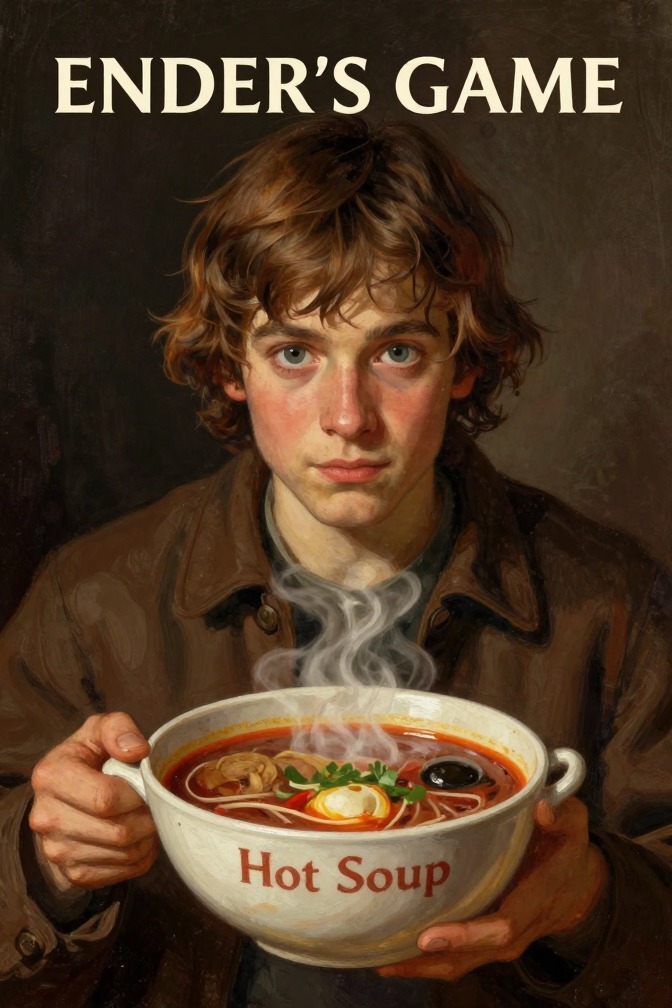
Hot Soup, whose real name is Han Tzu, is a toon leader in Ender Wiggin's Dragon Army during the Battle School, known for his tactical acumen, direct questioning of Ender, and his role in the army's innovative and successful strategies.
Shen is a minor but recurring character in Ender's Game, a Launchy in Ender Wiggin's original launch group who becomes one of his earliest friends and a loyal participant in his unofficial practice sessions. Though not a leader, Shen's loyalty and humor help Ender build a support network during his early days at Battle School, and he later serves as a squadron leader under Ender's command in the final battles against the buggers.
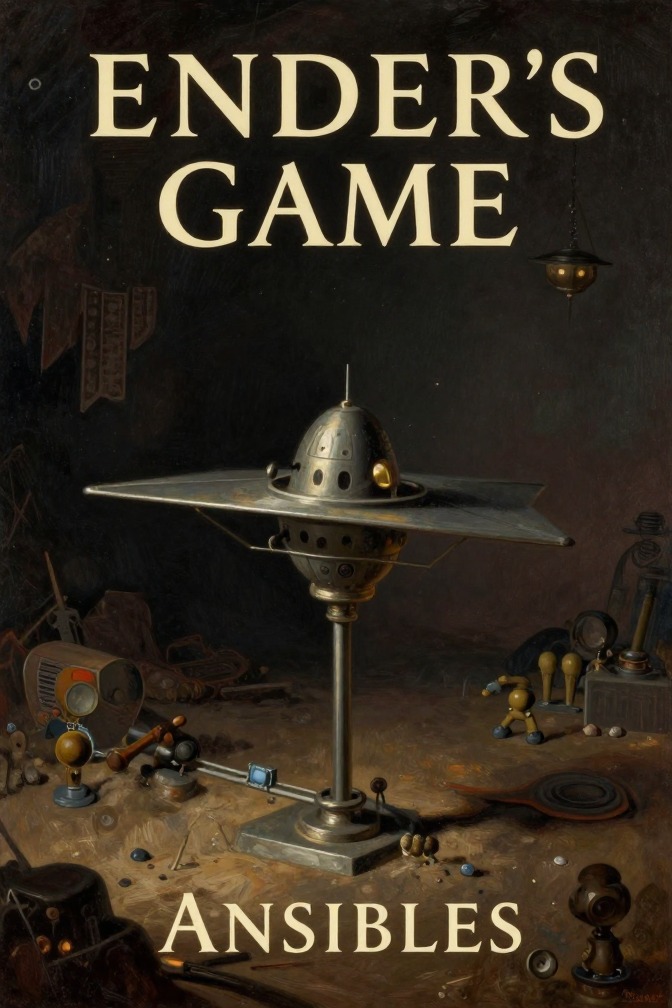
The ansible, officially the Philotic Parallax Instantaneous Communicator, is a fictional device in Orson Scott Card's Ender's Game that enables instantaneous communication across interstellar distances, a capability humanity reverse-engineered from the buggers' hive-mind. It is central to the plot, allowing the International Fleet to coordinate its invasion fleet and ultimately enabling Ender Wiggin to unknowingly command the real Third Invasion from the Command School on Eros.
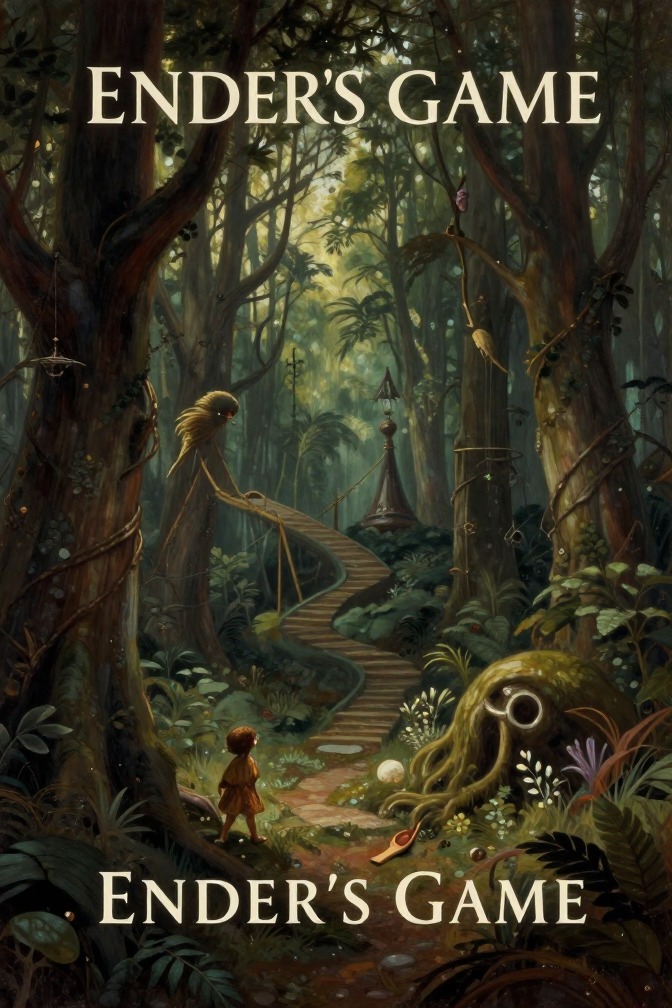
Fairyland is the name of the elusive, seemingly unwinnable realm at the heart of the Battle School's mind game, a computer-generated fantasy world that Ender Wiggin first glimpses only after he defeats the Giant in the Giant's Drink. It is a place of profound psychological significance, reflecting Ender's deepest fears, desires, and traumas, and it ultimately becomes the site where the buggers, through the hive-queen, leave him a message that reshapes his understanding of the war and his own identity.
Valentine's Letter is the first communication Ender Wiggin receives from his sister after four years at Battle School, a carefully crafted message that breaks his isolation and reconnects him to his most cherished memory, ultimately serving as a tool of manipulation by Colonel Graff to push Ender back toward his destiny as a commander.
The Hegemon is the supreme political office of the Hegemony, the international governing body that coordinates Earth's defense against the Buggers and, after the war, becomes the focus of Peter Wiggin's ambitions. The office is central to the novel's political structure, representing both the fragile unity of humanity under the threat of alien invasion and the dangerous concentration of power that emerges once that threat is removed.
The Speaker for the Dead is a role and a book that Ender Wiggin creates after the Third Invasion, transforming from a military commander into a narrator who speaks the unvarnished truth of the dead. It becomes a religious practice and a literary work that spreads across human colonies, offering a means of reconciliation and understanding between species and individuals.
Ender and Alai's friendship is a central emotional anchor in Ender's Game, evolving from a tentative alliance in the Battle Room to a sacred bond marked by the whispered 'Salaam,' and later strained by the demands of command, yet enduring as a source of memory and identity for Ender.
Peace is the central, elusive ideal of Ender's Game, a state that the novel defines through its absence: it is the prize humanity fights for, the justification for the war against the Buggers, and the condition Ender Wiggin himself can never attain. The narrative repeatedly shows peace as something promised but deferred, manipulated by adults, and ultimately achieved only through total destruction, leaving Ender to seek a personal, post-war peace that remains forever out of reach.
Frank Churchill is the charming, handsome, and long-absent son of Mr. Weston, whose secret engagement to Jane Fairfax drives much of the novel's romantic intrigue and exposes the dangers of deception and social performance.
Mr. Cole is a prosperous tradesman of Highbury whose rising wealth and social ambition make him a representative figure of the mercantile class seeking gentility. Though of low origin and in trade, his growing fortune, new dining-room, and increasingly frequent dinner-parties position him as second only to the Woodhouses in local consequence, and his character serves as a touchstone for Emma Woodhouse's snobbery and for the novel's exploration of class mobility.
Mr. Suckling is a minor but symbolically significant character in Emma, known only through the incessant name-dropping of his sister-in-law, Mrs. Elton. He is the wealthy owner of Maple Grove, a country estate near Bristol, and serves as the primary reference point for Mrs. Elton's social pretensions, representing the vulgar, mercantile gentility against which Emma Woodhouse defines her own superior refinement.
Mrs. Churchill is the domineering, capricious aunt of Frank Churchill, whose control over her nephew and her husband, Mr. Churchill, dictates the central romantic complications of the novel. Her illness and death serve as the crucial plot mechanism that finally permits Frank Churchill to reveal his secret engagement to Jane Fairfax, and her character is defined by pride, selfishness, and a tyrannical temper that makes her a formidable obstacle to the happiness of those around her.
Mrs. Goddard is the mistress of a respectable old-fashioned boarding-school in Highbury, a plain, motherly woman who provides a modest education and a safe home for girls like Harriet Smith, and whose school serves as a social anchor for the community.
William Larkins is Mr. Knightley's bailiff at Donwell Abbey, a trusted and long-serving employee whose practical loyalty and occasional bluntness provide a grounded counterpoint to the social machinations of Highbury.
Mrs. Weston gives birth to a daughter, an event that brings joy to her circle of friends and prompts reflections on child-rearing, the nature of spoiling, and the future shape of family life at Hartfield and Randalls.
Mrs. Elton's first visit to Hartfield marks the formal introduction of the newly married vicar's wife into Highbury society, an occasion that immediately reveals her vulgar pretension, her relentless self-promotion through comparisons to Maple Grove, and her profound incompatibility with the refined world of Emma Woodhouse.
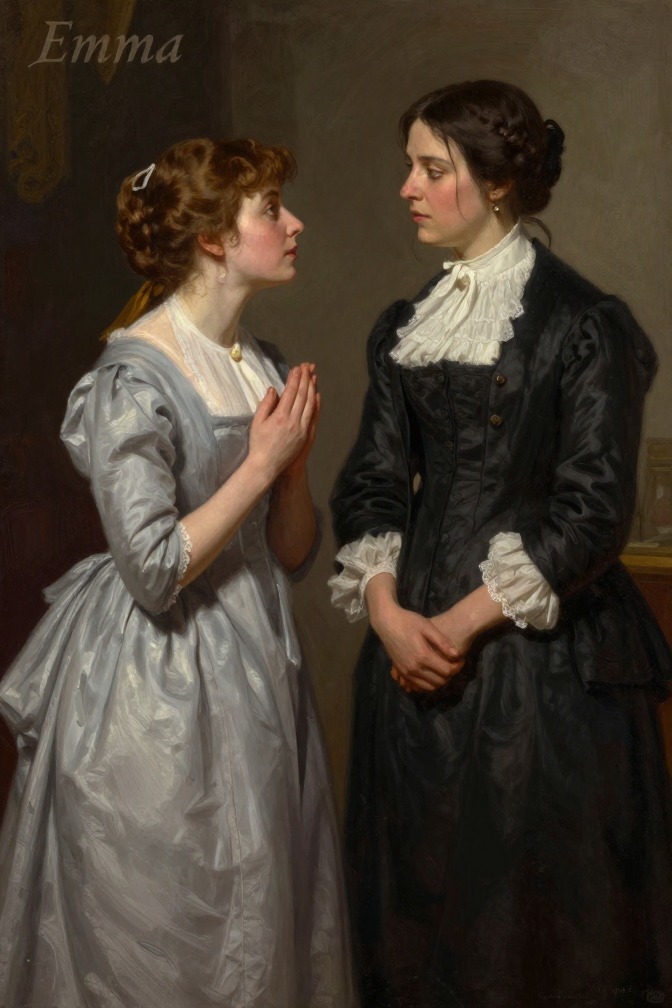
After Mr. Knightley's stern rebuke at Box Hill, Emma Woodhouse undergoes a profound moral reckoning and resolves to apologize to Miss Bates, marking a crucial turning point in her character development from thoughtless pride to genuine contrition and self-awareness.
Highbury is the large, populous village, almost amounting to a town, that serves as the primary setting of Jane Austen's *Emma*. It is the social and geographical center of the novel, where the Woodhouses are the first in consequence, and its intricate web of relationships, social hierarchies, and daily life drives the plot and shapes the characters' fates.
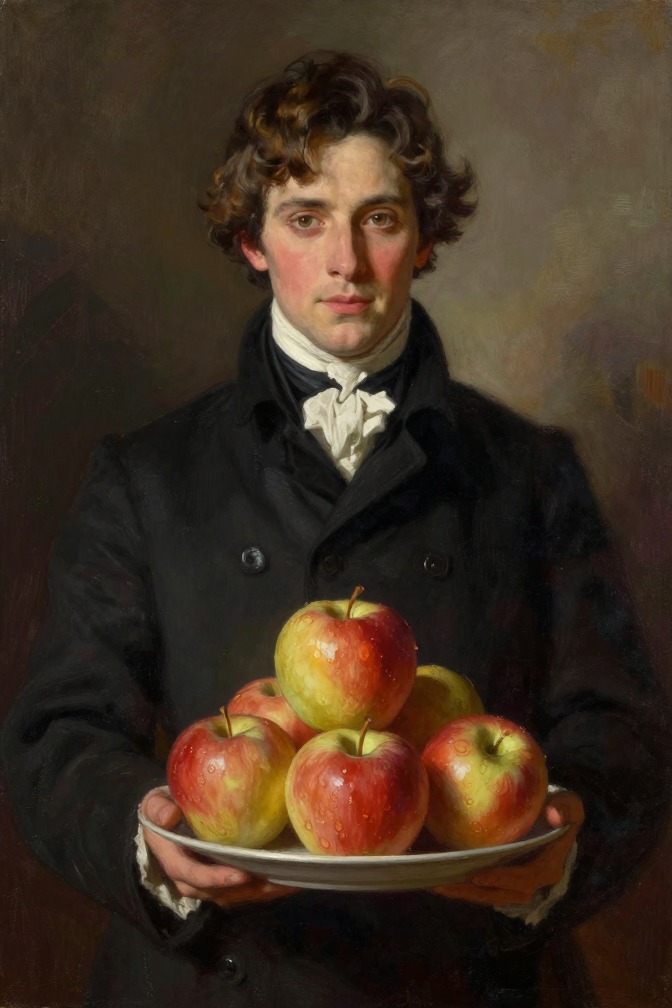
The apples from Mr. Knightley's Donwell Abbey orchard are a recurring object in Emma, symbolizing his generous, unostentatious kindness and the quiet, dependable abundance of his estate. They appear most prominently in a comic and touching episode where Mr. Knightley, learning that the Bates family has nearly exhausted his annual gift of apples, sends a bushel of his entire remaining store, an act that deeply moves Miss Bates and reveals the depth of his thoughtful, unassuming benevolence.
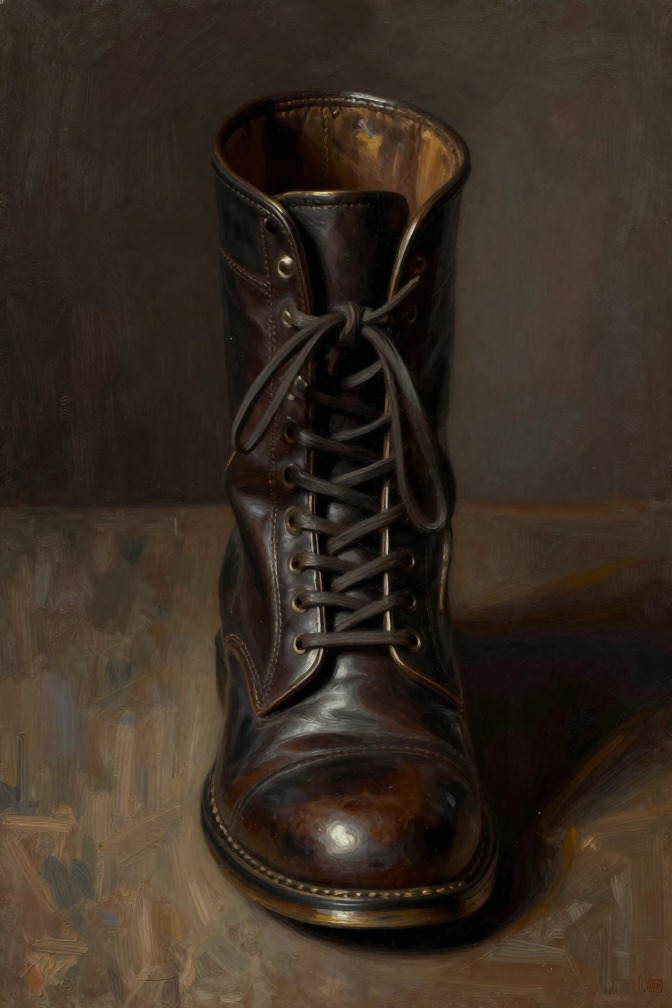
The boot lace is a small but strategically crucial object in Emma, used by Emma Woodhouse as a pretext to stage a private meeting between Harriet Smith and Mr. Elton at the Vicarage, thereby exposing the gap between her matchmaking schemes and reality.
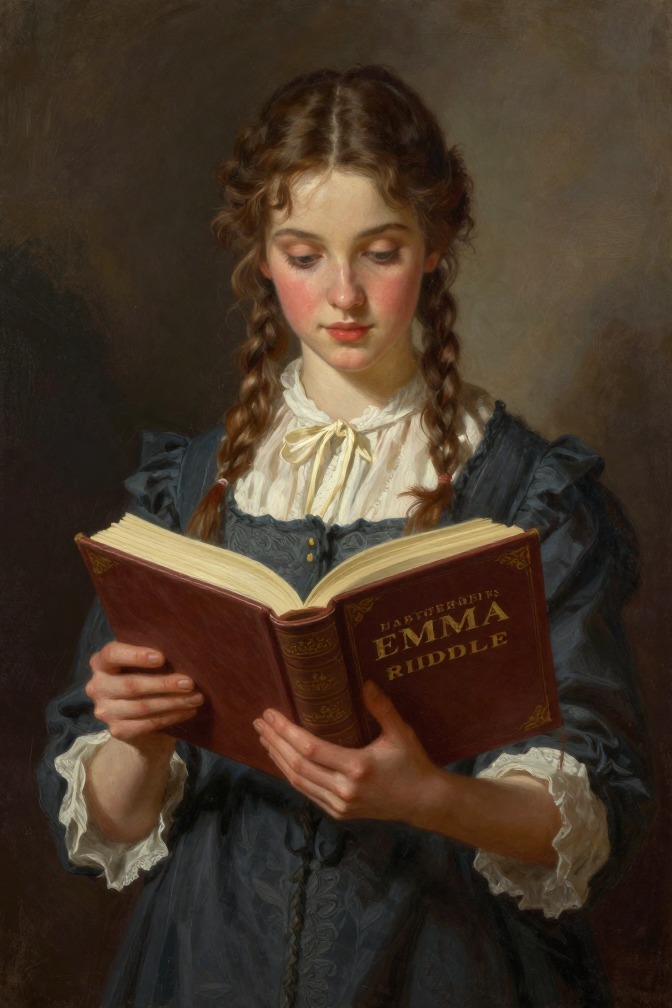
Harriet Smith's riddle book is a thin quarto of hot-pressed paper, ornamented with ciphers and trophies, in which Harriet collects and transcribes riddles of every sort. It becomes a vehicle for Emma Woodhouse's matchmaking schemes, as she uses it to encourage Mr. Elton's supposed courtship of Harriet, and later a site of embarrassment and self-reproach when her plans unravel.
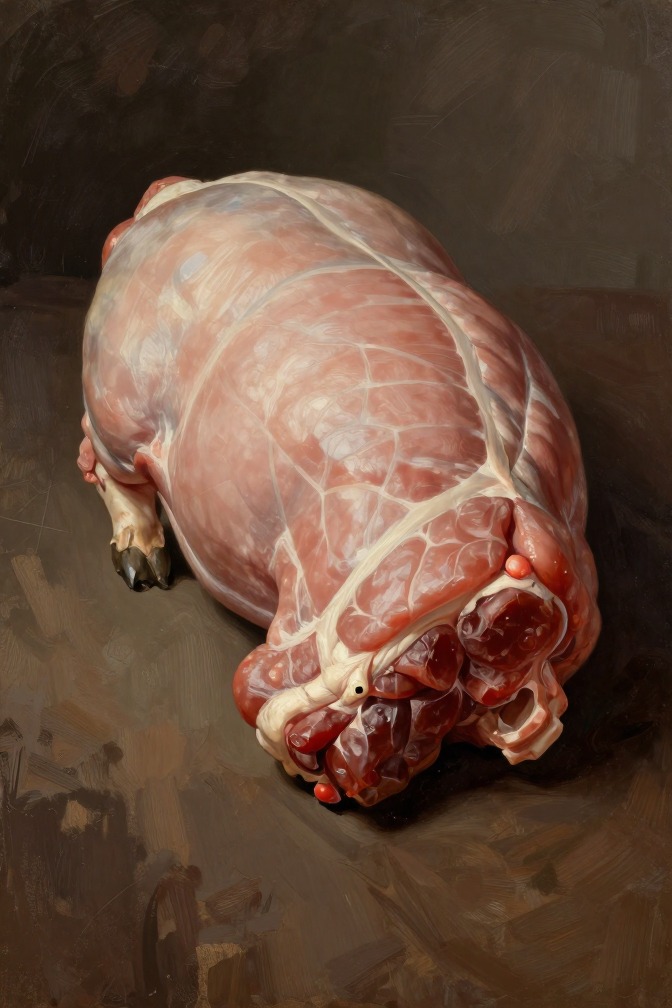
The hind-quarter of pork sent by Mr. Woodhouse and Emma to Mrs. Bates and Miss Bates is a concrete emblem of the Woodhouses' social position, their style of benevolent patronage, and the intricate web of gift-exchange, gratitude, and class obligation that structures daily life in Highbury.
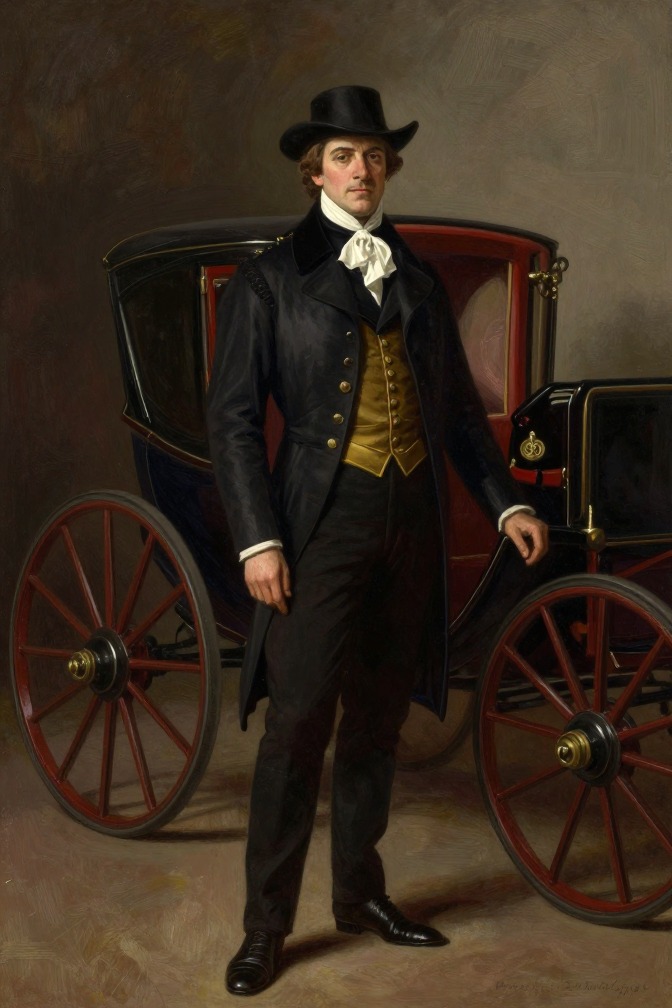
Mr. Knightley's carriage is a material object in Emma that repeatedly appears at moments of social tension, practical kindness, and narrative revelation, functioning not merely as a vehicle but as a concrete index of character, class, and concealed motive. Its appearances—offering a ride to the Bates women, arriving simultaneously with Emma at the Coles' party, and being lent for Harriet's journey to London—consistently mark acts of unostentatious generosity or moments when the story's emotional and social undercurrents surface. The carriage thus becomes a quiet but persistent sign of Mr. Knightley's humane, unpretentious character and of the network of obligation and gratitude that binds Highbury together.
The pencil end is a small, broken-off piece of pencil without any lead that Harriet Smith treasures as a relic of Mr. Elton, preserving it as a sentimental keepsake long after he has married another woman, and eventually burns it in a symbolic act of renouncing her misplaced attachment.
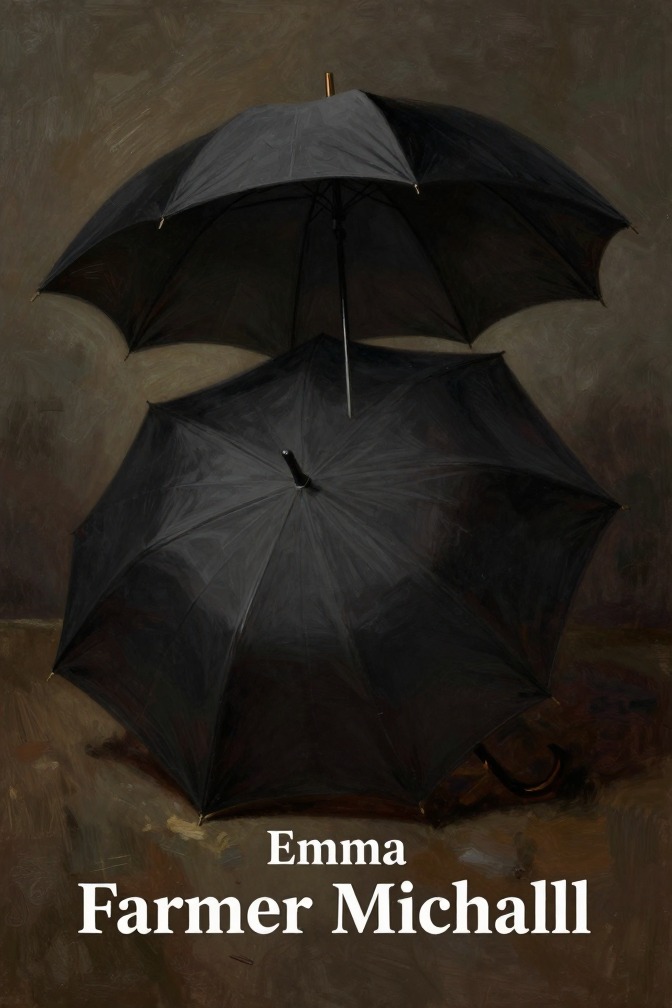
The Umbrellas from Farmer Mitchell are a minor but symbolically charged object in Emma, appearing in Emma Woodhouse's account of how she first conceived the match between Mr. Weston and Miss Taylor, and later serving as a touchstone for her self-deception about matchmaking and her eventual recognition of her own errors.
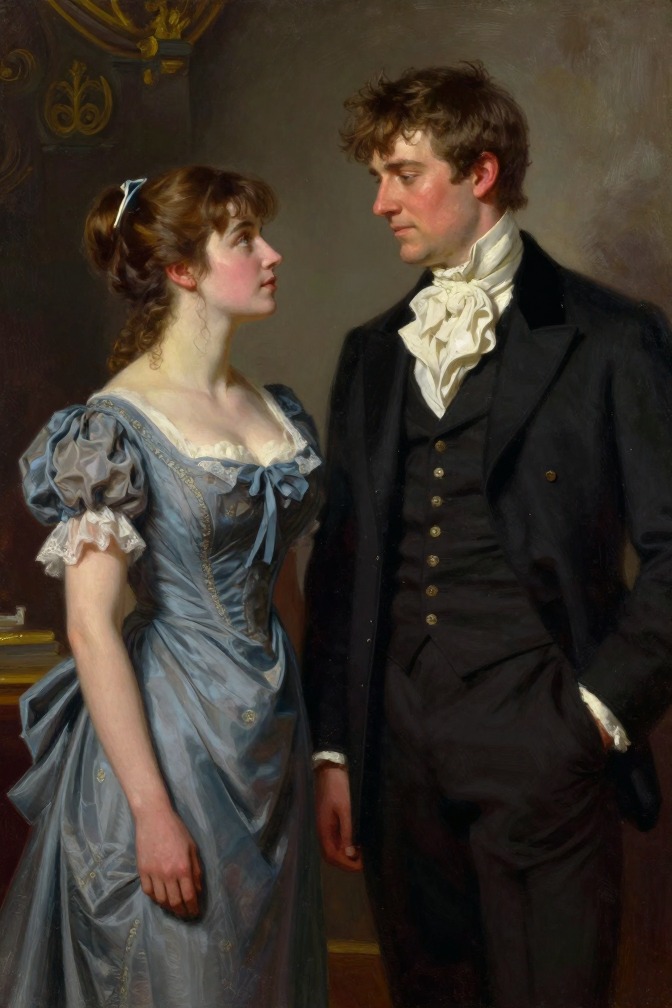
Emma Woodhouse and Frank Churchill share a flirtatious, mutually deceptive relationship that serves as a central romantic misdirection in the novel, ultimately revealing itself to be a friendship based on mistaken attraction and self-deception.