The Azores, a Portuguese archipelago in the North Atlantic, appear in Twenty Thousand Leagues Under the Sea as a geographical marker and a symbolic threshold. The islands are referenced in connection with the Gulf Stream's circulation, the lost continent of Atlantis, and the final, catastrophic events of the voyage, serving as a point of reference for the Nautilus's northward course and the narrator's reflections on the boundaries of the known world.
Cape São Roque is the easternmost point of South America, a significant navigational landmark that the Nautilus passes at high speed during its northward journey along the Brazilian coast, marking a moment of missed opportunity for escape and a transition into the equatorial waters of the Atlantic.
Newfoundland, the Grand Banks off its coast, and the adjacent waters form a crucial maritime region in Twenty Thousand Leagues Under the Sea, serving as the site of the Atlantic Cable's terminus, a rich fishing ground, and the location of the Avenger's wreck, where Captain Nemo's vengeful past is dramatically revealed.
Mount Sinai, also known as Mount Horeb, is the biblical mountain on which Moses received the Ten Commandments, and in the novel it appears as a landmark sighted by the Nautilus during its passage through the Strait of Jubal into the Gulf of Suez, serving as a geographical and symbolic marker of the boundary between the Red Sea and the Mediterranean.
The Gulf of Oman is a strategic body of water connecting the Arabian Sea to the Persian Gulf, which the Nautilus briefly explores in early February 1868. Its passage through this gulf marks a key moment of indecision and foreshadows the ship's subsequent entry into the Red Sea via the Gulf of Aden and the Bab el Mandeb strait.
The Carolinas, a region along the southeastern coast of the United States, serve as a significant geographical marker during the Nautilus's northward journey through the Gulf Stream, a passage that intensifies Ned Land's desperation to escape and brings the narrative closer to its climactic confrontation with a warship.
Tierra del Fuego is the southernmost archipelago of South America, a region of stark volcanic landscapes and treacherous seas that the Nautilus skirts after its escape from the Antarctic ice. For the narrator, it marks the return to civilization and the final, desperate phase of the voyage, as the ship's course shifts from polar exploration toward the climactic confrontation with a warship.
Pelusium is a coastal city in Egypt, briefly sighted by the Nautilus after its passage through the Arabian Tunnel, marking the vessel's entry into the Mediterranean Sea and serving as a geographical milestone in the journey from the Red Sea to European waters.
The Sargasso Sea is a vast, calm region of the North Atlantic Ocean, characterized by its dense mats of floating sargassum seaweed. In Jules Verne's *Twenty Thousand Leagues Under the Sea*, it serves as a unique and symbolic setting, representing a natural archive of oceanic debris and a place of eerie stillness, where the Nautilus navigates cautiously and where the crew witnesses the slow accumulation of matter that will one day become coal.
Madeira is a Portuguese archipelago in the Atlantic Ocean, referenced in Jules Verne's *Twenty Thousand Leagues Under the Seas* as one of the highest peaks of the sunken continent of Atlantis, a remnant of the cataclysm that obliterated the ancient land.
Timor is a large island in the Malay Archipelago that the Nautilus passes in the Timor Sea on January 13, 1868, during its journey from the Torres Strait toward the Indian Ocean. The island is notable for its rajahs, who claim descent from crocodiles, and for the brief glimpse Professor Aronnax gets of it as the chief officer takes his noon sighting. The Nautilus's passage near Timor marks a key navigational point as the vessel turns southwest toward the Indian Ocean, and the island's association with sacred crocodiles and its women's reputation for beauty in Malaysian markets are mentioned in passing.
The Gulf of Carpentaria is a large, shallow sea located between Australia and Papua New Guinea, which the Nautilus traverses in January 1868 after leaving Vanikoro. Its waters mark a transition in the voyage, as the Nautilus heads toward the dangerous Torres Strait, and the region is noted for its numerous reefs and the historical shipwrecks of explorers like Captain Cook.
The Avenger is a French 74-gun ship of the line with a storied revolutionary history, sunk in battle on June 1, 1794, whose wreck is discovered by Captain Nemo and becomes the catalyst for his final act of vengeance against an unidentified warship.
The black flag is a personal emblem of Captain Nemo, representing his sovereign authority, his rejection of all earthly nations, and his implacable will to vengeance. It is unfurled at two decisive moments: when he claims the South Pole in his own name, and when he confronts a warship he intends to destroy. The flag crystallizes Nemo's transformation from a scientist-explorer into a self-appointed judge and executioner, operating beyond any human law.
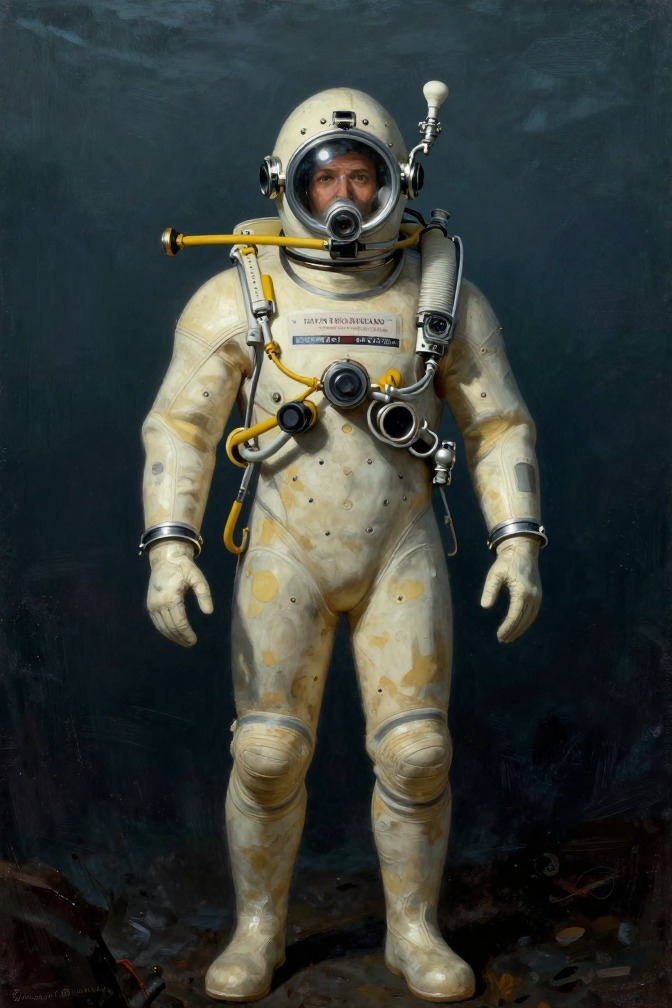
The Rouquayrol–Denayrouze device is a refined diving apparatus used by Captain Nemo and his crew aboard the Nautilus, enabling them to explore the ocean depths for extended periods by supplying breathable air from a high-pressure tank, and it is a key piece of technology that makes the novel's underwater excursions possible.
The Asiatic Society is a learned society in Calcutta that played a crucial role in the 19th-century investigation of the La Pérouse shipwreck, providing the institutional and financial backing that enabled Captain Peter Dillon to confirm the fate of the lost French explorer.
The Church of Saint-Sulpice in Paris is mentioned in Jules Verne's Twenty Thousand Leagues Under the Sea as the recipient of two giant clam shells from the Republic of Venice, which were converted into holy-water fonts, serving as a real-world reference point for the colossal size of the giant clam shell that forms the basin in the Nautilus's main lounge.
Cosmos is a scientific journal mentioned in Jules Verne's Twenty Thousand Leagues Under the Seas, cited as a publication that participated in the public and scholarly debate over the mysterious sea monster that plagued the world's oceans in 1866.
The French Navy is a recurring institutional presence in Twenty Thousand Leagues Under the Sea, serving as both a historical reference point for the novel's events and a symbol of the national authority that Captain Nemo has decisively rejected. Its ships, officers, and expeditions are mentioned in connection with the hunt for the supposed sea monster, the exploration of the Pacific, and the final, catastrophic encounter that reveals the depth of Nemo's personal vendetta.
The Inman Line was a major 19th-century British transatlantic steamship company, and one of its vessels, the Etna, was among the ships that reported encountering the mysterious sea monster in 1866, contributing to the public frenzy that led to the Abraham Lincoln expedition.
Lloyd's List is a British maritime newspaper that, in the world of Twenty Thousand Leagues Under the Sea, serves as a key barometer of public and commercial alarm over the mysterious sea monster, reporting on the creature's threat to shipping and the consequent rise in insurance premiums.
The Paris Museum of Natural History is the professional home and institutional identity of Professor Pierre Aronnax, the narrator of Twenty Thousand Leagues Under the Sea. As an Assistant Professor at the museum, Aronnax is a recognized specialist in marine biology, and his affiliation with this prestigious institution shapes his scientific authority, his motivations, and his narrative perspective throughout the voyage. The museum serves as the anchor of his terrestrial life, the source of his scholarly reputation, and the ultimate intended destination for the knowledge he gathers during his underwater journey.
Petermann's Mittheilungen is a German geographical journal cited in Jules Verne's Twenty Thousand Leagues Under the Sea as one of the scholarly publications that participated in the international debate over the nature of the mysterious sea monster in 1866–1867, representing the serious scientific discourse that the popular press eventually overwhelmed with satire.
The Royal Mail Steam Packet Company was a major British shipping line whose steamer the Shannon played a key role in the initial sightings of the mysterious sea monster, and whose vessel the Scotia suffered a notorious collision with the Nautilus, helping to ignite the public panic that set the novel's plot in motion.
The Smithsonian Institution is a major American scientific and cultural organization mentioned in Jules Verne's Twenty Thousand Leagues Under the Sea as one of the scholarly bodies that debated the nature of the mysterious sea monster in 1866–1867.
The United States Navy is the naval warfare service branch of the United States, which in the novel dispatches the frigate Abraham Lincoln to hunt the mysterious sea monster, later revealed to be the Nautilus, and whose warship is ultimately rammed and sunk by Captain Nemo in an act of vengeance.
The Manuscript Disposal Policy is Captain Nemo's plan to preserve the record of his life and discoveries by sealing a manuscript in an unsinkable container and casting it into the sea, to be carried by the waves to an unknown fate, ensuring his secrets survive even if the Nautilus is lost.
Captain Nemo's prohibition on whaling for sport is a defining rule aboard the Nautilus, reflecting his deep ecological ethics and his rejection of humanity's destructive impulses. This policy, articulated during a confrontation with the harpooner Ned Land, establishes a moral boundary that separates Nemo's undersea world from the exploitative practices of the surface. It is a direct expression of his broader philosophy of living in harmony with the sea, and it serves as a key point of tension between Nemo and the more traditional, utilitarian views of his captive passengers.
Escape is a central, recurring state in Twenty Thousand Leagues Under the Sea, representing the constant, frustrated desire of the three prisoners—Professor Aronnax, Conseil, and Ned Land—to regain their freedom from Captain Nemo's Nautilus. It is a driving force of the narrative's tension, manifesting in repeated plans, failed attempts, and a final, desperate bid that succeeds only as the ship is swallowed by the Maelstrom.
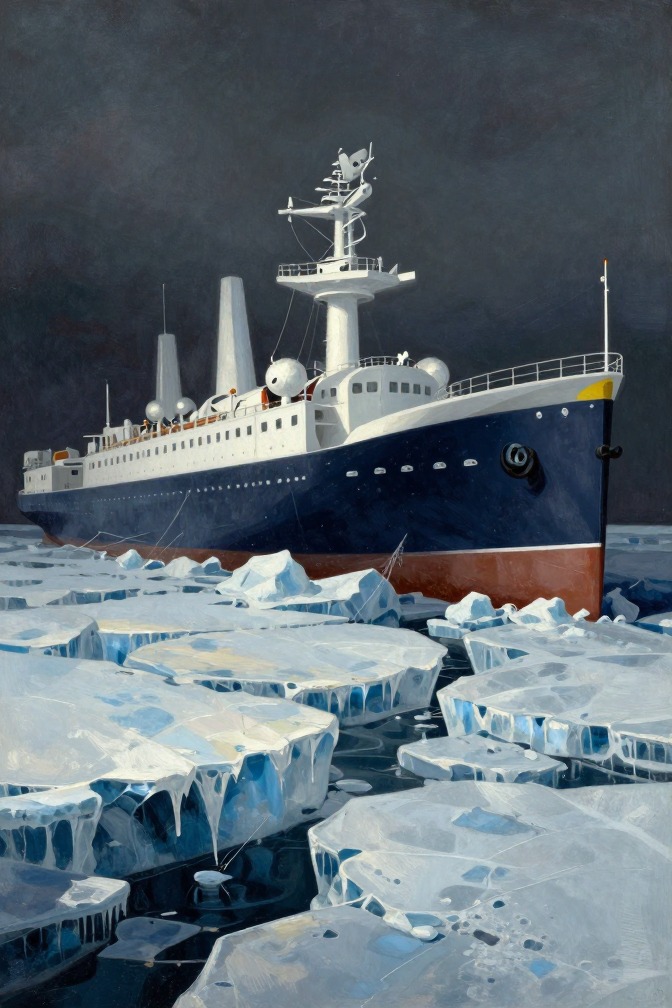
The Ice Barrier is the immense, impenetrable wall of pack ice that marks the southern limit of navigation in the Antarctic seas, serving as the ultimate physical and symbolic obstacle that Captain Nemo must overcome to reach the South Pole.